
Africa COP30 Countdown: Which Countries Have the Finance to Back Their Climate Pledges?
Eight months before Belém. The financing landscape has shifted. Five markets assessed.
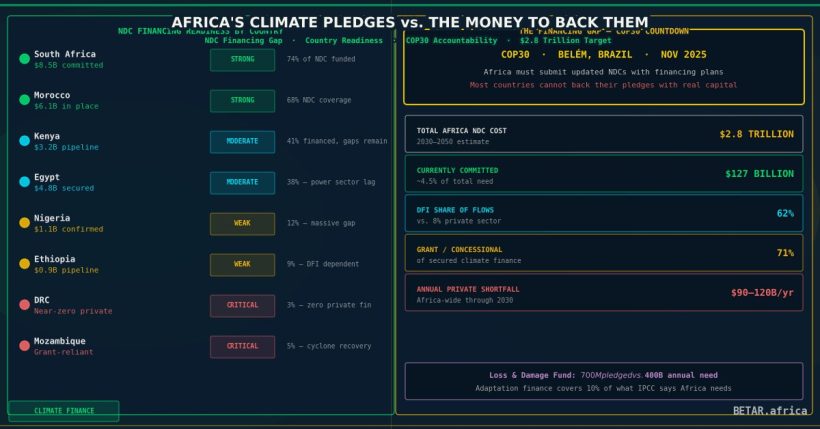
When African heads of state arrive at COP30 in Belém, Brazil in November 2026, they will present updated Nationally Determined Contributions — the pledges that define how each country intends to reduce emissions and adapt to climate change through 2030 and beyond. The pledges will be ambitious. The gap between those pledges and committed financing, for most of the continent, will be uncomfortably large.
The climate finance architecture that African countries planned around at COP26 and COP27 has been partly dismantled. The United States withdrew from the Just Energy Transition Partnership in early 2025, eliminating a billion dollars in Development Finance Corporation low-cost capital and half a billion dollars in grants that underpinned South Africa’s coal transition. USAID’s Power Africa technical advisory layer — the programme that embedded energy finance expertise inside African utilities and ministries for over a decade — has been cut to a skeleton. The concessional funding assumptions written into national energy transition plans are no longer reliable.
What remains: the European Investment Bank’s EUR 1 billion Mission 300 energy access commitment, the African Development Bank’s Sustainable Energy Fund for Africa, a growing Gulf sovereign wealth presence in infrastructure, and a private green finance market in early formation. Whether these flows can substitute for what has been withdrawn is the central question African climate negotiators must answer before Belém.
BETAR assessed five Tier-1 African markets — South Africa, Nigeria, Kenya, Morocco, and Senegal — across three dimensions: NDC ambition versus financing reality; concessional finance exposure following Western bilateral cuts; and private capital readiness to attract commercial green finance.
South Africa: Highest Ambition, Widest Gap
South Africa’s NDC is the most detailed on the continent — a specific emissions range corridor (420–350 MtCO2e by 2030), a managed coal phasedown pathway, and a renewable energy buildout target tied to independent power producer procurement rounds. The JETP was the financial spine of the plan: $1 billion in DFC debt financing at concessional rates, $500 million in grants for worker transition and community support, and bilateral commitments from the UK, EU, France, Germany, and the US totalling $8.5 billion.
With the US component gone, the gap is structural, not marginal. Private capital is partially filling it: Lyra Energy’s 255MW Thakadu solar project, backed by Standard Bank, reached financial close in early 2026. SolarAfrica’s wheeling arrangement through the Eskom grid demonstrates that commercial solar is investable at scale. But these are individual project financings — not the system-level concessional capital the JETP was designed to mobilise.
Assessment: High ambition, partially funded. Concessional exposure: high. Private capital readiness: improving. COP30 risk: financing gap likely to be visible in NDC update.
Nigeria: Ambition Built Around Domestics
Nigeria’s NDC targets a 47 percent emissions reduction by 2030 (conditional on international support) with a 20 percent unconditional floor. The distinction matters: the conditional component assumes $177 billion in international climate finance over the NDC period — a figure that was already optimistic before the JETP exit.
Nigeria’s off-grid energy programme is the continent’s most ambitious: the World Bank-backed DARES initiative has committed $750 million toward deploying solar mini-grids across 200,000 underserved communities. That capital is disbursing. But Nigeria’s NDC financing gap sits in the industrial decarbonisation and grid upgrade layer — the hard infrastructure that requires long-tenor concessional debt at single-digit interest rates that commercial markets will not provide at scale.
US bilateral energy exposure was always lower in Nigeria than in South Africa — Power Africa’s Nigeria portfolio was never as deep as its Southern Africa presence. The immediate USAID shock is smaller here. But the structural gap between conditional NDC ambition and realistic concessional capital availability is just as wide.
Assessment: Conditional targets vulnerable. Unconditional floor achievable. Concessional exposure: medium. Private capital readiness: growing, mini-grid sector leading. COP30 risk: moderate.
Kenya: The Clean Grid Paradox
Kenya already generates over 90 percent of its electricity from renewable sources — geothermal, hydro, and increasingly wind — making its electricity grid one of the cleanest in the world. Its NDC commits to a 32 percent emissions reduction by 2030, conditional on $62 billion in international finance. The supply-side story is positive. The demand-side story is not.
Kenya’s electricity tariffs are among the highest in Sub-Saharan Africa, driven by infrastructure debt, transmission losses, and take-or-pay geothermal contracts that were signed when demand projections were more optimistic. The result: a clean grid that industries and households cannot afford to connect to at the scale required to hit electrification targets. The NDC ambition is real. The financing mechanism to make clean electricity commercially accessible is not yet resolved.
The IM Bank–SIDA $30 million green finance facility, structured in early 2026, shows that DFI-commercial bank risk-sharing models can work in Kenya. This is the template for the private capital layer — but it needs to scale by an order of magnitude to be NDC-relevant.
Assessment: Generation targets on track; demand-side access funding lagging. Concessional exposure: medium. Private capital readiness: high among Tier-1 financiers. COP30 risk: low on generation, higher on energy access.
Morocco: Most Private-Capital Ready
Morocco’s NDC targets 52 percent renewable electricity by 2030 and is the only African market where private capital has moved from pilot to portfolio at meaningful scale. The Noor solar complex, wind capacity in Tarfaya and Taza, and a regulatory framework that permits competitive renewable energy procurement have created a track record that institutional investors and commercial banks can underwrite.
The Gotion High-Tech battery gigafactory under construction in Kénitra — Africa’s first lithium iron phosphate cell manufacturing facility — reflects Morocco’s position at the intersection of the energy transition and the critical minerals value chain. The facility requires clean energy inputs; Morocco’s grid can provide them. This is the closest Africa has to a bankable green industrial corridor.
Morocco’s concessional dependence is the lowest of the five markets assessed. European bilateral capital (EIB, AFD) remains active and politically durable. US bilateral exposure was always modest.
Assessment: Strongest private capital readiness. Concessional exposure: low. NDC targets achievable with current financing trajectory. COP30 risk: low.
Senegal: Fossil Revenue and Green Ambition in Tension
Senegal presents the most complex picture. The country’s first offshore oil and gas revenues began flowing in late 2024 — an economic transformation for a low-income country, and a direct tension with its NDC commitment to reduce per-capita emissions 5 percent unconditionally and 29 percent conditionally by 2030.
Senegal has signed a JCM bilateral carbon credit agreement with Japan and is among the more active Article 6 markets on the continent, signalling an intent to use carbon finance mechanisms to fund NDC implementation. Whether those mechanisms generate enough revenue to offset the emissions trajectory implied by hydrocarbon development is an open question the government has not yet quantified publicly.
The EU’s Carbon Border Adjustment Mechanism, fully operational from 2026, creates a direct financial incentive for Senegalese exporters — cement, fertiliser, steel — to decarbonise. That incentive is real and is beginning to shape investment decisions in the industrial sector.
Assessment: NDC ambition under fiscal stress from hydrocarbon development. Concessional exposure: medium. CBAM incentive creating private demand-pull. COP30 risk: narrative risk around gas expansion vs. climate pledge credibility.
The Scorecard
| Market | NDC Ambition | Concessional Exposure | Private Capital Readiness | COP30 Risk |
|---|---|---|---|---|
| South Africa | High | High | Improving | High |
| Nigeria | High (conditional) | Medium | Growing | Moderate |
| Kenya | High (generation) | Medium | High | Moderate |
| Morocco | High | Low | High | Low |
| Senegal | Medium | Medium | Developing | Moderate–High |
The COP30 Stakes
For African negotiators heading into Belém, the financing gap is both a political problem and a credibility problem. NDCs that were written assuming Western bilateral concessional finance must now be recalibrated. Countries that do not update their financing assumptions risk presenting pledges that independent analysts will immediately flag as unfunded.
“The expectation that Africa will come to COP30 with more ambitious pledges while the financing architecture is contracting is not realistic,” said one climate finance official at the NDC Partnership, speaking ahead of the March 2026 preparatory consultations. “What we need from Belém is a credible multilateral financing mechanism for the countries that have lost bilateral support — not just encouragement.”
The EU’s CBAM is the one structural force pulling in the right direction. For African exporters with significant industrial emissions, the cost of not decarbonising is now direct and measurable in export revenue terms. That incentive is creating private capital demand in Morocco and to a lesser extent Kenya that no amount of diplomatic pressure could generate. But CBAM affects a narrow slice of African industry; it does not solve the energy access financing gap or the grid upgrade gap.
The European DFI hedge — the EIB’s Mission 300, Germany’s doubling of JETP commitments via KfW, France’s AFD regional energy portfolio — provides partial coverage. EUR 1 billion in new EIB energy access capital over five years is real money. It is also less than half of what the US JETP withdrawal removed from South Africa alone.
What African Negotiators Need From Belém
Three outcomes would materially change the picture. First, a reformed Loss and Damage Fund with faster disbursement mechanisms for climate-vulnerable African economies. Second, an Article 6 ITMO rulebook at COP30 that ensures African countries receive fair value for carbon credits sold under bilateral agreements — not the current discount market. Third, a recommitment by the G7 to the $100 billion annual climate finance target that was never fully met, with Africa-specific earmarks.
None of these outcomes are guaranteed. What is certain is that the countries arriving at Belém with the most credible NDC financing stories — Morocco, Kenya — are those that built private capital readiness before the bilateral cuts came. For the rest, the gap between pledge and plan will be the defining story of Africa’s COP30 presence.
Related coverage: America’s Africa Energy Pivot — Clean Cooking and Critical Minerals Instead of Climate Finance | South Africa JETP: The Disbursement Gap | Africa Clean Energy Finance Q1 2026: DFI-Commercial Bank Shift
By the Energy & Climate Tech Reporter | BETAR.africa | March 2026
 UphivaBETAR

 Joseph Busari