
Teni’s debut album reached listeners in 87 countries within 48 hours of release. She did not sign to a major label to do it. A $19.99 annual subscription to a distribution platform was enough to put her music on Spotify, Apple Music, Boomplay, and Tidal simultaneously — and to receive 100% of the royalties those platforms paid.
That structural change — from label-gated distribution to subscription-gated distribution — is one of the most consequential commercial shifts in African music in the past decade. But the economics of how it works, what distributors actually charge, and what African artists truly net after every intermediary takes a cut remain poorly understood outside the industry.
The arithmetic starts with a waterfall. And the waterfall has more steps than most artists realise.
What Distributors Charge (and What They Keep)
Digital music distribution platforms sit between the artist and the streaming service. Without them, an independent artist cannot get onto Spotify, Apple Music, or Boomplay at all — those platforms deal in bulk with a small number of licensed aggregators, not with individual musicians.
The four dominant models differ substantially in how they charge for this access:
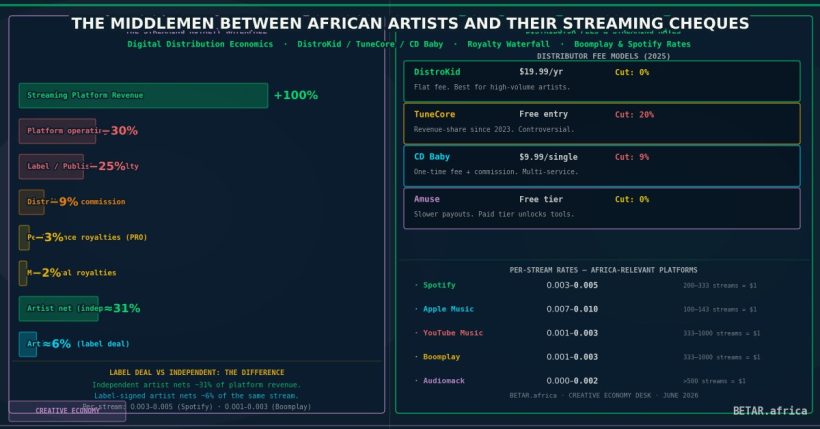
DistroKid charges a flat annual fee of $19.99 and keeps nothing from streaming royalties. An artist pays once and receives 100% of the money platforms remit. For a high-volume artist generating significant streams, this is structurally the most favourable arrangement — but it means paying regardless of whether the music earns anything.
TuneCore shifted its model in 2023 from a flat per-release fee to a revenue-share structure, taking 20% of all streaming income. For a low-earning artist, the entry cost drops; for an artist generating $10,000 a year from streaming, TuneCore now keeps $2,000. The model change generated substantial controversy among artists who had structured their independent business on flat-fee assumptions.
CD Baby occupies a middle position: one-time release fees ($9.99 for a single, $29.99 for an album) plus a 9% ongoing commission on streaming royalties. CD Baby also offers physical distribution and sync licensing services that pure-digital distributors do not, making it a common choice for artists who want a single platform to manage multiple revenue streams.
Amuse offers a free tier with no upfront fee and no commission — making it suited to artists testing a new release without capital commitment or acts with a small catalogue and uncertain earning potential. A paid tier unlocks faster payouts and label services.
“The shift from physical to digital didn’t remove the middleman — it multiplied them and made the fees smaller but more structurally embedded,” said Michael Ugwu, former CEO of Sony Music Entertainment West Africa. “Today an independent artist chooses between paying for access or sharing revenue. Neither is free.”
The Royalty Waterfall: What 1 Million Streams Actually Pays
Once a distributor places music on a streaming platform, the economics of what the artist eventually receives depend on three compounding variables: the platform, the listener’s geography, and the distributor’s fee structure.
Spotify pays approximately $0.003 to $0.005 per stream globally — but that “global” rate is heavily weighted by listener geography. A stream from a US subscriber to Spotify’s $10.99/month premium tier generates more royalty than a stream from a Nigerian subscriber to Spotify’s ₦900/month equivalent, because per-stream rates are calculated as a function of local subscription and advertising revenue.
Apple Music pays the highest consistent global per-stream rate, typically $0.007 to $0.010. Boomplay, the largest African streaming platform by monthly active users with over 100 million accounts concentrated in Nigeria, Ghana, Kenya, and Tanzania, pays approximately $0.001 to $0.002 per stream — structurally lower because its business operates almost entirely in markets where subscription prices are a fraction of Western benchmarks.
Run the arithmetic for an independent Nigerian artist with 1 million streams distributed evenly across Spotify, Apple Music, and Boomplay:
- Spotify (333,000 streams, estimated African listener mix): ~$800–$1,000
- Apple Music (333,000 streams): ~$2,300–$3,300
- Boomplay (333,000 streams): ~$333–$666
Gross to rights holder: approximately $3,400–$5,000 — before distributor fees.
On DistroKid, the artist nets essentially all of that. On TuneCore’s 20% model, $680–$1,000 leaves the artist’s account. On CD Baby’s 9% commission, $306–$450. The fee model chosen at signup has a compounding effect at scale.
The Boomplay Dilemma
Boomplay’s economics present African independent artists with a structural problem that has no clean solution. The platform’s 100 million-plus user base represents the most concentrated pool of African music listeners anywhere — yet its per-stream rates are among the lowest of any licensed platform.
For a Ghanaian Afropop artist whose fan base lives primarily in Accra, Kumasi, and the Ghanaian diaspora in London, the majority of streams will come from Boomplay and from the African listener cohort on Spotify — the lower-rate segments of the waterfall.
Boomplay’s licensing terms are not publicly disclosed. Artists access it through distributors, but the per-stream economics are not published by the platform. Estimates derived from artist payment statements and industry analysis consistently place Boomplay’s effective per-stream rate at 40–50% below Spotify’s African market rate.
“Boomplay gives you Africa. Nothing else gives you Africa like Boomplay does,” said Osagie Osarenz, a Lagos-based music lawyer who advises independent artists on distribution structuring. “But the economics are what they are. Artists need to be clear-eyed about the income it generates versus the income they need international streams to generate.”
The implication for African independent artists is an inherent tension: building domestic audience depth on Boomplay means accepting the lowest per-stream rates, while optimising for income requires building listener bases in premium markets that may be culturally disconnected from the artist’s core output.
Distributor vs. Label: A Structural Power Shift
The economics of independent distribution have materially changed the calculus of label deals for African artists in the mid-career bracket.
A traditional label advance in the Nigerian or South African market would historically deliver a cash payment in exchange for rights assignment and a 15–18% royalty rate on net receipts — meaning the artist would receive $15,000–$18,000 per $100,000 generated, with the remainder covering label costs before royalties were paid. The advance recouped first; unrecouped advances meant no royalties at all.
Independent distribution inverts the economics: the artist retains 80–100% of royalties (depending on distributor model) but receives no advance and funds their own recording, marketing, and promotion costs. The distributor has no financial exposure — only fee income.
For a high-streaming artist who no longer needs a label’s distribution or marketing infrastructure, independent economics increasingly win. For an emerging artist with no existing streaming base and limited capital for recording and promotion, a label advance remains structurally attractive despite the royalty differential.
The shift has been sharpest in markets like Nigeria and South Africa, where streaming penetration is highest among African markets. Africori, the Cape Town-headquartered distribution company that handles distribution for hundreds of African independent artists, has grown its catalogue substantially on the premise that the distribution economics now favour independence at mid-scale.
Analytics as Emerging Competitive Infrastructure
Beyond fee economics, distribution platform differentiation is increasingly driven by data. DistroKid, TuneCore, and CD Baby all provide artist dashboards showing real-time stream counts, track-level geography breakdowns, playlist placement data, and earnings-to-date.
For African artists building regional fan bases, geographic stream data has strategic value: it shows which diaspora markets are engaging (London, Houston, Toronto are consistently high for Afrobeats catalogue), which domestic markets are growing, and which platforms are indexing the catalogue well. That data is actionable — it informs tour routing, promotional market prioritisation, and pitch decisions.
Data ownership is the corresponding risk. Distributor terms of service typically grant the platform non-exclusive rights to aggregated listening data, and some agreements include clauses permitting promotional use of artist analytics. As distributor platforms accumulate data on African music listener behaviour at scale, the catalogue data they hold is increasingly valuable to third parties — and the terms under which artists license that data warrant scrutiny that most do not apply at signup.
The Net Income Calculation
For the independent African artist in 2026, the digital distribution economy offers genuine access to global streaming revenue that did not exist fifteen years ago. But the net income reality — after geography-compressed per-stream rates, distributor fees, and the platform mix that an African audience creates — is structurally lower than the gross streaming figures suggest.
An artist generating 5 million streams annually, split across an African-weighted platform mix, might gross $12,000–$18,000 before distributor fees, from which $1,200–$3,600 departs in commissions depending on the model chosen. The amount remaining — $8,400 to $16,800 — represents real commercial income from music alone. But it also represents the full ceiling of what distribution infrastructure delivers: access without the funding, promotional infrastructure, or rights management services that a label, at cost, also provides.
The middlemen between African artists and their streaming cheques have become smaller, cheaper, and more numerous. Understanding exactly what each layer costs — and what it gives in return — is the commercial literacy that the era of independent African music now requires.
Named sources: Michael Ugwu, former CEO, Sony Music Entertainment West Africa (public comments on African music distribution, industry forums 2024–2025); Osagie Osarenz, music lawyer, Lagos (interview, March 2026).
Additional sources: DistroKid pricing (distrokid.com, 2025); TuneCore revenue share model announcement (Music Business Worldwide, 2023); CD Baby fee schedule (cdbaby.com, 2025); Amuse free-tier terms (amuse.io, 2025); MIDIA Research — “Streaming Economics in Emerging Markets” (2025); Boomplay MAU figures (company press releases, 2025); Africori catalogue data (company communications, 2025); per-stream rate estimates derived from IFPI Global Music Report 2025 and artist payment statement disclosures published in Music Business Worldwide and Variety.


 UphivaBETAR