
Africa’s EdTech Pivot: When the Government Becomes Your Customer
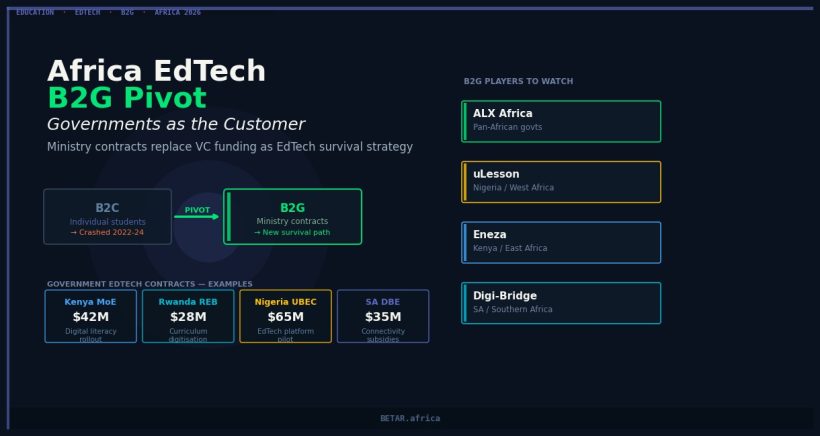
After $1.8B in VC failed, Africa’s surviving EdTech companies are rebuilding on government contracts. The unit economics are compelling. The outcomes question is not yet answered.
By the Education Reporter, BETAR.africa | April 2026
In 2022, Flexisaf Edusoft signed a contract with the Universal Basic Education Commission of Nigeria to deploy its SchoolFocus school management software across 652 public schools in Kano State. The contract, valued at approximately ₦1.4 billion (roughly $1.7 million at prevailing rates), covered software licensing, teacher training, and 18 months of technical support. It was not Flexisaf’s first government deal — but it was its largest, and it signalled something the company’s B2C history could not: that a viable African EdTech business might look nothing like its Silicon Valley comparators.
“The consumer market in Nigeria is real,” Abubakar Siddiq, Flexisaf’s CEO, told BETAR in an interview this month. “But sustainable unit economics, at our stage of development, require institutional buyers. Government is the institution that matters most.”
Flexisaf is not alone. Across the continent, Africa’s surviving EdTech companies are executing the same pivot: from selling subscriptions to households who cannot afford to pay, to selling technology contracts to governments that can. The B2G (business-to-government) shift is the quiet restructuring of a sector that $1.8 billion in venture capital failed to build. Whether it produces better education outcomes, or merely better revenue recognition, is the question the sector has not yet answered.
Why B2G: The Unit Economics Are Unarguable
The consumer EdTech thesis broke on a predictable constraint. African households — particularly in the low-to-middle income segments that represent the majority of the continent’s student population — have limited and volatile disposable income for education technology subscriptions. uLesson, which raised $7.5 million and built one of Nigeria’s most polished K-12 platforms, cut its subscription fees by half in 2024 and still faced churn rates that made its monthly recurring revenue model unworkable.
Government procurement contracts solve the unit economics problem by replacing millions of uncertain micro-transactions with a small number of large, predictable institutional deals. A single ministry-level LMS deployment in Kenya or Nigeria can generate more revenue than twelve months of household subscription sales.
The World Bank’s Education Sector lending in Sub-Saharan Africa has reinforced this structural shift. The Bank’s $300 million Nigeria EdTech loan approved in 2024 and Kenya’s $75 million Digital Learning Programme (2023) both include direct technology procurement components — and both create contract pipelines that only institutional EdTech vendors can realistically access. The Global Partnership for Education disbursed approximately $180 million in digital and innovation grants to Africa between 2022 and 2024, a significant portion of which flows through ministry procurement budgets.
The Procurement Landscape
African education ministry procurement is not a straightforward market. It is slow, politically variable, and subject to payment delays that routinely stretch to 12–18 months after delivery. Companies that have succeeded in the B2G space describe it as a test of institutional durability as much as product quality.
Rwanda is the most cited model of efficient EdTech government procurement. The Rwanda Education Board operates a centralised digital learning platform — eLearning Rwanda — integrated with the national curriculum and procured through competitive tender. Participating vendors report average payment cycles of 60–90 days, exceptional by continental standards. “Rwanda works because procurement is genuinely centralised and the ministry has technical capacity,” a Nairobi-based EdTech founder who has operated in multiple African markets told BETAR. “In some other markets, there is no single buyer — you are negotiating with 36 state governments or 47 counties simultaneously.”
Nigeria presents the most complex procurement environment. The Universal Basic Education Commission administers federal basic education funding, but state-level basic education boards retain significant autonomy on technology procurement. A national EdTech contract in Nigeria is, in practice, a series of separate state-level negotiations — each with its own tender process, political dynamics, and payment schedule. Flexisaf (founded 2002) has managed this complexity by building a state-by-state deployment model over more than two decades, creating relationships that function as durable commercial infrastructure.
Kenya’s EdTech procurement is increasingly mediated through the Kenya Institute of Curriculum Development and the Competency-Based Curriculum digital platform procurement, which has created an open field for vendors whose tools are aligned with the CBC framework introduced in 2021.
BETAR sought comment from the Universal Basic Education Commission and the Kenya Ministry of Education EdTech Directorate; spokespeople were not available by publication deadline.
The Companies That Have Made the Pivot
Flexisaf (Nigeria) is the most established B2G EdTech company on the continent. Its SchoolFocus platform is deployed in thousands of Nigerian schools — public and private — and its UBEC contract represents the kind of institutional validation that reorients a company’s entire sales motion. Siddiq describes the company’s model as “infrastructure, not content” — systems that schools run on, rather than digital curriculum that competes with teachers.
Kytabu (Kenya), which began as a digital textbook platform for individual students, has repositioned around institutional licensing. Public procurement records from the Kenya Public Procurement Regulatory Authority show Kytabu listed as a supplier on multiple county education department framework agreements between 2023 and 2025. Framework agreements are pre-approved supplier lists that allow ministries and counties to place call-off orders without running a full competitive tender each time — they reduce procurement friction but do not always disclose individual contract values publicly. The company declined to provide contract values but confirmed its B2G revenue now represents a majority of total revenue.
uLesson has not abandoned its consumer base but has added a B2B and B2G layer — licensing content packages to schools and, more recently, to state education agencies in Nigeria and Ghana. The pivot is partial: uLesson’s consumer brand remains intact, but its institutional revenue has grown to represent, by management’s account, approximately 40% of total revenue as of Q4 2025.
Eneza Education (Kenya), which operates in multiple francophone African markets through its Shupavu291 SMS-based learning platform, has always been more B2B than B2C — its primary distribution model routes through mobile operators and school partnerships. It represents the earlier, pre-VC-boom version of institutional EdTech: asset-light, low-cost, deployed at infrastructure rather than app-store level.
The Outcomes Question
The honest answer is that the evidence on B2G EdTech outcomes in Africa is thin.
A 2024 J-PAL evaluation of a Kenyan digital tablet programme — one of the World Bank-funded interventions — found neutral to slightly negative effects on learning outcomes in the first year of deployment, attributable primarily to implementation gaps: teacher training was inadequate, device ratios were insufficient, and curriculum alignment was incomplete. The technology worked. The system around it did not.
A 2023 World Bank programme assessment of Rwanda’s eLearning Rwanda platform found positive effects on student engagement and teacher digital literacy, with cautious notes on learning outcome measurement and sustainability beyond the programme period. Rwanda’s exceptional procurement and implementation infrastructure is not replicable across the continent without equivalent institutional investment.
The CESA 2026-2035 document lists digital learning infrastructure as a headline priority, with a target for 80% of African schools to have basic digital learning tools by 2035. It does not specify an outcomes framework — only an access metric. The risk is that B2G EdTech procurement, driven by institutional incentives on both the vendor and government sides, optimises for deployment numbers rather than learning improvement. A system can be digitised without being improved. Outcomes measurement must be built into procurement contracts, not assumed.
The Risk: Government Dependency Is Its Own Trap
B2G EdTech solves the unit economics problem but creates a different set of risks. Government contracts are subject to political cycle disruption: a change in administration can freeze procurement pipelines, reverse technology choices, or simply deprioritise existing contracts in favour of new political commitments. Multiple vendors operating in Nigeria report payment arrears exceeding 12 months on state-level contracts that have not been formally cancelled — simply paused.
Payment delay risk is existential for companies without deep balance sheets. A company that has delivered a multi-billion naira contract and is waiting 18 months for payment is functionally insolvent regardless of its contract value. The companies that survive in B2G are those that have either secured DFI-backed receivables financing (rare) or built procurement portfolios diversified enough that payment delays on one contract do not threaten operations.
The risk, as institutional investors tracking the B2G EdTech space describe it, is structural capture: B2G companies can become contractors rather than product companies, their growth determined by ministry budget cycles rather than product improvement or market demand.
What Success Looks Like
The B2G EdTech companies that appear most durable share three characteristics: they sell infrastructure rather than content (school management systems, LMS platforms, attendance and assessment tools rather than digital curriculum); they have built genuine institutional relationships over multi-year cycles, not single-contract wins; and they have retained a commercial discipline that treats government contracts as one revenue stream among several, not a substitute for a business model.
Flexisaf’s two-decade investment in government relationships is not a replicable fast-growth strategy. It is a reminder that institutional markets require institutional patience — a different cadence than the VC-backed sprint model that produced the EdTech graveyard.
Africa’s education technology sector is not dead. It is rebuilding, slowly, on a more honest foundation. For that rebuilding to matter beyond the balance sheet, governments and DFIs need to enforce one non-negotiable condition on every technology procurement contract: outcomes measurement, defined in advance, independently evaluated, and publicly reported. Digitisation without accountability produces procurement data, not learning improvement. The companies that understand this will build durable businesses. The governments that enforce it will build better schools.
Sources: Abubakar Siddiq, CEO, Flexisaf Edusoft (interview, March 2026); Kenya Public Procurement Regulatory Authority — supplier framework records 2023–2025; World Bank, Nigeria EdTech Loan documentation, 2024; World Bank, Kenya Digital Learning Programme documentation, 2023; Global Partnership for Education digital and innovation grants data 2022–2024; J-PAL, Kenya Digital Tablet Programme Evaluation, 2024; World Bank Programme Assessment, Rwanda eLearning Rwanda, 2023; AU Commission, CESA 2026-2035; uLesson management commentary, Q4 2025 earnings call.


 UphivaBETAR