
300 New Universities, But Who Is Getting a Degree Worth Having?
Africa’s higher education enrolment tripled in a generation. Graduate unemployment is rising anyway.
By the Education Reporter, BETAR.africa
In 2000, Ethiopia had two public universities. Today it has fifty. Undergraduate enrolment grew from 34,000 students to more than 729,000 in fifteen years. By any measure of access, the expansion is a policy success. By most measures of outcome, it is not.
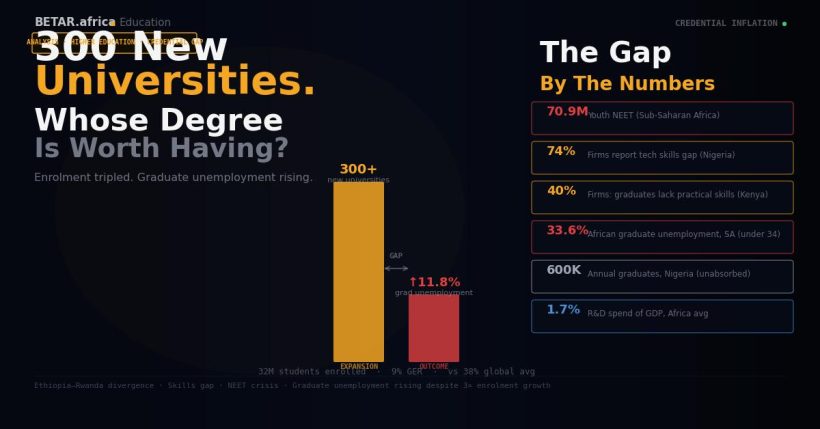
Across the continent, Africa has added more than 300 universities since 2000. The gross tertiary enrolment rate has climbed from roughly 4 per cent to 9 per cent of the eligible population — the fastest expansion in any developing region. The raw numbers are striking: an estimated 32 million students now enrolled in higher education, up from around 4 million at the turn of the century.
And yet graduate unemployment is worsening. Employer surveys report skills gaps of 40 to 74 per cent. Youth not in education, employment or training — the NEET rate — is rising in twelve of eighteen tracked African countries since 2022, despite more degrees being awarded than at any point in history. The continent is building universities faster than it is building economies capable of absorbing their graduates.
A Tripling That Has Not Translated
The UNESCO Institute for Statistics puts Africa’s tertiary enrolment growth in stark relief: Sub-Saharan Africa sits at 9 per cent gross enrolment ratio, against a global average of 38 per cent, Europe and North America at 79 per cent, and Latin America between 48 and 54 per cent. The gap is real and expansion is necessary. The question is whether the kind of expansion being pursued is the kind that produces productive graduates.
The International Labour Organization’s 2024 data on Sub-Saharan Africa NEET counts 70.9 million youth — 23.2 per cent of the continent’s young population — outside the education and employment system entirely. In Northern Africa the figure rises to 31 per cent. Women account for 61 per cent of all NEET youth, and are twice as likely as men to be in that category regardless of qualification level. These figures are not moving in the right direction.
South Africa, which has the continent’s most documented graduate labour market, illustrates the structural problem plainly. Graduate unemployment doubled from 5.8 per cent in 2008 to 11.8 per cent in 2023. Among African graduates aged 15 to 34, unemployment sits at 33.6 per cent — one in three — against 3.7 per cent for white graduates in the same cohort. A degree is increasingly a necessary but not sufficient condition for employment.
What Employers Are Actually Finding
The World Bank’s STEP Skills Measurement Survey in Kenya found that more than 40 per cent of firms disagree that the education system produces graduates with adequate practical experience. In Nigeria, a Q1 2026 survey by Decagon — a coding and professional skills programme that works directly with corporate employers — found that 74 per cent of tech sector firms still report significant skills gaps in recent graduates, even after filtering for candidates who have completed some form of post-university skills training.
The deficits cited are consistent across surveys and markets: communication, applied technical skills, decision-making under uncertainty, and the ability to transfer classroom knowledge to workplace problems. These are not gaps that more enrolment addresses. They are gaps that quality architecture — curriculum design, industry linkage, outcome measurement — addresses.
“The formal sector is structurally incapable of absorbing the ten to twelve million youth entering African labour markets annually,” notes analysis from the African Centre for Economic Transformation. “The majority are navigating the precarious informal economy, and credentials are increasingly disconnected from that reality.” Nigeria produces an estimated 600,000 university graduates annually into an economy that cannot structurally absorb them at the level the credential implies.
Ethiopia: When Access Outpaces Architecture
Ethiopia’s university expansion is the continent’s most dramatic case study. The government drove a deliberate policy of massification — the 2nd, 3rd, and 4th generation university construction waves of 2007, 2013, and 2016 each added institutions faster than the system could staff or equip them. Per-student budgetary allocations fell as institutions multiplied. Academic staff shortages became endemic.
Research published in peer-reviewed education journals found an insignificant statistical correlation between Ethiopia’s higher education expansion and measurable economic growth — a damning result given the theory of change underpinning the policy. The root causes identified were consistent: duplication of programmes across institutions, fragmentation of limited research resources, insufficient university autonomy, and state control that constrained academic freedom and curriculum adaptation.
Ethiopia now has 278 private higher education institutions operating alongside its 50 public universities. The system is vast. Whether it is producing graduates with skills that match the country’s economic trajectory — digital services, agro-processing, manufacturing — remains an open question that the Ministry of Education has yet to answer convincingly with data.
Rwanda’s Counter-Argument
Rwanda chose a different path. Rather than building new institutions, the government merged existing public universities into a single University of Rwanda, eliminating duplication and concentrating resources. The rationale was explicit: a small country with limited public funding could not sustain multiple under-resourced institutions and should instead build one institution capable of competing regionally.
The Higher Education Council (HEC) introduced a DACUM-based curriculum alignment process — a structured methodology for ensuring that degree programmes are developed in dialogue with industry rather than in isolation from it. Formal linkage agreements with the Rwanda Workforce Development Authority kept curriculum revision cycles tied to labour market signals. PhD staff development became a policy target rather than an aspiration.
Critically, Rwanda introduced graduate employment tracking — a system that follows outcomes rather than simply counting enrolments. It remains rare on the continent. The distinction matters: you cannot manage what you do not measure, and most African higher education systems measure inputs (number of institutions, number of enrolled students) rather than outputs (employment rates, wage premiums, employer satisfaction).
The outcomes data from Rwanda’s model is stronger than Ethiopia’s, though the comparison has limits — Rwanda is a smaller, more governable system with a different political architecture. But the lesson generalises: consolidation with outcome measurement produces better-evidenced results than expansion without it.
The Diploma Disease, African Edition
There is a structural dynamic at work that expansion alone cannot solve. Employers, facing a surplus of graduates and unable to efficiently assess competence, respond by requiring degrees for positions that previously required secondary school completion. This is credential inflation: the degree becomes a screening mechanism rather than a competence signal, and its value erodes for everyone.
The Association of African Universities (AAU) is attempting to address the quality assurance gap at the continental level through the Pan-African Quality Assurance and Accreditation Alliance (PAQAA), which has developed African Standards and Guidelines for Quality Assurance. Whether national accreditation bodies adopt and enforce these standards consistently is a different question. The gap between continental standard-setting and national implementation has defined African education governance for decades.
The AfDB’s 2025 African Economic Outlook estimates that 28.9 per cent of employed African youth are under-skilled relative to their qualifications — they hold credentials their jobs do not require. The paradox sits alongside a simultaneous shortage of workers with the applied technical skills that growing sectors actually need. More universities have not resolved the mismatch. They have, in some cases, deepened it.
What the Next CESA Must Fix
The Continental Education Strategy for Africa 2026–2035, currently being finalised by the African Union, has an opportunity to reframe the success metric for higher education. The previous CESA measured access. The next one must measure outcomes — graduate employment rates, employer satisfaction, research commercialisation, and the ratio of degrees to productive absorption in the formal economy.
Africa needs more university places. The enrolment gap relative to the global average is real and consequential. But the lesson of the last twenty-five years is that building institutions faster than you build quality architecture, employer linkage systems, and outcome measurement frameworks produces a generation of credential inflation — and a graduate unemployment crisis that more degrees will not solve.
Ethiopia has fifty public universities. Rwanda has one. Rwanda’s graduates are more likely to have a job.


 UphivaBETAR
 Joseph Busari