
Africa’s Tech IPO Class of 2027: Exchange Infrastructure and the Readiness Question
By Business Reporter, BETAR.africa | April 2026
Beat: BUSINESS / CAPITAL MARKETS | Issue: BETA-1101
This capital markets series has traced African startup capital through five structural chapters: the collapse of Series A funding, the rise of venture debt, the private equity exit gridlock, and the bank-fintech M&A wave now reshaping Africa’s financial services sector. Chapter 5 asks the terminal question in any startup capital cycle: when does a company built in Africa go public, and is the infrastructure there to receive it?
BETAR published its Africa IPO Pipeline survey in March 2026 — cataloguing Moniepoint, Wave, Onafriq, and Breadfast as the continent’s most plausible near-term public market candidates. That piece surveyed who might list and where. This chapter takes the harder question: are these companies structurally ready, and are the exchanges structurally equipped?
The answers are more complicated than the current optimism in Africa’s institutional investor community suggests.
The Jumia Audit: Five Compounding Failures
The standard reading of Jumia’s 2019 NYSE listing collapse is that the company was unprofitable and investors eventually noticed. That reading understates the operational specificity of what went wrong — and understates the structural improvements that the current IPO class has made as a result.
Jumia failed across five distinct dimensions, not one.
Revenue misrepresentation. In the weeks before its April 2019 NYSE debut, Citron Research published a detailed analysis alleging that Jumia’s S-1 had materially overstated GMV by including cancelled and fraud-reversed orders. Jumia disputed the characterisation but later restated its active customer numbers. A company approaching public markets cannot survive a credibility deficit on its primary growth metric in the first quarter of trading.
No dedicated institutional base. Jumia listed primarily on New York retail enthusiasm for an “Africa’s Amazon” narrative. It had no dedicated institutional shareholder base — no cornerstone investor with a structural mandate to hold African tech equity that would absorb the selling when the narrative hit earnings. When short sellers entered, there was no institutional floor.
Thin free float with poor liquidity.** Jumia’s public float at listing was concentrated enough that any sustained institutional selling created outsized price movement. A company listing on a narrative premium needs a large enough free float to absorb price discovery without catastrophic downside. Jumia did not have it.
No anchor domestic holder. An NYSE listing with no Nigerian institutional anchor — no pension fund, no sovereign wealth position, no domestic insurance company — meant that the company had no home-market constituency defending the valuation. Every sell-side downgrade landed without a buyer of last resort.
Premature timing relative to operating model. Jumia listed across 14 markets with no clear path to profitability in any one of them. The market was asked to price a portfolio of unresolved business model experiments. It could not, and it did not.
The companies now in the 2026-2027 IPO conversation have each addressed at least three of these five failure modes. The question is which ones they have missed.
Exchange Architecture: The Honest Assessment
No African exchange today is fully equipped to absorb a landmark $500 million African tech IPO without preparation. That is not a pessimistic reading — it is an accurate one, and understanding why matters for structuring the right listing architecture.
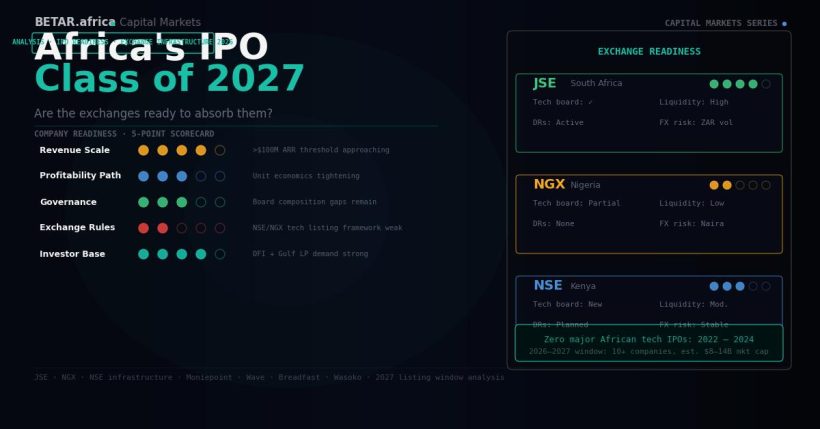
Nigerian Exchange Group (NGX). Daily average turnover on the NGX in the first quarter of 2026 was approximately ₦3 billion to ₦15 billion, depending on market conditions — at the mid-rate, that translates to roughly $3 million to $10 million in daily trading volume. A $500 million IPO with a 25% free float creates $125 million in publicly tradeable equity. For that equity to trade without chronic illiquidity discount, the exchange needs daily turnover multiples of the float. The NGX does not yet have it. What the NGX does have is clear strategic intent: CEO Temi Popoola has publicly committed to NGX Growth Board development and to creating a listing pathway for pre-profitability technology companies. If Moniepoint lists on NGX — the most likely domestic scenario — the listing would itself catalyse institutional depth by forcing pension fund participation in a high-quality tech equity for the first time.
Johannesburg Stock Exchange (JSE). The JSE is Africa’s most liquid equity market, with over R18 trillion in listed equity, functioning institutional infrastructure, and analyst coverage depth that no other African exchange approaches. For South African companies or businesses with significant southern African revenue, it is the clear primary option. For West African companies like Moniepoint, the geographic and currency friction — naira revenue basis vs. rand-denominated market — creates a mismatch that suppresses the domestic price discovery benefit of listing.
Nairobi Securities Exchange (NSE Kenya). Safaricom’s continued presence on the NSE as a high-quality liquid stock demonstrates that the exchange can price and support a large-cap tech-adjacent business. The NSE has established market infrastructure and is the natural home for any East African tech IPO. Its limitation is depth: the institutional investor base outside Safaricom is thin, and a new large-cap technology listing would absorb significant attention without the bandwidth that the NYSE or LSE would provide.
BRVM Abidjan. The regional exchange for Francophone West Africa is where Wave’s potential listing creates the most interesting structural question. Wave’s core market is Francophone Africa — Senegal, Côte d’Ivoire, Mali, Burkina Faso. Listing on BRVM would place the company closest to the users, regulators, and governments that define its operating environment. BRVM’s constraints are significant: thin liquidity, limited institutional depth, and currency complexity across a multi-country region. A BRVM listing for Wave would be politically and strategically defensible but financially suboptimal without complementary international listing.
London (LSE/AIM). For infrastructure and B2B technology companies, London offers the deepest institutional appetite among international venues. Onafriq’s payment-rail positioning makes it a natural LSE candidate. London’s fintech institutional coverage — BlackRock, Fidelity, Baillie Gifford — is comfortable with African payment infrastructure in a way that New York generalist funds are not. The compliance costs for an LSE main market listing are material, but Onafriq’s existing governance infrastructure, built through years of DFI reporting, reduces the incremental cost.
The dual-listing case. The exchange architecture that makes the most structural sense for the largest candidates — specifically Moniepoint — is a dual listing: NGX as primary domestic exchange, LSE as international secondary. This architecture has not been successfully executed for an African technology company, but it is not without precedent in other markets. A dual-listing requires sustained governance investment: IFRS financial statements audited to international standards, an investor relations function capable of managing two regulatory regimes, and board composition that satisfies both NGX and LSE requirements. Moniepoint’s corporate governance posture, built through its DPI-led Series C, is further along this path than any other Nigerian tech company. It is not yet there.
The Readiness Scorecard
Applying five criteria to the four primary candidates produces differentiated verdicts:
Moniepoint
- Revenue quality: Transaction fee revenue from SME banking and POS infrastructure — recurring, defensible, with clear unit economics. Strong.
- Governance standards: DPI-led board with institutional-grade governance requirements. Strong.
- Audit compliance (IFRS): IFRS adoption confirmed, but NGX-primary listing requires transition to Big Four audit with international review standards. In progress; estimated 12-18 months to full international audit standard.
- Free-float viability: Investor base includes Google Africa Investment Fund and DPI; a 20-25% float at current valuation range would create adequate liquidity with an anchor domestic institutional co-investor. Achievable.
- Price discovery risk: Revenue growth trajectory is legible; unit economics are disclosed. Lowest price discovery risk of the four candidates.
Assessment: Closest to public market readiness. NGX-LSE dual listing achievable by Q4 2027 with IFRS audit transition and anchor institutional commitment confirmed.
Wave
- Revenue quality: Near-zero transaction fees creates a revenue model that is opaque to traditional public market analysts. Wave’s monetisation depends on float income, premium product adoption, and ecosystem expansion — a financial model that requires education before pricing.
- Governance standards: Sequoia and Stripe on cap table bring institutional governance discipline. Strong.
- Audit compliance (IFRS): Multi-country operations across Francophone Africa require consolidated IFRS reporting across multiple regulatory regimes. Complex but manageable.
- Free-float viability: 2021 Series A valuation of $1.7 billion was set at peak-market conditions. Secondary market marks in 2024-2025 suggest compression to $900 million to $1.2 billion. A listing at compressed valuation vs. 2021 peak creates the reverse-Jumia optics problem: institutional buyers will ask what happened to the billion-dollar narrative.
- Price discovery risk: Highest of the four. Revenue model is non-standard; geographic concentration in Francophone Africa reduces comps universe; valuation narrative has been disrupted by secondary compression.
Assessment: 2027 listing is possible but requires either a revenue model evolution that makes monetisation legible to public market analysts, or acceptance of a valuation below 2021 reference points. Neither condition is met today.
Onafriq
- Revenue quality: Platform access fees and transaction routing revenue from 400 million connected mobile wallets. Infrastructure model is recurring and predictable — closest analogue is a payment processing company, which trades at defined multiples.
- Governance standards: Helios Investment Partners and DFI reporting requirements have built institutional-grade governance. Strong.
- Audit compliance (IFRS): IFRS-compliant across operations. Ready for LSE main market requirements.
- Free-float viability: $100 million Series C at a modest valuation relative to the payment infrastructure comps universe. A 2027 IPO at 15-20x recurring revenue — consistent with comparable payment infrastructure companies on LSE — would generate an adequate free float.
- Price discovery risk: B2B infrastructure company with no consumer brand — price discovery depends entirely on analyst and institutional understanding of the payment rail model. Requires concentrated pre-IPO institutional engagement.
Assessment: LSE listing is structurally well-suited. The disclosure challenge is translating a pan-African B2B infrastructure model for an institutional audience that may lack African market depth. This is an investor education problem, not a financial quality problem.
Breadfast
- Revenue quality: Quick commerce is a notoriously margin-thin model globally. Breadfast’s private label strategy and Breadfast Pay embedded finance integration have improved the unit economics profile. But the fundamental quick commerce revenue model — delivery economics, basket value, retention — requires more public market stress-testing than the current institutional narrative reflects.
- Governance standards: IFC and EBRD participation in the Pre-Series C brings multilateral governance requirements. Strong.
- Audit compliance (IFRS): Egypt-domiciled with Central Bank of Egypt licensing for Breadfast Pay. IFRS compliance through IFC requirements. Meets threshold.
- Free-float viability: Most recent private round implies a valuation that would require strong institutional demand to sustain a public float at comparable multiples. Dependent on Breadfast Pay penetration accelerating the overall monetisation story.
- Price discovery risk: Quick commerce has a damaged global narrative (Getir, Gorillas, GoPuff restructuring stories). Breadfast needs to demonstrably separate itself from the global quick commerce model failure thesis. The embedded finance angle is its strongest differentiator but not yet the core financial narrative.
Assessment: Most dependent on external narrative conditions. If Breadfast Pay monetisation accelerates and the global quick commerce narrative rehabilitates, a 2027 listing is plausible. If not, 2028-2029 is more realistic.
BETAR Assessment
No African tech company will complete a landmark public market listing in 2026. This is not a pessimistic verdict — it is a precise one.
The conditions for a landmark 2027 listing — specifically a Moniepoint dual NGX-LSE transaction — require: IFRS audit transition to international standards (estimated 12-18 months from today); confirmed anchor institutional commitment from at least one Nigerian pension fund or sovereign wealth vehicle; and NGX Growth Board infrastructure development sufficient to provide a domestic liquidity floor. All three are achievable by end-2027. None are certain.
The broader structural point this series has been building toward is this: the Africa Capital Markets Series of 2026-2027, if it materialises, will not look like a traditional emerging market IPO wave. It will be driven by companies that survived a brutal funding cycle, built real unit economics under pressure, and absorbed the Jumia lesson at the product level. The listing candidates emerging from this cycle are measurably better businesses than those that attempted public markets in the 2019-2021 window.
Whether African exchanges and international institutional infrastructure is ready to receive them on terms that make the listing successful — not just executed, but sustained — is the remaining question. The answer depends on decisions that exchange operators, institutional investors, and regulators must make in the next eighteen months.
Africa has the companies. The question is whether it has the market.
Sources: BETAR Africa IPO Pipeline Survey, March 2026 (BETA-498); AVCA African Private Capital Activity Report 2025; Jumia Technology AG SEC S-1 Filing (2019); Jumia 2022 Annual Report; NGX Market Statistics Q1 2026; Citron Research Jumia Analysis (April 2019); Moniepoint Series C investor disclosures; Wave Series A term sheet documentation (2021); DPI portfolio communications; IFC/EBRD Breadfast Pre-Series C press releases.
BETAR sought comment from NGX Group, Renaissance Capital, and Stanbic IBTC Capital. No responses were received at time of publication.
Related BETAR coverage:
BETA-498 — Africa’s IPO Pipeline 2026-2027 |
BETA-566 — Africa’s Series A Desert |
BETA-1028 — Venture Debt: Private Credit Wave |
BETA-1054 — Africa PE Has $10B It Cannot Exit |
BETA-1069 — Africa Bank-Fintech M&A 2026
— Business Reporter, BETAR.africa

 UphivaBETAR

 Joseph Busari