
What It Actually Costs to Make an African Music Video
From ₦2 million indie shoots to $94,000 TG Omori commissions — BETAR maps the full economics of Africa’s music video production industry: director fees, production house margins, YouTube CPM returns, and the brand co-financing model that is quietly subsidising A-list budgets.
21 March 2026
In 2024, a Cameroonian artist named Kocee wired $94,000 — approximately ₦120 million at the prevailing exchange rate — to a Nigerian cinematographer named TG Omori to direct a single music video. The same year, Davido had paid Omori ₦100 million ($78,000) for the visuals to “Feel.” These were not outliers in a market accustomed to six-figure productions. They were the market rate for Africa’s most commercially dominant music video director.
That the economics of African music video production have never been systematically reported is a structural gap in how the continent covers its own creative industries. Nigeria’s music industry generates an estimated $600 million annually by government figures. Its visual production layer — the directors, production houses, post-production facilities, and the YouTube revenues those videos generate — sits alongside that number, largely uncounted.
This is that count.
The Budget Spectrum: From ₦2 Million to $165,000
African music video budgets occupy a range wide enough to span small business capital and mid-tier feature film production.
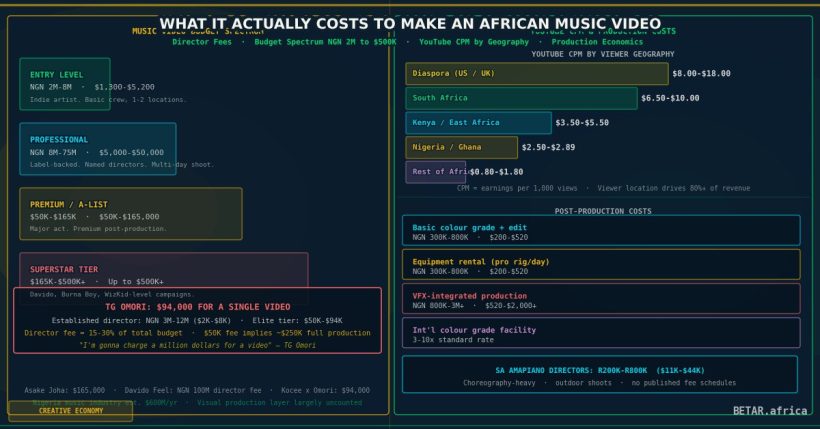
At the entry level, an independent artist in Lagos can commission a watchable, professionally shot video for ₦2 million to ₦8 million — roughly $1,300 to $5,200 at current exchange rates. That budget covers a director, a basic camera crew, one or two locations, and rudimentary post-production. It will not clear the threshold for YouTube editorial pitch consideration or generate the visual treatment that platform algorithmic promotion rewards.
The professional tier — where artists with label backing or self-funded mid-career catalogues operate — runs between $5,000 and $50,000. At this level, directors with recognised visual identities become accessible, multi-day location shoots become feasible, and post-production quality reaches streaming platform standards.
At the premium end, the arithmetic shifts sharply. A confirmed production data point: Asake’s hit single “Joha” reportedly cost $165,000 to shoot. Davido’s “Feel” cost ₦100 million ($78,000) in director fees alone — total production costs would have exceeded that. For the major-label tier (Davido, Burna Boy, WizKid-level campaigns), budgets reaching $300,000 to $500,000 are structurally plausible based on director rates and production scale.
Timaya, in a 2025 public statement, lamented that music video production and promotion combined now cost ₦100 million. That figure captures a different reality than pure director fees: the full marketing cost of releasing a visual in a market where distribution, promotions, and platform placement all carry separate price tags.
What Directors Earn
Director fee structures in Nigeria follow a recognisable hierarchy, though rates at the top have inflated rapidly as the export value of Afrobeats has drawn international commissioning.
The benchmark rate for an established but non-elite Nigerian director sits between ₦3 million and ₦12 million per video ($2,000–$8,000). Clarence Peters — who set the commercial production standard for Nigerian music videos across the 2010s — was publicly reported to charge ₦3 million to ₦6 million per video during the period when he was the market’s dominant name.
TG Omori (ThankGod Omori Jesam, known as Boy Director) has restructured what the top of that market looks like. His current rate is reported at approximately $50,000 per video, with individual commissions reaching $94,000. He has publicly stated his price aspiration: “If I don’t die young, I’m gonna charge a million dollars for a video and y’all gonna pay.” The market trajectory does not make that statement implausible.
What those headline rates obscure, however, is the cost structure beneath them. In a June 2025 interview, Omori disclosed the financial reality that accompanied his rise: “I only started making profits in 2023. Every time I’m losing money from pick-up shoots or something! Budget is never enough. In fact, I was in bad production debt for five years.” He cleared that debt, he said, not from shoot fees but from brand and personality income — a structural detail that reframes how director rates are read. The fee charged is not the fee earned; equipment, crew, and production overruns routinely compress net margins well below the headline number.
Director fees in Nigerian productions typically represent 15% to 30% of total video budget — consistent with international industry norms. At TG Omori’s $50,000 rate, a video where his fee represents 20% of the total budget implies a $250,000 full production. That arithmetic helps explain where A-list Nigerian video budgets land even when the total figure is not disclosed.
South Africa’s Amapiano ecosystem has generated its own director economy, centred on visual treatments suited to the genre’s choreography-heavy, outdoor production style. Named South African directors command rates in the R200,000–R800,000 range ($11,000–$44,000) for premium commissions, though published fee schedules do not exist for this market segment.
The Production House Layer
Behind the director sits a production infrastructure with its own margin structure. Lagos production houses that specialise in music video output price projects at rates that include crew, equipment, and logistics — with director fees typically billed separately.
Ebuka Nwobu, a producer at Lagos-based production outfit Ladder, Lex and Booker, has described the cost mechanics plainly: crew and equipment take the bulk of the money, and location choices drive significant variance — the outfit has paid ₦800,000 for a single-day shoot at a premium venue. A complicating factor, Nwobu noted, is that artists and labels are rarely forthcoming with their budgets even when they know them, forcing production houses to scope projects with limited visibility into the total envelope.
Equipment economics matter: camera bodies, lighting rigs, and stabilisation equipment used for a ₦5 million production day involve either ownership by the production house (high capital, lower per-shoot cost) or rental from Lagos-based equipment houses (₦300,000–₦800,000 per day for professional-grade packages). Most mid-tier Lagos production houses operate on owned-equipment models to protect margin on high-frequency shoots.
Post-production cost structures are tiered by complexity: a straightforward colour grade and edit for a performance-format video runs ₦300,000–₦800,000; VFX-integrated productions or music videos requiring international colour grading facilities run multiples of that. The percentage of total video budget allocated to post-production has grown as streaming platform algorithms increasingly reward visual quality — a trend that has compressed margins for directors and production houses who compete on post-production differentiation.
YouTube: When the Video Starts Paying
A music video is a marketing asset. Its financial return is structurally indirect — but YouTube monetisation creates a direct revenue layer that has changed how artists and labels calculate production investment.
The CPM (cost per thousand views) economics for African music content are determined primarily by viewer geography, not artist nationality. A Nigerian Afrobeats video watched predominantly by Nigerian and Ghanaian audiences generates a CPM of approximately $2.50 to $2.89 — YouTube’s published and estimated rate for Nigeria and Ghana. South African viewers generate $6.50 to $10.00 CPM.
After YouTube’s revenue split (45% retained by YouTube, 55% to the rights holder), a video generating 10 million views with a predominantly West African audience produces approximately $11,000 to $13,000 in direct YouTube revenue. The same 10 million views with a UK/US diaspora audience split can generate two to three times that figure.
A $50,000 music video investment that achieves 50 million views — realistic for an established Afrobeats act with an active global audience — generates approximately $55,000–$80,000 in YouTube AdSense alone. The production cost recovers from YouTube revenue within the view count range that successful videos now routinely reach. The calculation has made production investment in premium videos economically rational in a way it was not before monetised streaming existed.
VEVO, the music video platform that distributes through YouTube’s infrastructure, is underutilised by African artists. VEVO’s CPM rates are structurally higher than standard YouTube channel rates — but most African independent and mid-tier artists access YouTube directly through their distributor or label rather than through VEVO, which requires an application and approval process that filters out catalogue below a certain streaming threshold.
Brand Co-Financing: The Hidden Budget Subsidy
Corporate Nigeria’s investment in Afrobeats has moved well beyond artist endorsements into direct video production financing. Glo, MTN, Pepsi, Guinness Nigeria, and Stanbic IBTC collectively spend hundreds of millions of naira annually on branded music content — and product placement within music videos has emerged as a structured co-financing mechanism.
Mavin Records pioneered visible product integration with Access Bank in Korede Bello’s “Godwin.” The model has matured: brands now negotiate specific placement, exclusivity windows, and social media amplification obligations as part of video co-financing deals. Brand placement typically covers 20% to 50% of a video’s total production budget, in exchange for featured product integration and the artist’s social media distribution of the content.
The practice is sufficiently institutionalised that it has restructured how major-label management accounts for video production spend. Asa Asika, the manager behind Davido’s global campaign for the Timeless album, stated in an August 2025 interview: “I can’t remember the last time I paid 100% for a music video for Davido. I always have a brand that’s willing to pay for at least half the video.” The brands that have funded Davido videos include Martell, Infinix, and PlayStation — each covering placement costs that offset what would otherwise be out-of-pocket production outlays.
For a $100,000 video, a single brand integration deal covering 30% of cost reduces the label or artist’s net outlay to $70,000 — while the brand receives guaranteed placement in content that may accumulate tens of millions of views. At the Davido tier — where brand deals cover 50% or more — the effective production cost to the artist’s side drops dramatically, making premium video investment structurally different from what the raw budget number implies. The economics favour both parties at the volume of YouTube traffic that established Afrobeats acts reliably generate.
The Investment Case
The clearest lens on African music video economics is the production-to-marketing-yield calculation. Labels servicing an Afrobeats single at an average cost of $45,000 — covering video production, digital promotion, playlist pitching, and PR — operate on the thesis that a well-produced visual is the single highest-leverage input in streaming discovery. Playlist editorial teams at Spotify and Apple Music pitch-consider music differently when professional visuals exist. YouTube’s discovery algorithm surfaces content with higher watch-time completion rates — which professional production quality materially affects.
The $600 million that Nigeria’s music industry generates annually does not sit apart from its video production layer. The two are economically coupled: the industry’s export capacity depends directly on the visual treatment that makes Afrobeats music legible and aspirational to international audiences. TG Omori’s $94,000 fee is not an aberration — it is evidence of a market that has finally begun pricing its visual production at rates commensurate with the audiences those visuals reach.

 UphivaBETAR
 Joseph Busari