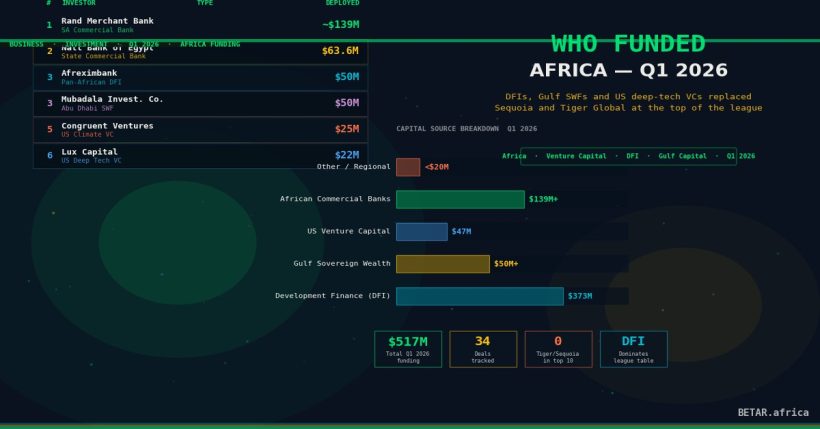

The $517 million that flowed into African startups in Q1 2026 did not come from the investors who defined Africa’s last funding boom. It came from an infrastructure PE firm out of South Africa, a state-owned Egyptian bank, and a pan-African development lender — with Gulf capital and US deep-tech VCs rounding out a league table that reads like a map of who actually funds Africa now. The composition of the investor base tells a sharper story than the headline number.
BETAR’s Q1 2026 Funding Tracker logged 34 deals across the quarter. When ranked by capital deployed, the resulting investor league table looks nothing like the 2021–2022 vintage: no Sequoia, no Tiger Global, no QED Investors in the top tier. Instead, the league is led by a South African infrastructure private equity firm, flanked by a state commercial bank, a Pan-African DFI, and a US accelerator-backed impact fund. Africa’s capital supply chain has been structurally reordered.
The League Table
| Rank | Investor | Type | Capital Deployed | Deal |
|---|---|---|---|---|
| 1 | Metier Sustainable Capital | SA Infrastructure PE | $94M | SolarAfrica |
| 2 | National Bank of Egypt | State Commercial Bank | $63.6M | valU |
| 3 | Afreximbank | Pan-African DFI | $50M | Spiro |
| 4 | Endeavor Catalyst | US Impact / Accelerator | $50M | Breadfast |
| 5 | Sawari Ventures | Egyptian VC | $45M | GoCab |
| 6 | Congruent Ventures | US Climate VC | $25M | Zeno |
| 7 | Equitane DMCC | Dubai Mobility Fund | $24M | MAX |
| 8 | Lux Capital | US Deep Tech VC | $22M | Terrahaptix |
Note: FMO ($21M, Lula) and Tas’heel ($20M, NowPay JV) are the #9 and #10 investors by capital deployed. Enza Capital led Yakeey ($15M) and co-invested in Tuteria.
Metier Sustainable Capital’s position at the top reflects its lead on the quarter’s single largest transaction: the $94 million project finance facility into South Africa’s SolarAfrica, co-invested alongside AIIM and Norfund. Metier is not a venture fund. It is a specialist infrastructure PE firm focused on sustainable assets across sub-Saharan Africa. Its position at the head of Africa’s Q1 2026 investor league table is a direct signal that the quarter’s largest capital deployment was an infrastructure deal — not a startup round in any conventional sense — and that the line between infrastructure PE and technology investment is increasingly blurred as Africa’s digital infrastructure buildout accelerates.
At #5, Sawari Ventures — the Egyptian VC that led GoCab’s $45 million structured hybrid round in Côte d’Ivoire — is the league table’s most underappreciated entry. Sawari is a Cairo-based fund that backed GoCab’s pan-West Africa ride-hailing and logistics expansion with a package structured as $15 million equity alongside $30 million in debt. An Egyptian VC leading the largest Francophone Africa mobility deal of Q1 is a signal about Egyptian capital’s expanding continental ambition — and about which funds are willing to underwrite complex, multi-structure transactions in markets where local VC is thin.
The DFI Effect: Does Development Capital Suppress Valuations?
Six of the top eight investors in Q1 2026 are either state-linked, multilateral, development-mandated, or impact-oriented. The question African founders and local fund managers are wrestling with is whether DFI-dominated rounds create distortions: in valuations, in board dynamics, and in the exit timelines that growth-stage companies are designed around.
The concern is structural. DFIs price debt facilities on risk-adjusted return metrics that are not anchored to equity market comparables. When a DFI provides a $50 million debt facility at concessional rates to an energy infrastructure company, it does not set a valuation — but it does set a precedent for what the company’s debt-to-equity ratio looks like on the next cap table conversation. Equity investors who follow face a more complex structure and, often, lower return leverage. Afreximbank’s $50 million facility into Spiro — structured vehicle-fleet debt for the pan-African electric motorcycle company — is a textbook illustration: the deal keeps Spiro’s expansion alive, but at terms that no commercial VC would meet on equity.
Kola Aina, Founding Partner of Ventures Platform, framed the dynamic bluntly in the context of his firm’s Fund II close in late 2025: the retreat of purely return-driven US capital has left a structural gap that DFIs are filling on their own terms, not venture terms. “The backing we’ve received from a diverse group of blue-chip partners is a powerful endorsement of Africa’s place as the purest, most asymmetric source for non-consensus alpha,” Aina said at the time. The subtext was clear: someone needs to bridge the gap until commercial venture re-engages, and the terms on offer from that bridge matter enormously for founders.
The counterargument is that DFI capital, for all its structural complexity, is keeping deals alive that would not otherwise close. SolarAfrica’s $94 million facility was not going to happen on equity terms in Q1 2026. Neither was Spiro’s $50 million debt round. DFIs are not suppressing valuations — they are financing assets that the equity market has correctly priced as long-duration infrastructure rather than venture-scale returns. The question of whether DFI dominance is structural or cyclical depends almost entirely on when and whether commercial equity returns.
Gulf Capital: Two Deals, One Pattern
Gulf-linked capital appeared in two Q1 2026 transactions — smaller in headline terms than last cycle, but structurally significant in what it reveals about Gulf institutional appetite for African digital infrastructure. Equitane DMCC, a Dubai-based mobility fund, led MAX’s $24 million hybrid round in Nigeria — backing Africa’s largest motorcycle logistics operator at profitability, in a deal structured to support balance sheet expansion rather than growth-stage equity dilution. Tas’heel (United International Holding Company), a Saudi-linked investment vehicle, injected $20 million into NowPay via a JV structure that created NowAccess, a new Saudi Arabia entity. The deal is not simply a fintech investment — it is a market entry by a Gulf institutional player into Egyptian fintech infrastructure.
The absence of a flagship Gulf sovereign wealth fund from the top-tier transactions is itself data. In 2024 and early 2025, Mubadala, ADQ, and affiliated vehicles were visible participants in African tech rounds. Q1 2026 sees Gulf capital present but repositioned: Equitane and Tas’heel are smaller, more operationally focused vehicles than Mubadala or ADIA. They are making targeted bets on mobility and fintech infrastructure rather than headline consumer tech. This may reflect selectivity, patience, or simply the absence of a sufficiently large pure equity opportunity in Q1. Gulf sovereign capital tends to move in concentrated bursts; the Q2 pipeline will provide a clearer read on whether Q1 was a pause or a pivot.
Nigeria’s Defence Tech Surprise
The quarter’s most unexpected data point landed in Nigeria, from a sector that African startup coverage has almost entirely ignored: defence and dual-use technology. Terra Industries and Terrahaptix — two Nigerian companies operating at the intersection of security, hardware, and frontier technology — together raised $33.75 million in Q1, backed by 8VC and Lux Capital.
8VC, the San Francisco-based venture firm co-founded by Joe Lonsdale, has a track record in US defence-adjacent technology through its portfolio relationships with firms supplying the US federal government. Lux Capital has similarly built a reputation backing deep-science and dual-use hardware companies. Their combined bet on two Nigerian companies in the same quarter is not coincidental — it suggests active thesis construction around African defence and security technology, likely connected to the continent’s growing demand for indigenous security infrastructure amid deteriorating stability in the Sahel and parts of East Africa.
The $33.75 million combined figure makes Nigeria’s defence tech cluster the second-largest sector story of Q1 by equity deployed, behind fintech. It attracted zero domestic African VC participation in either deal. That gap — between the risk appetite of global deep-tech investors and local African funds — is a structural feature of the ecosystem worth monitoring.
Morocco’s Five-Deal Quarter
Morocco logged five consecutive equity deals in Q1 2026 — WafR, Enakl, Weego, Woliz, and Yakeey — totalling $24.6 million. More notable than the capital is the investor mix: Azur Innovation Fund anchoring two deals, Sanlam Maroc making its debut startup investment (Woliz), and Enza Capital leading Yakeey’s $15 million Series A — the largest single Morocco deal of the quarter. A year ago, Morocco was a single-digit deal market. In Q1 2026, it recorded more individual equity transactions than any country except Nigeria.
The cluster effect is significant. Investor activity in Morocco is now generating its own gravity — each deal reduces perceived risk for the next. The Azur Innovation Fund’s consistent presence as the anchor investor in the Moroccan ecosystem is functioning as the kind of conviction signal that catalyses co-investment. Morocco’s emergence as a fifth major African deal market, alongside Nigeria, South Africa, Egypt, and Kenya, has likely moved from thesis to established fact.
What Investor Composition Signals for Q2 2026
The Q1 2026 investor league table is a leading indicator. A market in which infrastructure PE and state development banks hold the top two slots — and in which the only commercial VCs in the top eight are a US climate specialist and a deep-tech firm backing defence technology — is a market in structural transition, not temporary disruption.
Founders raising in this environment have adapted their pitches accordingly. Michael Spencer, founder of Kenyan EV company Zeno, closed a $25 million Series A in March backed by a deliberately blended mix of commercial and impact-linked capital. Spencer described the structure at the time as “designed for the current market environment, where purely return-driven US venture has pulled back” — an acknowledgement that the LP base behind the Q1 investor league table is not a temporary substitute, but the capital infrastructure founders must now build their businesses around.
The Africa-focused VC funds that defined the 2019–2022 funding cycle are not absent from Q1 2026 — Enza Capital at #11 (Yakeey, Tuteria), TLcom Capital at #12 (Flextock) — but they have been displaced from the capital rankings by investors with different mandates, different return expectations, and different views of what African startups should look like. For founders navigating Q2 2026, the composition of that investor base is not an abstraction. It determines which business models get funded, which markets get covered, and which exits become possible.
— Business Reporter, BETAR.africa

 UphivaBETAR

 Joseph Busari