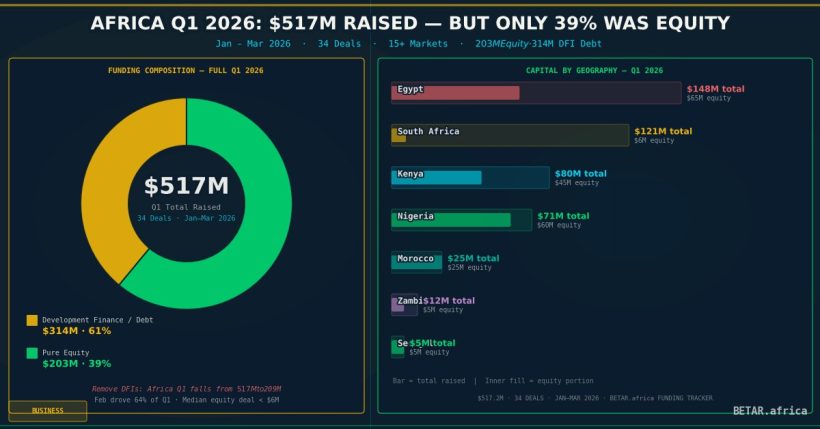

African startups raised $532 million across 41 deals in the first quarter of 2026, according to BETAR’s Q1 2026 Funding Tracker — a number that looks healthy until you examine how the capital is structured. Some $219 million of that figure, or 41%, was equity. The remaining 59% came from development finance debt, project finance facilities, and structured debt instruments. More money than the same period a year ago. Fundamentally different capital.
The composition shift is the defining story of African startup finance in 2026. Venture capital — the equity that funds asymmetric bets on early-stage businesses — has retreated. Development finance institutions (DFIs) and development banks have stepped in to hold up the headline number. Africa’s Q1 funding figure is real. The venture economy underpinning it is under serious structural pressure.
How the Quarter Unfolded
February was responsible for most of it. Of the $532 million tracked through Q1, $330 million — 62% — landed in a single month. Four deals drove February’s surge: SolarAfrica’s $94 million debt facility (Rand Merchant Bank and Investec), Spiro’s $57 million debt raise (Afreximbank), Breadfast’s $50 million pre-Series C equity round (Mubadala, IFC, EBRD, SBI Investment, Y Combinator), and GoCab’s $45 million Series B hybrid transaction.
January and March — each contributing roughly $150 million and $52 million respectively — were steadier months dominated by seed and Series A equity. March proved more active than expected, with 14 deals closing in the final weeks of the quarter. The Q1 story is two different market stories running simultaneously: a surge of large-ticket debt instruments financing energy and mobility infrastructure, and a quieter, more cautious equity market funding growth-stage tech businesses in single-digit millions.
| Month | Deals | Total Capital | Equity Only |
|---|---|---|---|
| January 2026 | 13 | $149.9M | ~$93M |
| February 2026 | 14 | $330.4M | ~$96M |
| March 2026 | 14 | $51.8M | ~$11.8M |
| Q1 Total | 41 | $532.1M | $219.1M |
The Geography of Capital
Egypt led the quarter by total capital at $148 million and was the standout equity story. Six Egyptian deals contributed $64.6 million in equity — 38% of all tracked equity capital in Q1. The centrepiece was Breadfast’s $50 million pre-Series C, the largest single equity round of the quarter. The Cairo-based grocery delivery company has disclosed IPO plans at a roughly $400 million valuation, which would make it a significant moment for the continent’s consumer tech pipeline if it proceeds.
Nigeria led by deal count with ten transactions totalling $71 million, a mix of equity and debt across fintech, enterprise security, and mobility. South Africa placed second by capital at $121 million, though $94 million of that was the SolarAfrica debt facility — strip it out and South Africa’s equity picture is $6 million across four deals. Kenya contributed $80 million, led by Spiro’s $57 million debt round and Zeno’s $25 million Series A equity raise in electric vehicle charging infrastructure.
Morocco had its best-ever quarter, recording six consecutive equity deals — WafR, Enakl, Weego, Woliz, Yakeey, and GoSwap (a battery-swap BaaS platform) — totalling $24.6 million, all equity. For a market that recorded almost nothing in Q1 2025, the concentration of investor types (Azur Innovation Fund backing three deals, Sanlam Maroc’s first startup investment, IFC, CDG Invest) suggests structural deepening, not coincidence. Morocco matched Nigeria’s deal count this quarter — six transactions each.
Sector Composition: Energy Overtakes Fintech
Energy and cleantech displaced fintech as the largest sector by capital in Q1 2026: $153 million versus $150 million — the narrowest gap in five years. Both figures are dominated by debt — SolarAfrica and Spiro are the primary drivers — but the shift is notable. Fintech has been Africa’s capital-intensity leader for five consecutive years. The displacement reflects the growing volume of project finance instruments flowing into renewable energy and electric mobility infrastructure, not a deterioration of fintech’s underlying deal activity.
The story that stands out for the wrong reason is enterprise SaaS and AI. Despite a global investment narrative centred on artificial intelligence, the sector raised just $5.6 million across five deals in Q1. BETAR has tracked a consistent pattern in its coverage: African AI businesses are raising at the infrastructure layer (compute, data centre, connectivity) or at the compliance layer (AI-enabled KYC, AML monitoring), not at the foundation model or consumer AI application layer. The enterprise SaaS deficit in Q1 is consistent with that picture.
DFIs as the Structural Backstop
The development finance story is not incidental to Q1 2026 — it is load-bearing. Six of the 41 tracked deals were DFI debt or project finance instruments: the NBE facility into valU, RMB/Investec into SolarAfrica, Afreximbank into Spiro, FMO into Lula, REGMIFA into Fido, and EBRD co-investing in Breadfast’s equity round. Combined, these six transactions contributed $308 million — 58% of the Q1 total.
The implication is direct: remove DFIs from Q1 2026 and African startup capital falls from $532 million to $224 million. As BETAR reported in its Africa Series A Desert analysis, US venture capital activity in Africa dropped 53% year-on-year in early 2026. DFIs and development banks are absorbing most of that gap. The capital is real and consequential, but its structure — patient debt, not growth equity — rewards different business models and different exit timelines than the venture capital it is replacing.
Michael Spencer, founder of Kenyan EV company Zeno, articulated the context when his company raised a $25 million Series A in March: the deal was backed by a mix of commercial and impact-linked capital — a structure he described at the time as deliberately designed for the current market environment, where purely return-driven US venture has pulled back. Zeno’s round represents what high-quality equity fundraising looks like in Q1 2026: smaller, more structurally patient, and less dependent on American LP capital.
What Q1 2026 Signals
Three patterns from this quarter are likely to persist through the year.
First, the DFI backstop is structural, not temporary. Development finance institutions have multi-year deployment mandates and continental infrastructure priorities. Their presence in Africa’s funding stack will not diminish as interest rates normalise; if anything, the geopolitical case for development-linked capital has strengthened.
Second, the geographic diversification is real but fragile. Morocco’s five-deal quarter, Zambia’s Lupiya Series A extension, and Senegal’s first Francophone West African deal of the quarter (Eyone, a healthtech seed round) suggest genuine broadening. But combined, these three markets contributed $37 million — 7% of total Q1 capital. The headline diversity masks a continued concentration in Egypt, Nigeria, South Africa, and Kenya.
Third, the equity market for growth-stage companies — Series A and above — remains under pressure. As the Series A Desert analysis showed, the Series A conversion rate for African startups is at a multi-year low. Q1 2026’s equity-only figure of $219 million, spread across 41 deals, implies an average equity deal size of just over $5 million for disclosed rounds. That is seed and early Series A territory — the growth-stage funding gap is not closing.
The capital is there. The question that will define the rest of 2026 is whether the equity layer — the part that actually funds founders taking asymmetric risk — reassembles fast enough to back the companies being seeded today.
— Business Desk Editor, BETAR.africa
 UphivaBETAR

 Joseph Busari