
Africa’s Regulatory Sandbox Wave: 25 Programmes, 15 Markets, One Continent Testing AI and Fintech in Safe Harbours
Ahead of GITEX Africa 2026, where 400 VCs will hear governments pitch their innovation environments, we map the continent’s regulatory sandbox ecosystem for the first time. Here is which markets are open, what startups qualify, and which create the clearest path from test to full licence.
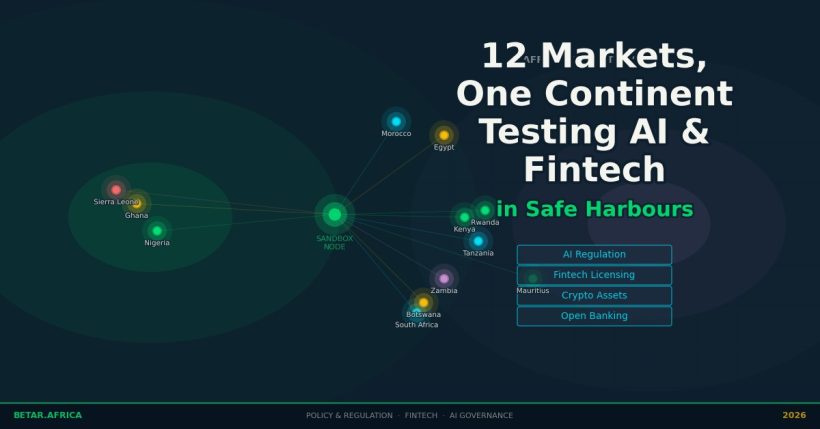
Africa has more active regulatory sandboxes for fintech and AI than any other emerging market region. Twenty-five programmes are running across fifteen countries. Ghana admitted eleven crypto firms into a VASP sandbox in March 2026. Nigeria is preparing a Regulatory Sandbox 2.0 covering AI and RegTech. Kenya’s AI Bill would create the continent’s first AI-specific supervised testing environment. South Africa’s Intergovernmental Fintech Working Group has run cohorts for five years. Rwanda has completed seven. Almost no one has mapped the whole picture.
That changes at GITEX Africa 2026. When the event opens in Marrakech on April 7, African governments will be pitching their regulatory environments to more than 400 venture capital firms managing an estimated $350 billion in assets under management. The sandbox question will be live in every deal room: which African markets offer a meaningful path from innovation test to operating licence — not just a regulatory safe harbour, but a graduation track?
The answer depends on which sandbox you are entering, and what you are building. BETAR’s continent-wide mapping, drawn from regulatory circulars, cohort records, and multilateral trackers, finds that Africa’s sandbox ecosystem is more developed than most investors realise — and more uneven than the headline numbers suggest.
The Map: Who Is Running What
The seven markets in the table below account for the continent’s most developed sandbox infrastructure. The remaining eight — Tanzania (BOT fintech sandbox), Uganda (Bank of Uganda sandbox), Mauritius (FSC Mauritius regulatory sandbox), Zambia (Bank of Zambia fintech sandbox), Zimbabwe (RBZ fintech sandbox), Namibia (NAMFISA sandbox), Sierra Leone (BSL framework), and Mozambique (BM sandbox elements) — run programmes at earlier stages of institutional development. The 25-programme total reflects multiple parallel sandboxes within single markets: Nigeria runs separate CBN and SEC sandboxes; Kenya runs CA and CMA sandboxes independently; South Africa coordinates across four regulatory bodies through the IFWG structure.
| Market | Regulator | Sandbox Type | Sectors | Cohort Duration | Status | Licensed Graduates |
|---|---|---|---|---|---|---|
| Ghana | SEC Ghana | VASP / Crypto | Virtual assets, crypto exchanges, tokenisation | 12 months (fast-track at 6) | Active — 11 firms admitted March 2026 | 0 (programme launched March 2026; 6-month fast-track path available) |
| Nigeria | CBN / SEC | Fintech + AI/RegTech (2.0) | Payments, lending, AI compliance, cross-border | 6–12 months | Sandbox 2.0 pilot cohort announced; SEC crypto sandbox paused pending VARA build | ~12 firms from CBN Sandbox 1.0 (2020–2024); Sandbox 2.0 not yet open |
| South Africa | FSCA / IFWG | Multi-regulator fintech | Payments, insurance, crypto, open banking | 6 months (extendable to 12) | Active — ongoing cohorts since 2020; production-ready stage required | 30+ firms across Cohorts 1–5 (2020–2025); several received full FSCA licensing |
| Kenya | CA / CMA | Fintech + AI (proposed) | Telecoms, capital markets, AI systems (AI Bill) | 12-month cycles | CA and CMA sandboxes active; AI Commissioner sandbox at Senate committee stage | ~15 firms (CA + CMA combined across active cycles); AI sandbox pending enactment |
| Rwanda | BNR / RDB | Fintech / payments | Payments, savings, insurance, digital assets | 6–12 months | Active — 7 cohorts completed; strong graduation record | ~35 firms graduated; among the highest full-licence conversion rates on the continent based on publicly available cohort data |
| Egypt | CBE | Fintech / e-KYC | Payments, e-KYC, open banking | 6 months (extendable to 12) | Active — 3 editions; 2019 launch | ~10 firms across 3 editions; payments and e-KYC players fully licensed |
| Morocco | AMMC / Bank Al-Maghrib | Fintech + AI (Digital X.0) | Capital markets, payments, AI applications | Flexible | Digital X.0 framework active with AI-specific lanes | Limited public data; framework relatively recent (2025–2026) |
Ghana: The Sharpest Graduation Track
Ghana’s March 2026 VASP sandbox launch is the most clearly structured graduation pathway currently active on the continent. The Securities and Exchange Commission admitted eleven firms — including asset tokenisation platforms Africoin, Blu Penguin, Vaulta, XChain, and Goldbod, alongside crypto exchanges Hyro Exchange, HanyPay, and WhiteBit — into a twelve-month testing programme explicitly designed to inform final licensing rules under the Virtual Asset Service Providers Act 2025.
The architecture is investor-legible: firms that reach market-readiness and regulatory compliance within the first six months can transition to full licensing ahead of schedule. The sandbox results directly feed the permanent framework. For a crypto or tokenisation startup weighing East versus West African market entry, that clarity is significant. Rwanda has a deeper fintech track record; Ghana now has the sharper virtual asset path.
Nigeria: The Architecture Under Construction
Nigeria’s sandbox story is complicated. The CBN’s Regulatory Sandbox 2.0, which will extend safe-harbour testing to AI and RegTech use cases for the first time, has been announced as part of the 2026 Fintech Roadmap but has not yet opened its first cohort. The SEC’s existing crypto sandbox has been paused while the regulatory architecture for the new Virtual Asset Regulatory Authority (VARA) is built out — firms already in the pipeline are holding, not graduating.
The longer-horizon development is the Nigeria Fintech Regulatory Commission Bill, which proposes a unified sandbox architecture across CBN, SEC, and NITDA jurisdictions. If passed, it would be the most ambitious cross-regulator sandbox design on the continent: single admission, multiple regulatory lanes, and a defined graduation protocol. The bill is at committee stage. The sandbox timeline follows the bill timeline.
For startups ready to test now, Nigeria’s openness is limited by this transition moment. For those planning a twelve-to-eighteen-month market entry, the architecture being built is the most sophisticated in Africa.
South Africa: The Oldest Track Record
South Africa’s Intergovernmental Fintech Working Group sandbox, running since 2020, is the continent’s most battle-tested environment. The IFWG’s multi-regulator structure — coordinating the FSCA, Reserve Bank, National Credit Regulator, and Financial Intelligence Centre — means a sandbox participant interacts with the full stack of relevant authorities simultaneously, not sequentially. For a startup seeking cross-sector regulatory certainty (say, an embedded lending product that touches both payments and credit regulation), this is materially valuable.
The admission requirement — production-ready, not prototype-stage — filters for serious operators rather than early-stage explorers. That is a feature for investors seeking de-risked bets, and a barrier for pre-revenue startups. South Africa’s sandbox is not a market entry programme. It is a regulatory validation track for companies that have already found product-market fit and need the regulatory framework to catch up.
Kenya, Rwanda, Egypt: The Maturing Middle
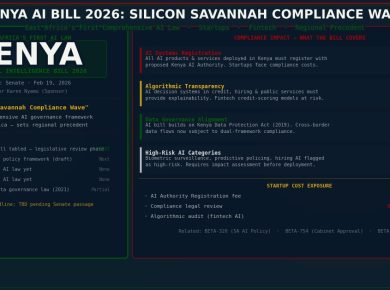
Kenya runs parallel sandboxes under the Communications Authority and Capital Markets Authority on twelve-month cycles. The Kenya AI Bill 2026 would add a third lane: an AI Commissioner-supervised sandbox for artificial intelligence systems — the first of its kind on the continent if enacted. The bill is at Senate committee stage, meaning the AI sandbox remains prospective, but the fintech lanes are operational now.
Rwanda has completed seven cohorts across the BNR and Rwanda Development Board sandbox. Its track record — combined with the Kigali Declaration on Fintech Licence Passporting signed with Kenya in March 2026 — positions Rwanda as the clearest corridor-market for startups wanting to test in one East African market and scale to another through a defined regulatory pathway.
Egypt’s CBE sandbox, the oldest on the continent at seven years, has run three editions with a focus on payments and e-KYC solutions. Its 2026 cohort has not been publicly announced, but the infrastructure is established and the CBE has been active in digital financial services licensing.
The Investor Question: Which Market Creates the Clearest Path?
For a VC entering the Marrakech convention centre at GITEX Africa on April 7, the sandbox question translates to a single investment thesis test: does safe-harbour testing in this market create a defensible licence — or just a twelve-month delay before the real regulatory work begins?
Ghana’s VASP sandbox scores highest on pathway clarity for virtual assets. Rwanda scores highest on track record and cross-border passport compatibility. South Africa scores highest on regulatory completeness for multi-sector products. Nigeria scores highest on market size and long-term architectural ambition — with the caveat that the most important piece of that architecture is currently in parliament, not in production.
The meta-finding is that Africa’s regulatory sandbox ecosystem has matured faster than the investor community has tracked it. Twenty-five programmes across fifteen countries represents a governance infrastructure that did not exist ten years ago and was largely invisible to international capital five years ago. The startups that understand which sandbox matches their product stage, market focus, and graduation timeline will have a structural advantage over those treating regulatory engagement as a later-stage problem.
It is not a later-stage problem. In several African markets, the sandbox is how the regulation gets written.
— Technology Desk, BETAR.africa

 UphivaBETAR