
Egypt’s 1GW Solar Race: How Africa’s Largest Renewable Projects Are Being Financed
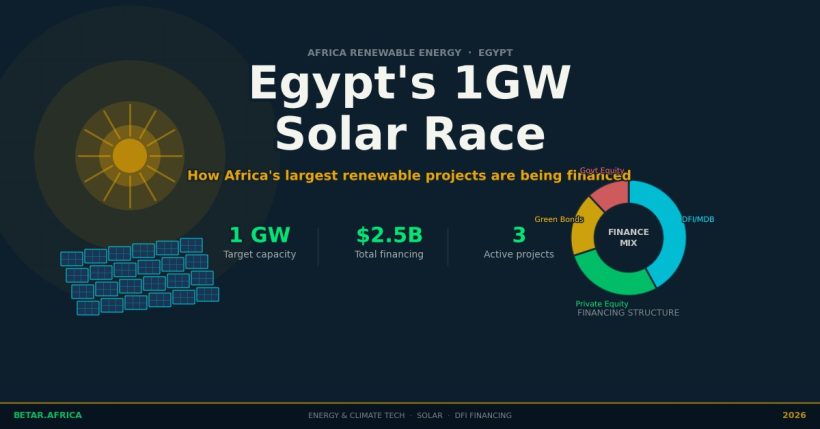
Two projects, both claiming the title of Africa’s largest single-site renewable energy facility, both reaching financial close within months of each other. The story is not the projects — it’s the financing architecture that made them possible.
Something unusual happened in Egypt in late 2025 and early 2026: two separate solar-plus-battery storage projects, each with a capacity above one gigawatt, reached financial close within months of each other. Both claim to be Africa’s largest single-site renewable energy facility. Both are backed by major multilateral development finance institutions. Both are targeting commercial operations before the end of 2026.
AMEA Power’s 1GW solar PV plant, paired with 600MWh of battery energy storage, broke ground in Aswan Governorate with a $570 million senior debt package led by the International Finance Corporation. Co-investors include the OPEC Fund for International Development and Europe Arab Bank. Japan’s Kyuden International Corporation is a strategic equity partner. Commercial operations are targeted for June 2026.
In parallel, the African Development Bank approved $184.1 million for the Obelisk project — a 1.1GW solar plant with 200MWh of BESS in Egypt’s Nagaa Hammadi region, developed by Norwegian renewable energy company Scatec ASA. Obelisk is designed to generate 2,772 GWh of clean electricity annually and contribute to Egypt’s national grid. The facility targets commercial operation in Q3 2026.
Together, these two projects represent more than $750 million in development finance institution lending, directed at solar infrastructure in a single country in under twelve months. That concentration of DFI capital in one national market — more than many African countries attract in a decade — is the real signal worth examining.
What the DFI Stack Actually Means
Neither the IFC’s $570 million nor the AfDB’s $184.1 million is a grant. Both are debt — structured, senior, and priced at concessional rates that commercial lenders would not offer to a project of this scale in an emerging market without the DFI imprimatur.
The mechanism the IFC deployed in the AMEA Power transaction is called crowding-in. The IFC’s senior debt tranche — the largest single-ticket renewable energy debt deal the IFC has concluded in Africa — serves as an anchor that makes the overall financing package bankable to private co-lenders. Without IFC participation, neither the OPEC Fund nor Europe Arab Bank would have underwritten the scale of debt this project requires. The DFI is not replacing commercial capital; it is manufacturing the conditions under which commercial capital is willing to participate.
The same logic applies at the project level. Egypt’s Renewable Energy Feed-in Tariff programme and the subsequent REIPPP-style competitive procurement rounds that followed created the revenue certainty — long-term power purchase agreements with the Egyptian Electricity Transmission Company — that allows a 25-year infrastructure debt instrument to be underwritten. Without the PPA framework, there is no DFI debt. Without the DFI debt, there is no private co-investment. The stack is not sequential; it is nested.
Scatec’s Obelisk deal with the AfDB follows a different structure. The AfDB’s sovereign guarantee backing — Egypt’s credit rating is sub-investment-grade by international standards — allows Scatec to finance a project at a debt-service cost that its projected tariff revenue can support. At market rates for emerging market infrastructure debt, the project would not close. The AfDB’s balance sheet transforms the risk profile.
Why Egypt, Not Somewhere Else
The question the concurrent financing of these two projects raises for the rest of Africa is a straightforward one: what does Egypt have that other African nations do not?
The answer is not solar irradiance — the Sahel belt through Mali, Niger, and Chad receives comparable or higher solar resource than Aswan. It is not proximity to European power markets, though Egypt’s Mediterranean position gives it optionality on interconnection that landlocked African states lack. The answer is institutional infrastructure: a functioning regulatory framework for independent power producers, a creditworthy off-taker in the form of the Egyptian Electricity Transmission Company, and a government that has consistently honoured power purchase agreements even through periods of macroeconomic strain.
This institutional premium is what DFI underwriting is designed to substitute for in markets where it does not exist. In Nigeria, the Siemens Presidential Power Initiative has faced consistent payment delays from distribution companies, deterring private investment. In Ghana, accumulated arrears to independent power producers — the so-called legacy debt — deterred new private investment for years. In Kenya, despite the greenest grid in sub-Saharan Africa, new generation projects have stalled because the grid cannot absorb additional capacity efficiently at current transmission investment levels.
Egypt has built — over two decades, through multiple governments and significant external shocks — the institutional environment that makes a $570 million DFI senior debt deal possible. That is not easily replicated. It can be developed, and DFIs are explicitly mandated to support its development. But the timeline is generational, not annual.
The Continental Picture
Africa has a renewable energy installation gap that is measured not in megawatts but in ambition. The continent needs an estimated 50GW of new clean energy capacity annually through 2030 to meet rising demand and its Paris Agreement commitments — and installed less than 5GW in 2024. Egypt’s concurrent 2.1GW project pipeline represents, in a single market, nearly half of the continent’s annual installation rate.
South Africa’s Renewable Energy Independent Power Producer Procurement Programme has demonstrated that competitive procurement rounds, backed by credible government offtake commitments, can mobilise private capital at scale. The 10,000MW it has procured across five bid windows represents the largest private renewable energy programme on the continent by transaction value. Morocco’s Noor solar complex — 580MW, DFI-financed, developed by MASEN with ACWA Power — established the template for large-scale CSP development in North Africa that the AMEA and Obelisk projects follow.
Kenya represents the cautionary example. Despite 75% of its generation capacity coming from renewables — geothermal, hydro, wind — Kenya’s grid is unaffordable: electricity tariffs are among the highest in East Africa, because transmission and distribution infrastructure has not kept pace with generation investment. Adding more generation without solving the transmission gap produces clean but expensive electricity. Kenya’s paradox is a reminder that DFI financing for generation assets alone does not solve energy access.
Egypt’s two projects avoid this trap by connecting to the existing high-voltage transmission backbone and feeding directly into the EETC grid rather than into isolated mini-grid or embedded generation configurations. The infrastructure is already there. The projects are adding capacity to a functioning system, not building a new one.
What Comes After Financial Close
Both projects are targeting commercial operation before the end of 2026. When they reach that milestone, Egypt will add more than 2GW of utility-scale solar capacity to a grid that currently runs on a mix of natural gas, hydro, and oil — reducing both emissions and the fuel-import bill that has contributed to Egypt’s persistent current account deficit.
The broader implication for African renewable energy financing is structural. The DFI playbook — IFC crowding-in at the anchor tranche, AfDB sovereign-backed project finance, long-term PPAs with state offtakers — works when national institutional frameworks are in place. The challenge for the next decade is not replicating the projects; it is building the regulatory environments in which the playbook can function across more of the continent than it does today.
Two gigawatts in Egypt is a milestone. A continent-wide pipeline would be a transformation.
This article is part of BETAR.africa’s Energy & Climate Tech coverage. Related: Africa’s Battery Storage Race | Morocco’s Gotion Gigafactory: Africa’s First EV Battery Manufacturer

 UphivaBETAR
 Joseph Busari