
MTN War Chest Q2 2026: 90 Days In, the Acquisition Pipeline Has Changed
By Business Reporter, BETAR.africa
Beat: Corporate Strategy / M&A / African Telecoms
Issue: BETA-1113
When MTN Group CEO Ralph Mupita confirmed a $2 billion acquisition war chest in February 2026, he framed it in terms that were specific and forward-looking: product depth for MoMo, fintech acquisitions in East Africa, and a structural shift toward financial services revenue. Ninety days on, BETAR revisits the four questions that matter most — and finds that the landscape has changed in ways that neither MTN nor its analysts fully anticipated.
1. Moniepoint: The Target That Moved First
Moniepoint was the most frequently cited acquisition candidate in the weeks following MTN’s war chest announcement. The Nigerian fintech’s 87-million-user operational template, its Series C capitalisation of $110 million (2023), and its product stack — merchant POS, SME banking, real-time settlements — mapped almost precisely onto MoMo’s product gap. Deal speculation was not idle: M&A advisory desks in Lagos and Johannesburg were openly discussing the match.
The speculation is now significantly less plausible. In late March 2026, Moniepoint confirmed the acquisition of a 78 percent controlling stake in Sumac Microfinance Bank Kenya — its first regulated East Africa entry, built on a CBK-licensed MFB rather than a payment service provider application. Moniepoint is not waiting for an acquirer. It is executing its own expansion playbook, using capital from a balance sheet that has been building since the 2023 Series C.
A company actively acquiring licensed entities in target markets is a structurally different negotiating counterparty than one evaluating strategic options. Moniepoint’s Sumac deal does not make an MTN acquisition impossible — but it raises the price, complicates the structure, and, most importantly, signals that Moniepoint’s founders believe they can build the East Africa foothold independently. That signal matters to any M&A process.
The most discussed potential target 90 days ago is now effectively off the near-term acquisition table.
2. East Africa Entry: Still the Priority, Harder to Execute
MTN’s stated East Africa gap — Kenya, Tanzania, Ethiopia, representing more than 200 million people in markets where MTN has no mobile subscriber base — remains the most consequential geographic absence on the group’s map. Mupita’s position has not changed: MTN will not seek to re-enter these markets through conventional telecoms licensing. The entry will be through acquisition of licensed fintech operators.
What has changed is the supply of available targets. The Moniepoint-Sumac deal is the clearest example, but it is part of a broader pattern: Kenya’s most capable fintech operators — those with regulatory permission sets that would give MTN immediate operating authority — are not sitting idle. Well-capitalised Nigerian fintechs, Gulf-backed growth equity, and a handful of Nairobi-native operators are all competing for the same short list of regulated acquisition candidates.
MTN’s East Africa pipeline includes several names across cross-border remittances, digital lending, and insurance, according to investment bankers in Nairobi with knowledge of regional M&A activity — but no deal has been announced. The absence is not evidence that the search has stalled; it is consistent with the diligence timelines on licenced-entity acquisitions, which typically run six to nine months from first engagement. A deal announced in Q3 or Q4 2026 would be consistent with serious engagement beginning in late 2025 or early 2026.
The risk is not that MTN cannot find a target. It is that the most strategic targets are being priced off the table by competing acquirers who move faster.
3. MoMo Expansion: The Capital Constraint Is Real
MoMo’s operating picture through Q1 2026 is steady but not accelerating. The 69.5 million monthly active users reported in the FY2025 results (December 2025) represent 10 percent year-on-year growth — respectable for a platform at this scale, but below the rate that would close the monetisation gap with M-Pesa without product intervention. Fintech revenue below 4 percent of MTN service revenue, against M-Pesa at approximately 40 percent of Safaricom’s, is the gap the war chest was designed to close.
What has changed is the capital available to close it.
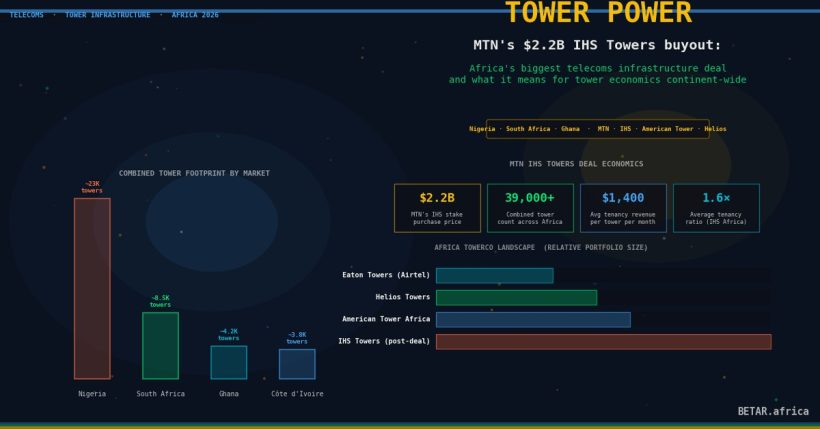
MTN’s announcement that it is acquiring the remaining equity in IHS Towers — at a total deal valuation of $2.2 billion, comprising $1.2 billion in equity and approximately $1 billion in assumed debt obligations — has redirected the majority of the war chest. The equity component alone ($1.2 billion) consumes roughly 60 percent of the $2 billion Mupita signalled in February. The remaining approximately $800 million is acquisition-capable but not transformationally so: it can fund one credible mid-market fintech deal, not the portfolio approach the original thesis implied.
The IHS acquisition is strategically defensible on its own terms. MTN is IHS’s largest customer by revenue; full ownership eliminates the infrastructure dependency that had become a structural risk as IHS navigated its own debt challenges. And the internal EBITDA accretion from converting external lease payments into internal cost transfers is material — analyst estimates at Nedbank CIB put it at ZAR 3 billion to ZAR 5 billion annually. But the market was told the war chest was for fintech. Most of it has gone to towers.
MTN’s free cash flow trajectory provides partial relief. Operating free cash flow grew 82 percent to R57 billion in FY2025, and Nedbank CIB projects this could reach R65 billion by FY2026 as capex intensity moderates from its current 17 percent of service revenue. That trajectory adds approximately $500 million annually in incremental acquisition capacity. The war chest is compressed, not destroyed — but the timeline has shifted. Fintech acquisitions that Mupita might have executed in 2026 may now happen in 2027.
4. Realistic Timeline: 2026 Is Possible, 2027 Is More Likely
MTN shareholders are not yet restless. The FY2025 results — a swing from a R4.1 billion pre-tax loss to R47.4 billion profit, a 45 percent dividend increase, 307 million subscribers — give Mupita significant goodwill. The war chest narrative was one signal among many, and the IHS deal carries its own credible rationale.
But the clock is running. Every quarter without a meaningful fintech acquisition is a quarter in which Airtel Money, Moniepoint, Wave, and others are extending their footprint in the markets MTN most wants to enter. Fintech valuations in East Africa remain compressed from their 2021 peaks — a favourable environment for an acquirer with capital — but that window will not stay open indefinitely. As growth equity and DFI capital continues to flow into the region (BETAR has tracked a material uptick in Q1 2026), the discount relative to peak valuations will narrow.
The realistic timeline for MTN’s first transformational fintech announcement: late 2026, most likely Q4, anchored in Kenya. The pipeline exists. The regulatory due diligence on licenced-entity acquisitions takes time. The post-IHS capital position can support one deal in the $300 million to $500 million range. That is not the MoMo-defining acquisition the February thesis implied — but it is the beginning of one.
If nothing is announced by end of FY2026, the war chest thesis does not fail. It becomes a 2027 story — funded by the free cash flow that IHS infrastructure ownership will, by then, be generating. That is a coherent sequence. It is also a different sequence than the one investors were sold in February.
BETAR Assessment
MTN enters Q2 2026 with its balance sheet intact, its subscriber base growing, and its Nigeria-anchored profit engine generating cash at a rate that preserves the M&A optionality the IHS deal has compressed. The war chest narrative has been complicated — by the IHS acquisition, by Moniepoint’s pre-emptive East Africa move, by a target landscape that is moving faster than MTN’s deal process.
None of this is fatal to the long-term thesis. MoMo’s product gap is real. East Africa is the right market. The capital, while reduced, is present. The question is whether MTN can close its first transformational deal before the window narrows further.
90 days in, the war chest is smaller, the targets are more expensive, and the urgency is higher. The next 90 days will determine whether the thesis is a strategy or a story.
Sources: MTN Group FY2025 Results (16 March 2026); MTN Group IHS Towers acquisition announcement; TechCabal (Moniepoint/Sumac MFB, 26 March 2026); Nedbank CIB analyst projections; BETAR reporting. Related BETAR coverage: BETA-1053 — MTN Spent Its War Chest on Towers. Now What? | BETA-965 — MTN FY2025 War Chest Strategy Validation | BETA-1072 — Moniepoint/Sumac MFB: The East Africa Credit Push Explained | BETA-366 — MTN’s $2B Acquisition War Chest Original Thesis
— BETAR.africa Business Desk


 UphivaBETAR


 Joseph Busari