
Showmax Is Shutting Down. Africa’s Most Ambitious Streaming Play Couldn’t Make the Numbers Work
By BETAR.africa Technology & Creative Economy Desks
Filed: 21 March 2026 | Publication target: Monday 24 March 2026
Word count: ~1,350
Canal+ confirmed on March 21 that Showmax will stop accepting new subscribers on March 31 and will shut down entirely on April 30, 2026. The announcement closes the most serious attempt ever made to build a homegrown African streaming champion — and it ends badly.
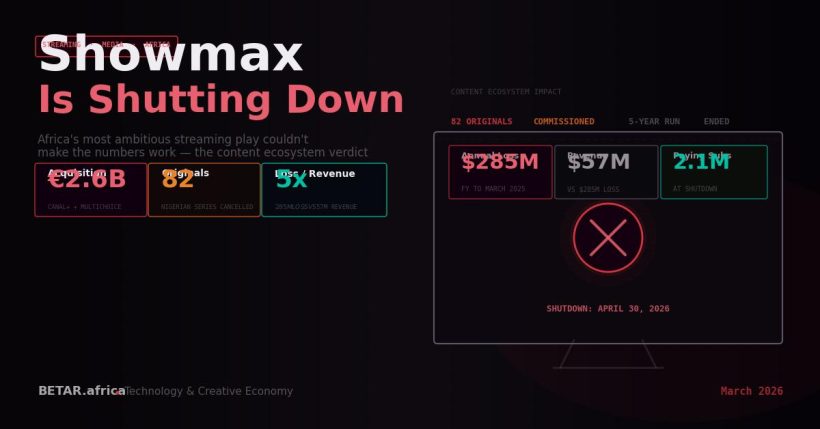
The platform that MultiChoice launched in 2015, relaunched as Showmax 2.0 in a €2.6 billion joint venture with Canal+ in early 2025, commissioned 82 Nigerian original series, built a paying base of 2.1 million subscribers, and proceeded to lose $285 million in the financial year to March 2025 alone. Revenue was $57 million. The loss was five times the revenue. Canal+ CEO Maxime Saada described the platform publicly as “not commercially successful” in January 2026. The shutdown, when it came, was not a surprise. It is an autopsy.
For the continent’s content industry, the implications run well beyond one platform closing. Showmax was Africa’s largest buyer of original content. Its exit removes a commissioning budget and a distribution channel simultaneously — at the worst possible moment for an industry that had structured around its existence.
The Collapse Sequence: How a €2.6B Acquisition Ends in a Write-Down
The numbers tell the story. Canal+ acquired MultiChoice — Showmax’s parent — for approximately €2 billion, completed in 2025. As part of its restructuring, Canal+ has now written down Showmax’s carrying value: a $160 million stake buyback from NBCUniversal (which held 30% of the Showmax 2.0 JV) and an $85 million impairment charge on the platform’s remaining assets. Total direct write-downs: $245 million. Total trading loss in FY2025 alone: $285 million. The accumulated cost of the Showmax project, from launch through closure, exceeds $300 million.
The structural problem was never the content or the audience engagement. Showmax’s subscriber base grew 44% year-on-year in FY2025 in its Rest-of-Africa markets — a real signal that demand existed. The problem was what those subscribers would pay. Africa’s SVOD ARPU sits at a structural ceiling of approximately $0.84 per month in volume markets, and $2.90 per month at the premium end of the South African market. Showmax’s blended ARPU — approximately $2.90 — required a subscriber base three to four times larger than it ever achieved just to break even on content costs that were designed for a much higher revenue-per-user model.
At 2.1 million peak subscribers, Showmax was generating roughly $6 million per month in revenue. Its content budget required multiples of that. The maths was irreparable without either massively increasing prices (which the market would not accept) or massively scaling the subscriber base (which would have required years of further losses). Canal+, targeting €400 million in annual savings by 2030, chose neither.
Content Ecosystem Fallout: 82 Originals, an Empty Commissioning Pipeline
The most immediate casualty of the Showmax closure is not the subscriber base — it is the content pipeline it leaves behind.
Showmax had commissioned 82 Nigerian original series since its relaunch, making it the most active buyer of Nollywood content on the continent outside YouTube. South African productions — dramas, reality formats, documentaries — were deep in its commissioning pipeline. Those projects are now cancelled. Production companies that had green-lit development budgets against Showmax advances face writedowns of their own. The talent — writers, directors, crew — attached to those productions face a simultaneous reduction in the most significant commissioning client their industry had.
The intellectual property question is unresolved and consequential. The originals Showmax commissioned are understood to be held by Canal+, which now controls MultiChoice and all its legacy IP. Whether Canal+ will license that content to other African platforms, sit on it, or incorporate it into its own DStv Stream repositioning is a question the industry is waiting to answer. For the independent production companies that co-produced Showmax originals, the IP position matters — if Canal+ owns the originals without sub-licensing them back into circulation, years of creative work disappear from the market.
The ripple effect extends to the international co-production ecosystem. Showmax had positioned itself as a gateway for international content partners seeking African distribution. Those deals dissolve. International production companies that had structured African distribution strategies around Showmax as an anchor platform must now reroute — primarily to Netflix, which has the continent’s only comparable reach, or abandon African theatrical windows entirely.
The Competition Commission Is Watching
The South Africa Competition Commission has confirmed it is investigating the Showmax shutdown. The probe centres on two questions: whether Showmax is complying with the conditions attached to the Canal+/MultiChoice merger approval, and what subscriber remedies are required from a platform that is terminating service on paying customers.
When the Competition Commission approved Canal+’s acquisition of MultiChoice, the approval carried conditions — standard practice in South African competition law for mergers involving dominant market players. Those conditions included, among other requirements, commitments around local content investment and service continuity. The Commission’s current investigation is probing whether the Showmax closure breaches those merger commitments, and if so, what remediation Canal+ is obligated to provide.
For subscribers, the immediate practical question is what they receive when the platform closes. Showmax had 2.1 million subscribers at its peak; the number still paying as of March 21 is unconfirmed. Canal+ has indicated that subscribers will be offered migration paths — DStv Stream (MultiChoice’s repositioned streaming product) or Canal+ direct subscriptions — but the terms of those migrations, including price equivalence and whether existing Showmax subscribers receive favourable rates, have not been formally confirmed as of publication.
The Commission has the power to require specific subscriber remedies, including refunds, price matching on successor products, or penalty payments if merger conditions are found to have been breached. Proceedings are expected to move quickly given the April 30 closure deadline.
Who Wins: Netflix, by Default and by Architecture
Netflix is the structural beneficiary of the Showmax collapse, but it is winning by design as much as by default.
Netflix has approximately 6.9 million African subscribers — direct and via distribution partnerships — at an ARPU of roughly $5.70. From July 2025, Netflix has been bundled into Canal+ subscriptions across 24 French-speaking sub-Saharan African countries, turning Canal+’s 8.2 million pay-TV subscribers into potential Netflix reach without Netflix bearing acquisition costs. The Canal+/Netflix partnership, announced before the Showmax shutdown, is now revealed as the strategic masterstroke that made Showmax’s competitive position definitively untenable: Canal+ locked up its own subscriber base for Netflix, then eliminated the local platform it had promised to build.
The other winner is DStv Stream — MultiChoice’s direct-to-consumer streaming product, which now becomes the default successor for subscribers who want to stay in the MultiChoice content ecosystem. DStv Stream carries live sport (SuperSport), local channels, and the Canal+ channel bundle. It is not a Showmax replacement as a commissioner of African originals, but it is the migration path most subscribers will be directed toward.
For lean, diaspora-focused platforms like Kava — the Nollywood streaming service launched in the UK in 2025 by Inkblot Studios and Filmhouse Group — the Showmax closure creates a marginal opportunity. Kava operates on a content-ownership model that keeps costs structurally lower than Showmax ever achieved. Its addressable market is diaspora subscribers in the UK, US, and Canada, where $5.99 per month is a sustainable price point. Showmax’s closure does not meaningfully change Kava’s growth trajectory, but it does remove the most credible argument against the diaspora-first model: that a continent-scale African platform could eventually make the economics work.
It could not.
The Verdict
The Showmax closure is a structural verdict on African streaming economics, not a management failure. The platform was well-run relative to its constraints. Its content was well-received. Its subscriber growth was real. What it could not solve — what no platform has solved — is the gap between the ARPU that African consumers can pay and the content investment required to compete with global platforms that amortise costs across hundreds of millions of subscribers worldwide.
That gap is not closing. Africa’s SVOD market is projected to grow from $3.04 billion in 2025 to $4.58 billion by 2030 — a healthy 8.5% CAGR. But that growth will accrue to platforms with global scale (Netflix), distribution leverage (Canal+/Netflix bundling), or content ownership models that keep per-subscriber costs structurally lower than the Showmax model ever permitted.
For the content industry, the question is how long it takes for a replacement commissioning budget to emerge. Netflix commissions African originals but at a volume and pace that cannot absorb the pipeline Showmax had built. Canal+ has not indicated what, if anything, its restructured Africa strategy allocates to original African content production. The €400 million savings target points away from commissioning budgets, not toward them.
Africa’s most ambitious streaming play had a thesis that was correct — a continent of 1.4 billion people with enormous cultural output should be able to sustain a premium video platform — and an economic model that the continent’s purchasing power would not support at the required scale. Those two facts were always in conflict. April 30 is when the conflict ends.
Sources: Canal+ Group investor communications and Showmax closure announcement (March 2026); MultiChoice Group FY2025 Annual Results (JSE); South Africa Competition Commission public statements; Ampere Analysis Africa SVOD ARPU data; Mordor Intelligence Africa SVOD Market Report 2025–2030; Digital TV Research; Techpoint Africa Digest 1304 (March 21, 2026); Variety, Bloomberg, Deadline (Canal+/Showmax shutdown coverage, March 2026). Cross-references: BETAR.africa BETA-355 (Pan-African Streaming Wars), BETA-301 (Nollywood streaming economy), BETA-864 (Competition Commission probe lead).
 UphivaBETAR

 Joseph Busari