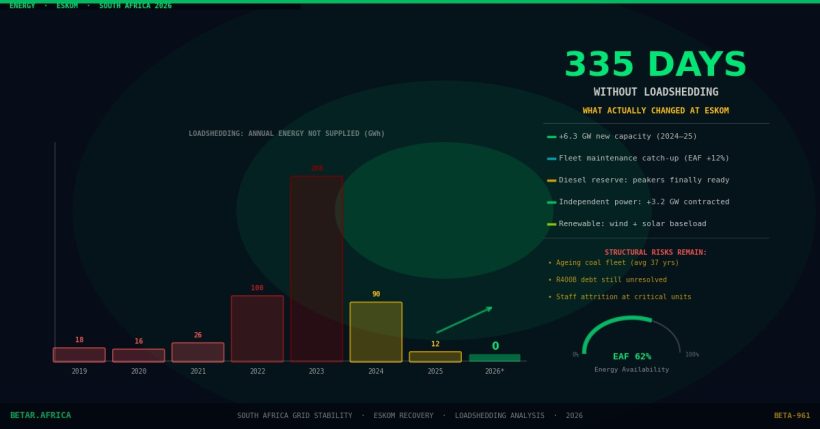

South Africa Has Gone 335 Days Without Loadshedding. Here Is What Actually Changed at Eskom — and What Hasn’t
The rolling blackouts that defined South African life for a decade — and cost the economy an estimated R1 billion per day at their peak — have been absent for more than 335 consecutive days. Whether that represents a structural fix or a temporary reprieve depends on questions the country has not yet answered.
In early 2023, Eskom imposed Stage 6 loadshedding — up to 12 hours of daily blackouts — across South Africa for extended periods. At its worst, the national grid was shedding more than 6,000 megawatts of demand daily. The South African Reserve Bank estimated the economic cost at R1 billion per day. Manufacturing orders were restructured around power availability. Businesses installed generators as standard infrastructure. The country’s investment case rested on whether the grid could be fixed.
The answer, as of March 2026, appears to be yes — at least for now. South Africa has recorded more than 335 consecutive days without loadshedding. The milestone is the longest uninterrupted period of grid stability the country has achieved since scheduled rolling blackouts became a national emergency in 2007. It is also the most consequential energy story on the African continent this year, both for what it signals about South Africa’s investment environment and for what it demonstrates — or fails to demonstrate — about the replicability of the turnaround across the continent.
What Actually Changed
The stabilisation has four structural drivers, and understanding them matters because not all carry equal weight or durability.
The first is the Renewable Energy Independent Power Producer Procurement Programme. REIPPPP, South Africa’s competitive tender framework for private renewable energy, had stalled under the previous Eskom leadership and was revived aggressively from 2022 onwards. Between 2023 and 2025, more than 6,000 megawatts of new contracted renewable capacity reached commercial operation — wind and solar projects across the Northern Cape, Western Cape, and Eastern Cape that feed directly into the national grid. This is not marginal capacity; it is a structural addition to the generation mix that reduces Eskom’s dependence on its coal fleet.
The second driver is embedded generation — rooftop and commercial-and-industrial solar installations that do not appear in Eskom’s generation statistics but reduce the demand Eskom must meet. South Africa now has more than 7 gigawatts of installed embedded solar capacity, the result of a surge in residential and commercial installations during the 2022–2023 loadshedding crisis. At peak solar production hours, embedded generation reduces Eskom’s net demand by an estimated 1,500 to 2,000 megawatts. That is the equivalent of one large coal unit that Eskom does not need to dispatch.
The third driver is operational improvement within Eskom itself. Dan Marokane, Eskom’s Group CEO, confirmed in an operational briefing earlier this year that the utility’s Energy Availability Factor — the share of its total installed capacity that is available for dispatch — had reached 62 per cent in early 2026, up from a low of below 55 per cent during the worst of the loadshedding crisis. The improvement reflects accelerated maintenance programmes, the resolution of some legacy unit failures, and the procurement of emergency diesel-fired open-cycle gas turbines for peak periods. Battery energy storage from the BESIPPPP programme has added grid balancing capacity that reduces reliance on diesel dispatch.
The fourth driver is less positive: demand suppression. A decade of loadshedding and the associated economic damage has structurally reduced electricity consumption among South Africa’s industrial users. Mines, smelters, and large manufacturers have cut production, closed operations, or installed embedded generation — removing demand that the grid once had to meet. Some of what looks like grid stability is not expanded supply so much as contracted demand.
What Has Not Changed: Three Structural Risks
The 335-day milestone does not resolve South Africa’s structural energy challenges. Three are material for investors and businesses assessing the durability of grid stability.
The first is the coal fleet retirement timeline. More than 12 Eskom coal units are scheduled for retirement by 2030, representing a significant volume of dispatchable baseload capacity. Renewable energy — weather-dependent by definition — cannot directly replace baseload coal without paired storage at a scale South Africa has not yet contracted. The Integrated Resource Plan update, currently in its most recent revision cycle, must reconcile these retirement timelines with the BESIPPPP battery storage pipeline and the pace of new gas-to-power procurement. The numbers do not currently add up without additional contracting.
The second structural risk is the transmission bottleneck. The National Energy Regulator of South Africa has identified more than 4,300 megawatts of renewable energy projects currently approved under REIPPPP but unable to connect to the grid due to transmission infrastructure constraints. Eskom’s transmission division — separated from generation under the Electricity Regulation Amendment Act — is managing a multi-year capital programme to expand grid capacity, but the backlog creates a ceiling on how quickly South Africa can add renewable generation. Projects that are contracted and financed are sitting idle, waiting for grid access.
The third is the financing gap created by the United States’ withdrawal from the Just Energy Transition Partnership. The JETP — a multilateral financing framework that committed approximately R600 billion to support South Africa’s coal-to-clean transition — was premised on significant US contributions through the MDB structure. US withdrawal has reopened a financing gap that the European and UK partners cannot cover alone. South Africa’s coal transition is slower and more expensive without JETP functioning at the scale originally committed.
Eskom’s debt position — R400 billion or more in government-guaranteed obligations — remains a structural constraint on the utility’s capital spending capacity. Government’s debt relief arrangement, which transferred a portion of Eskom’s debt to the national balance sheet, reduced but did not eliminate the constraint. Eskom’s ability to fund the transmission expansion and the new build pipeline depends on cash flows that are in turn dependent on Nersa’s tariff determinations — the next of which will be material for the utility’s financial stability.
What This Means for Investors and the Continent
For businesses operating in South Africa, 335 days of grid stability has produced measurable improvements. Manufacturing sector output correlates with power availability; the South African Chamber of Commerce and Industry’s business confidence data through early 2026 reflects improved sentiment among manufacturers who have reduced generator fuel costs and resumed production schedules previously constrained by loadshedding. The commercial property sector, which spent billions on backup power infrastructure during the crisis, is now assessing whether that infrastructure is a stranded cost or a strategic asset.
For continental investors, South Africa’s experience is a data point for a broader question: can grid crises be resolved through a combination of policy reform, private sector embedded generation, and accelerated renewable procurement? The REIPPPP model — competitive tender, private capital, long-term power purchase agreements with government backstop — has been studied and adapted across East and West Africa. The South African evidence through 2025 suggests the model can deliver at scale, given a functioning procurement pipeline and a credible regulatory framework.
The durability question — structural improvement versus suppressed demand plus emergency diesel — will be answered over the next 18 to 24 months as coal unit retirements accelerate and the transmission bottleneck either eases or compounds. For now, 335 days without loadshedding is a milestone that South Africa earned through specific, traceable policy and operational decisions. It is not permanent by default. Keeping it requires resolving the structural risks that the milestone does not eliminate.