
Southern Africa Hydropower Crisis: When Climate Change Kills the Continent’s Baseload
Zambia and Zimbabwe are in the grip of one of the worst electricity crises in a generation. The cause is the same climate change that Africa’s energy transition finance is supposed to address — but most of that capital flows to new solar installations, not to protecting the clean baseload capacity the continent already has.
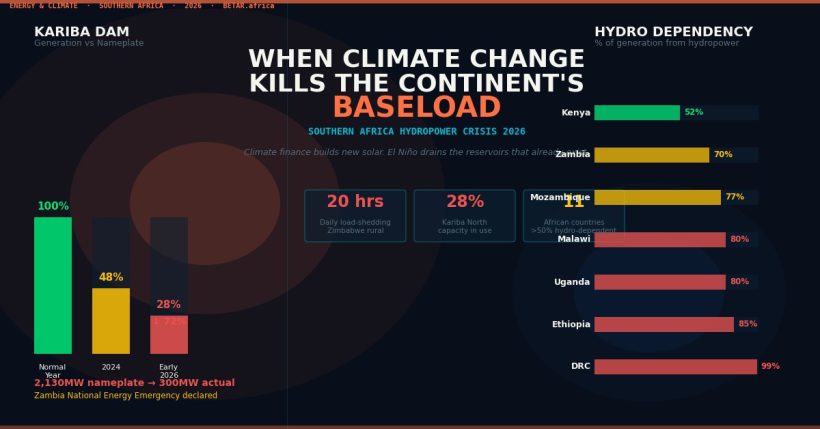
Zambia has declared a national energy emergency. Zimbabwe’s state utility, ZESA Holdings, is implementing 18 to 20 hours of daily load-shedding in rural areas and up to 16 hours in urban centres. Copper production at Zambia’s mines — the source of roughly 70% of the country’s export earnings — has been curtailed as industrial loads compete with households for constrained grid capacity.
The cause is Kariba Dam.
The Kariba reservoir, which sits on the Zambezi River straddling the border of Zambia and Zimbabwe, is Africa’s largest man-made lake by volume and one of the continent’s most critical pieces of energy infrastructure. Kariba Dam feeds two power stations: Kariba North Bank Power Station in Zambia, with a nameplate capacity of 1,080 megawatts, and Kariba South Bank Power Station in Zimbabwe, with 1,050 megawatts. Together, they account for more than 60% of electricity generation in both countries. As of early 2026, following successive El Niño-driven droughts in the Zambezi River catchment, actual generation from Kariba North has fallen to approximately 300 megawatts — less than 28% of nameplate capacity.
The Defining Contradiction
This crisis is the defining contradiction in Africa’s energy transition narrative.
International climate finance — the World Bank, the African Development Bank, the European Investment Bank, bilateral development agencies — has committed hundreds of billions of dollars to Africa’s clean energy transition. Solar, wind, and geothermal projects have attracted unprecedented capital flows. Africa is celebrated globally for its renewable energy potential, for its solar irradiance, for its wind corridors, for its geothermal fields.
But none of that capital is protecting the clean energy the continent already has. Hydropower accounts for 16% of Africa’s installed electricity capacity and generates a significantly higher share of actual electricity produced, because hydro capacity factors are typically 40–60% while African thermal plants often run at lower rates due to fuel supply constraints. Kariba, Cahora Bassa on the Mozambique-Zimbabwe border, the Aswan High Dam in Egypt, the Grand Renaissance Dam in Ethiopia, the Akosombo Dam in Ghana — these installations represent billions of dollars of clean baseload capacity that took decades to build and are, in many cases, vulnerable to the same climate dynamics that Africa’s transition finance is supposed to address.
The climate finance system as currently structured is paying to build new solar panels while the droughts driven by climate change drain the reservoirs that already exist.
The Hydro Dependency Problem Across the Continent
Zambia and Zimbabwe are extreme cases, but they are not outliers. Across sub-Saharan Africa, eleven countries derive more than 50% of their electricity from hydropower. Ethiopia (85%), Uganda (80%), Mozambique (77%), Democratic Republic of Congo (99%), Malawi (80%), and Zambia itself (>70% in normal years) are all heavily hydro-dependent economies where prolonged drought translates directly into national electricity crises.
The Southern African Power Pool (SAPP) — the interconnection framework that allows member countries to trade electricity across the region — provides some buffer in normal years: a country with surplus can export to one with deficit. But when all members of the pool are simultaneously drought-affected — as occurred in 2019 and is occurring again in 2024-2026 — the interconnection system cannot substitute for the missing generation. Regional power trade collapses because everyone is a buyer and no one is a seller.
The SAPP situation in early 2026 illustrates this precisely: Zambia is in energy emergency. Zimbabwe is load-shedding. South Africa’s Eskom, which normally acts as the pool’s marginal balancing generator, is itself managing constrained coal capacity. Mozambique’s Cahora Bassa — the other major regional hydro resource — is also operating below capacity due to low Zambezi River flows. The interconnection system, designed for normal hydrological variance, is stress-tested at exactly the moment when climate disruption makes normal assumptions obsolete.
Emergency Solar: The Gap Between Announcement and Connection
The response from Zambia’s government and international development partners has been predictable: emergency solar deployment. The AfDB, World Bank, and bilateral agencies have committed financing for rapid solar installations as a substitute for constrained hydro generation.
The problem is time. A solar installation — even a fast-tracked emergency deployment — requires site identification, environmental clearance, equipment procurement and shipping (typically from China, with 8–16 week lead times), civil works, electrical installation, grid-connection agreement with the utility, and commissioning. The fastest credible timeline from financial commitment to operational power delivery is 12 months for small-scale installations. Utility-scale solar takes 18–24 months under emergency conditions. The Zambian families and Zimbabwean factories currently operating on 4 hours of grid power per day are not going to be rescued by solar panels that will be installed 18 months from now.
This timeline gap is not a failure of will or finance. It is a physical constraint of energy infrastructure development. It means that the correct response to climate-driven hydro disruption is not only emergency solar deployment after the crisis begins — it is investment in energy system resilience before the crisis arrives.
What Resilience Finance Would Actually Look Like
Climate adaptation in energy systems requires a different financing logic than transition finance. Building new renewable energy is a productive investment with returns — electricity sold, emissions avoided, industrial development enabled. Financing energy system resilience is harder to monetise: a battery system that smooths hydro output fluctuations does not generate incremental electricity; it just keeps existing generation reliable. A water catchment management programme that maintains Kariba reservoir levels does not produce any energy at all; it just preserves capacity already installed.
This distinction matters because international climate finance, as currently structured, follows returns. The mechanisms that have channelled capital to African solar and wind — carbon credits, power purchase agreements, equity investment in independent power producers — are designed for new production, not for asset maintenance or system resilience. There is no carbon credit mechanism for preserving hydropower reservoir catchments. There is no PPA structure for battery storage that extends the productive life of a drought-stressed hydro asset.
The World Bank’s Kariba Rehabilitation Project — a multi-year engineering programme to reinforce and rehabilitate the Kariba Dam wall, which is under stress from decades of use and seismic activity — offers a partial model. But rehabilitation of a physical dam structure is different from the systemic resilience investment that Africa’s hydro-dependent grid economies actually need: diversification into non-hydro renewables built specifically to balance hydro variability, transmission investment to move power from non-drought-affected regions, and storage capacity that can capture hydro surplus in wet years for dispatch in dry ones.
The EIB’s Mission 300 commitment and the World Bank’s DARES programme are moving capital into Africa’s energy access gap. But neither programme is primarily structured around the hydro resilience challenge that Zambia and Zimbabwe are experiencing in real time.
The COP30 Framing
COP30 will be held in Belém, Brazil in November 2026. The host country — Brazil, itself heavily hydro-dependent — has structured the summit around loss and damage, adaptation finance, and the implementation of the Global Stocktake findings. African negotiators arriving in Belém will do so with the Southern Africa hydropower crisis as a live exhibit of precisely what loss and damage looks like in practice: not a future risk but a present emergency, affecting 30 million people across two countries, caused by climate change that Africa did not cause.
The political irony is acute. Africa produces less than 4% of global greenhouse gas emissions. Its energy sector is already predominantly clean — hydro, geothermal, and solar account for a majority of new generation additions. The continent’s most vulnerable communities are now rationing electricity not because they burned too much fossil fuel, but because the water that should be filling their reservoirs has been displaced by weather patterns driven by emissions they did not produce.
The transition finance community’s answer to this has been to accelerate solar deployment. That is necessary but not sufficient. Africa’s energy transition will require building new capacity and protecting the clean capacity already built — and the climate finance architecture does not yet have an adequate instrument for the latter.


 UphivaBETAR
 Joseph Busari