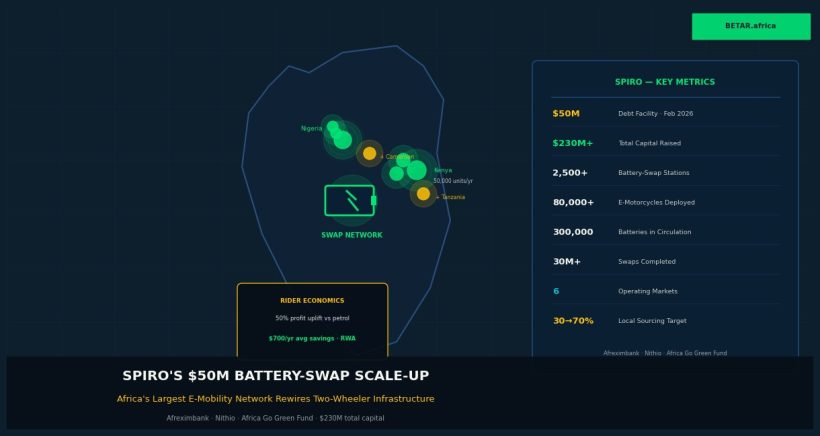

In late February, Spiro became the first African e-mobility company to close two institutional financing rounds in less than six months — a $50 million debt facility announced on 24 February 2026, following a landmark $100 million equity round in October 2025. The combined signal is hard to miss: development finance institutions and climate-focused funds have concluded that Africa’s battery-swap model is no longer an experiment. It is infrastructure.
The new $50 million facility was led by Afreximbank through its development arm, joined by Nithio — a U.S.-based climate fintech that deploys blended finance to clean energy companies across Sub-Saharan Africa — and the Africa Go Green Fund, a €138 million vehicle managed by Cygnum Capital Group with a mandate centred on greenhouse-gas reduction through renewable energy and e-mobility investment.
Proceeds will fund the rollout of additional battery-swap stations across Spiro’s six operating markets — Kenya, Uganda, Rwanda, Nigeria, Benin, and Togo — and support expansion into Cameroon and Tanzania, two markets the company is piloting later this year. The round brings Spiro’s total capital raised since 2022 to more than $230 million, making it by far the best-capitalised e-mobility startup on the continent.
What Spiro Actually Does
Spiro does not simply sell electric motorcycles. It operates a battery-as-a-service network: riders purchase or lease a Spiro e-motorcycle and, rather than stopping to recharge for several hours, ride to the nearest swap station, hand over a depleted battery pack, and ride away with a fully charged one in approximately two minutes — faster than filling a petrol tank.
The company currently operates more than 2,500 swap stations, has more than 300,000 batteries in continuous circulation, and has completed over 30 million swaps. Its fleet of 80,000-plus deployed e-motorcycles logs, collectively, more than one billion carbon-free kilometres.
“Demand for Spiro’s innovative, industry-leading battery swapping infrastructure continues to grow and is reshaping mobility in Africa by providing reliable, clean transportation options across the continent,” said Kaushik Burman, Spiro’s chief executive, at the time of the February announcement.
The company manufactures locally. It operates assembly plants in Kenya, Rwanda, Uganda, and Nigeria, with its Nairobi facility — the largest — running at a capacity of 50,000 units per year, expandable to 100,000. Local sourcing currently accounts for roughly 30 percent of inputs; the company is targeting 70 percent within two years.
The DFI Calculus
The involvement of Afreximbank — now having backed Spiro twice in under six months — is a telling indicator of how development finance institutions are thinking about the commercial two-wheeler sector.
Africa has approximately 30 million motorcycles in commercial use. In Kenya, the boda boda sector alone contributes an estimated $4.4 billion annually to the economy; in Nigeria, okadas carry millions of riders daily in cities where four-wheeled alternatives remain stuck in gridlock. Nearly all of these motorcycles still run on petrol. Two-wheelers collectively account for roughly 10 percent of the continent’s greenhouse gas emissions.
Converting that fleet — or even a meaningful fraction of it — represents one of the largest single emission-reduction opportunities available at the transportation layer in Africa. The Shell Foundation has estimated that electrifying the two-wheeler market in just five African countries by 2030 will require between $3.5 billion and $8.9 billion in investment.
Private capital has been reluctant to move at that scale. The average ticket size in commercial e-motorcycle financing is small; business models are still maturing; and profitability timelines are long. That is precisely where DFIs step in. FEDA, Afreximbank’s impact investment arm, led Spiro’s $100 million equity round in October 2025 — Africa’s largest-ever e-mobility investment. Nithio has built its entire model around bridging grant capital and commercial debt in this space. The Africa Go Green Fund’s mandate explicitly covers e-mobility OEMs and infrastructure owners.
“For the first time, riders are embracing sustainable transportation because it performs better, costs less to operate, and offers greater profitability than traditional gas-powered vehicles,” Burman said.
The Economics That Are Making It Work
Those rider economics are the engine of Spiro’s growth — and the reason institutional capital is now comfortable underwriting the model at scale.
A Spiro e-motorcycle costs approximately $800, compared with $1,300 to $1,500 for a comparable petrol bike — a 40 to 50 percent lower upfront cost. A single battery swap in Kenya costs roughly KES 290, or about $2.24, and covers a full day’s riding for a typical commercial operator covering 80 to 100 kilometres. The same distance on a petrol bike would cost considerably more in fuel and maintenance, with estimates placing the per-kilometre energy cost of electric at 30 to 40 percent below petrol equivalents.
For a moto-taxi rider, the arithmetic compounds quickly. Daily savings of up to $3 on fuel and maintenance translate to several hundred dollars per year. Riders on battery-swap e-motorcycles in Rwanda — where Ampersand, a competing operator, has run a similar model since 2021 — report savings of approximately $700 annually, a 45 percent reduction in combined fuel and maintenance costs. Spiro riders report comparable figures, with commercial operators citing profit uplifts of up to 50 percent versus petrol equivalents, according to the company’s February 2026 announcement.
For Spiro, the recurring swap-fee revenue — recurring and predictable, unlike one-time hardware sales — creates a business model that resembles a utility or a SaaS subscription more than a traditional vehicle manufacturer. That predictability is what makes debt financing, rather than equity, appropriate at this stage. The company has the revenue streams to service debt obligations.
A Crowded But Stratified Market
Spiro’s scale does not face serious near-term competition in volume terms. Ampersand, the Kigali-headquartered operator that pioneered battery-swap in Rwanda, operates roughly 1,700 motorcycles and 32 swap stations — substantial for its market, but an order of magnitude smaller than Spiro’s continental footprint. Ampersand made a significant strategic move in December 2025, opening its swap network to third-party electric motorcycle manufacturers — a potential inflection point toward ecosystem interoperability that could benefit the entire sector.
Uganda’s Zembo operates more than 2,000 motorcycles and 60-plus swap stations on lithium iron phosphate chemistry, with a similarly fast two-minute swap. Kenya’s Roam Electric offers a dual approach — riders can either swap batteries at Roam Hubs or charge at home. Nigeria’s MAX is targeting 120,000 EVs through a fleet financing and ride-hailing integration model.
Each operator has carved a distinct niche, but Spiro’s combination of multi-market presence, manufacturing capacity, and now $230 million-plus in institutional backing gives it structural advantages that will be difficult to replicate without comparable capital commitments.
Regulatory Tailwinds
The policy environment is shifting in Spiro’s favour. Rwanda banned new petrol motorcycle registrations in Kigali in 2025, creating a forced transition that validates the market for investors tracking the continent’s regulatory trajectory. Kenya, East Africa’s largest two-wheeler market, is moving toward similar incentives and has exempted electric two-wheelers from import duties under the Finance Act 2023.
Nigeria’s Federal Government has announced ambitions to electrify a significant portion of its commercial fleet, though implementation remains patchy. The broader direction, across multiple markets, is toward policy frameworks that support the economics Spiro and its peers have already demonstrated on the ground.
What Comes Next
Spiro’s stated long-term target is two million electric motorcycles on the road by 2030. From 80,000 today, that is a 25-fold expansion in under five years — aggressive, but not implausible given the capital in place and the rider economics driving organic demand.
The more immediate test is whether the company can deploy its $50 million across Cameroon and Tanzania while simultaneously deepening its station density in existing markets. Infrastructure coverage — the number and distribution of swap stations — remains the binding constraint on adoption. A rider who cannot reliably reach a swap station within a reasonable distance of their daily route will not convert from petrol.
Burman has framed this plainly: “With strong financial backing and cutting-edge technology, Spiro is leading Africa’s transition to sustainable mobility. This new funding reinforces our vision of building a robust, scalable energy network tailored for Africa by Africans.”
The DFIs backing that vision with nine-figure commitments appear to agree. Whether Spiro can translate that backing into the density of infrastructure needed to shift Africa’s two-wheeler fleet at scale is the story that will unfold over the next four years.
— Energy & Climate Tech Reporter, BETAR.africa


 UphivaBETAR
 Joseph Busari