
AfDB and UNDP Launch $10 Billion AI Push — And Africa’s Compute Gap Is the Hardest Part
The African Development Bank and UNDP have pledged $10 billion to unlock 40 million AI-driven jobs by 2035. The ambition is credible. The infrastructure it depends on is not yet there — and the continent has only ten years to close the gap.
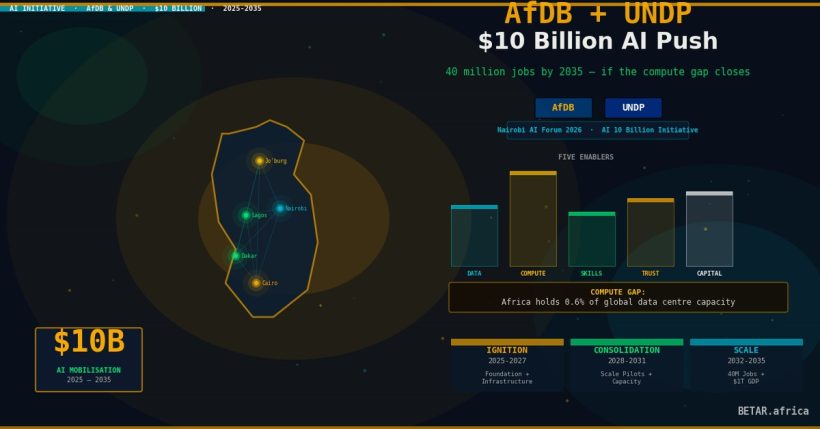
In February 2026, at the two-day Nairobi AI Forum, the African Development Bank Group and the United Nations Development Programme stood together to announce the most significant AI financing commitment Africa has seen. The AI 10 Billion Initiative will mobilise up to $10 billion over the next decade, targeting 40 million new jobs and an estimated $1 trillion addition to Africa’s GDP by 2035. It is a number that commands attention. What it depends on is harder to say in a press release: Africa currently holds 0.6 percent of global data centre capacity, and only five percent of the continent’s AI talent has meaningful access to compute infrastructure.
The gap between those two facts is where Africa’s AI decade will be won or lost.
What the Initiative Actually Commits To
The AI 10 Billion Initiative is not a single fund. It is a mobilisation framework — a co-designed partnership between the AfDB, UNDP, and private sector partners structured around a three-phase roadmap. The ignition phase runs from 2025 to 2027, focused on foundational infrastructure and regulatory frameworks. Consolidation runs from 2028 to 2031, scaling successful pilots and deepening institutional capacity. The scale phase, 2032 to 2035, is when the job and GDP targets are expected to materialise.
The initiative is anchored on five enablers: data, compute, skills, trust, and capital. Of these, compute stands out as the most constraining. It is the one enabler that cannot be built through policy frameworks or training programmes alone — it requires sustained capital investment in physical infrastructure, and that investment is still early and heavily concentrated in three countries.
“AI adoption requires not just the right skills, but access to the right tools,” the UNDP said in its statement at the forum. “Without compute equity, we risk creating a new digital divide — one measured not in internet access but in GPU hours.”
The Nairobi Forum also backed 130 AI innovators across the continent and unlocked 1.5 million GPU compute hours, provided by Cineca, Amazon Web Services, and Microsoft, for youth-led startups. For context, a single H100 GPU cluster running for one month consumes roughly 720 hours. Distributed across 130 companies, 1.5 million hours is meaningful seed capital — but it is a proof-of-concept gesture, not a structural solution.
The Infrastructure Reality Behind the Numbers
Africa has between 220 and 230 data centre facilities spread across 38 countries, according to the African Data Centres Association’s 2026 Economic Report. Combined installed IT capacity is approximately 1.2 gigawatts — and is expected to triple to about 1.2 GW of IT load by 2030. The continent accounts for 0.6 percent of global capacity despite housing over 17 percent of the world’s population.
South Africa, Nigeria, Kenya, and Egypt account for the overwhelming majority of that capacity. The other 50-plus African countries share the remainder. For AI workloads — which demand not just storage and bandwidth but the specialised GPU clusters that run large language models and computer vision systems — the gap is wider still. General-purpose data centres built for enterprise software do not support AI-grade compute without significant retrofitting.
The UNDP’s internal research on compute access is the sharpest indictment of where things stand. Only one percent of Africa’s AI talent has on-premise access to GPUs. Four percent can afford to rent cloud compute. The remaining 95 percent — researchers, engineers, founders building the products the AfDB initiative is trying to catalyse — are working with consumer hardware, borrowing time on university clusters, or not experimenting at all. A private sector startup in a G7 country can iterate on a model every 30 minutes during training. Their African counterpart, on current infrastructure, may wait up to six days.
Nigeria’s First AI Data Centre Is a Symptom and a Signal
The most concrete proof of the infrastructure thesis is also the most scrutinised project in West African tech: Kasi Cloud’s LOS1 campus in Lekki, Lagos. The company broke ground on the 4.2-hectare site in 2022, backed by a $250 million investment and supported by the Nigeria Sovereign Investment Authority. The first facility — 5.5 megawatts of capacity across one floor — is expected to reach commercial operations in the second quarter of 2026. At full build-out across four buildings, the campus is engineered for up to 100 megawatts: Africa’s largest dedicated data centre substation.
LOS1 is optimised for AI GPU workloads from the ground up, built to densities that existing Nigerian facilities cannot support. It has a partnership with UduTech, the GPU cloud platform focused on African AI developers, and is coordinating with Africa GPU Hub to provide cloud GPU services to the regional market.
The project’s significance is not purely commercial. It represents the clearest evidence that AI-grade compute infrastructure can be built in Africa outside of South Africa’s established data centre corridor. The question is whether it can be replicated fast enough, and in enough markets, to support an initiative targeting 40 million jobs continent-wide.
Nigeria’s power grid remains the most visible risk. Despite 13,000 megawatts of installed generation capacity, the national grid supplies approximately 5,800 megawatts. Kasi Cloud is building hybrid power systems combining gas, solar, and battery storage to guarantee uptime independent of the grid. That solution works for a $250 million hyperscale campus. It does not scale economically to the hundreds of mid-tier facilities that a genuine AI infrastructure layer would require.
What the Roadshow Must Deliver
The AfDB will spend the next ten months on a roadshow, engaging governments, private sector players, and development partners to convert the $10 billion framework into committed capital. The first phase alone — ignition through 2027 — requires governments to establish regulatory frameworks for AI, create national AI strategies, and begin investing in data infrastructure. For many African governments, these are not incremental additions to existing programmes. They are new capabilities being built in parallel with the initiative itself.
The UN Economic Commission for Africa’s 2026 Economic Report on Africa, being launched this month at the ECA Conference of Ministers in Tangier, provides the macroeconomic context. AI alone is projected to grow from $189 billion to $4.8 trillion globally by 2033. Africa’s share of that market is currently marginal. The ECA’s position is that strategic adoption of AI and frontier technologies represents the continent’s best near-term opportunity to leapfrog traditional development pathways — but only if complementary investments in skills, compute infrastructure, and regulatory clarity happen in sequence, not in isolation.
“The economic impact of frontier technologies depends on complementary policies that nurture skills, industrial capacity, research and development, and access to finance,” the ECA report notes. “These factors determine whether technological advances can be absorbed, adapted, and scaled across sectors.”
The Founder’s Calculation
For African AI founders and developers, the AfDB/UNDP announcement is significant not as a source of direct funding — the initiative will flow primarily through governments and institutional intermediaries — but as a signal of the regulatory and infrastructure trajectory the continent is on. The ignition phase creates the conditions: national AI frameworks, data infrastructure investment, skills pipelines. Founders building in 2026 are building for a market that, by 2028, should have materially better regulatory clarity and, by 2030, meaningfully more compute capacity.
The risk is a familiar one in African tech: the headline number and the on-the-ground reality diverge for long enough that the initiative’s credibility erodes before its infrastructure targets are met. The AfDB’s own June 2025 report — Africa’s AI Productivity Gain: Pathways to Labour Efficiency, Economic Growth and Inclusive Transformation — identified compute access as the primary structural bottleneck. The AI 10 Billion Initiative’s success will be measured not by the dollars mobilised but by how many African AI developers can, by 2027, access GPU infrastructure within their own countries without waiting six days for a training run.
That is the target that matters. Everything else is a dependency.
AI 10 Billion Initiative at a Glance
| Phase | Period | Focus |
|---|---|---|
| Ignition | 2025–2027 | Regulatory frameworks, data infrastructure, foundational compute |
| Consolidation | 2028–2031 | Scaling pilots, institutional capacity, cross-border data sharing |
| Scale | 2032–2035 | $10B mobilised, 40M jobs target, $1T GDP contribution |

 UphivaBETAR