
The Deal
On March 3, the COMESA Competition Commission cleared Vodacom Group’s acquisition of an additional 20% stake in Safaricom — with no conditions attached. Vodacom’s ownership rises from 35% to 55%, making it the first time a South African telco holds majority control of East Africa’s dominant mobile operator.
The clearance was swift and unconditional. COMESA reviewed the transaction and found it unlikely to substantially lessen competition in any of the common market’s member states. That judgment will be cited by lawyers and advisers across every future Africa telecoms M&A file.
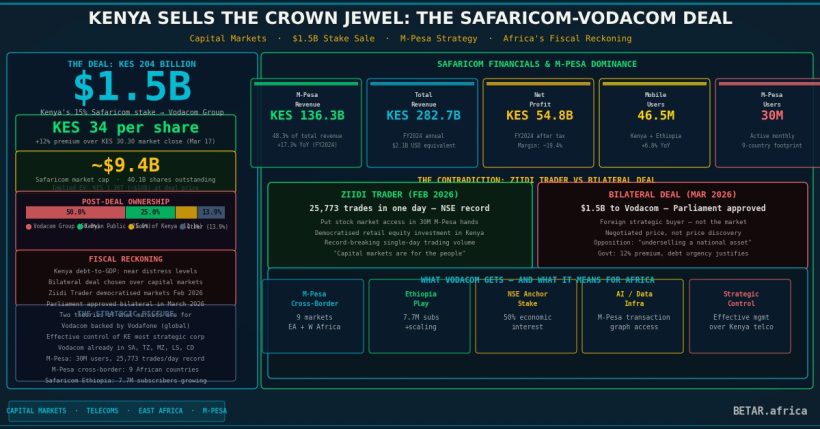
The deal structure involves two tranches: Vodacom buys approximately 15% from the Kenyan government at around $1.6 billion, and acquires a further 5% from Vodafone at approximately $0.5 billion. The blended price reflects KES 34 per share. Kenya’s parliament approved the government’s stake sale after sustained public debate about sovereignty and strategic asset disposal. The Kenyan government retains approximately 20% — a minority position, not a blocking stake.
Remaining regulatory approvals are pending from the EAC, Kenya’s Communications Authority, South Africa’s competition authorities, and Ethiopia. But with COMESA cleared, the trajectory is set.
Why Now
Vodacom has wanted majority control of Safaricom for years. M-PESA — the payments infrastructure embedded into Safaricom’s network — processes over 100 million transactions daily and moves approximately $450 billion in value annually. That’s not a telco product. That’s financial infrastructure.
The problem, until now, was governance. Joint venture mechanics meant that major product decisions, capital allocation, and cross-border expansion strategies required alignment between Vodacom, Vodafone, the Kenyan government, and Safaricom’s independent board. Reaching consensus across four principals on anything strategic was slow, when it happened at all.
Majority control collapses that structure. Vodacom will now hold board-level control: the product roadmap, capital deployment decisions, and pan-African integration strategy move to Johannesburg. Safaricom’s Ambition 2030 target — 120 million financial services users across its footprint — requires exactly the kind of unified execution that minority ownership made structurally difficult.
What Moves to Johannesburg
Governance is the headline shift. At 55%, Vodacom controls Safaricom’s board. That means three things change materially: product direction, M-PESA integration with Vodacom’s other markets, and capital discipline.
Safaricom has historically operated with significant autonomy — a feature that protected M-PESA’s Kenya-specific product evolution but limited its pan-African reach. Vodacom has been building M-PESA out across Tanzania, Mozambique, and the DRC. Those markets run on the same underlying infrastructure but with fragmented product development, separate licensing relationships, and inconsistent feature sets.
Majority control unlocks unified product development across the entire corridor. A single M-PESA integration API across Kenya, Tanzania, Mozambique, and the DRC is a plausible near-term deliverable. That’s a cross-border payments corridor that no other operator — not MTN, not Airtel — can replicate from a standing start.
Kenya’s NSE minority investors are watching carefully. Safaricom remains publicly listed in Nairobi, and the government’s dilution to 20% shifts the stock’s political dynamics. For years, Safaricom’s strategic decisions were partially anchored by Kenyan public ownership sensitivities. At 20%, the government retains a voice but not a veto. The board will be less constrained.
The M-PESA Integration Play
The strategic logic ultimately points to one outcome: Vodacom building the dominant pan-African mobile payments layer.
MTN MoMo serves more registered wallets across more countries. But active monthly users, transaction depth, and merchant ecosystem penetration are Safaricom metrics — and Kenya’s M-PESA numbers are in a different class from any comparable market. Moving that execution model across Vodacom’s footprint is the prize.
The Tanzania-Kenya-Mozambique-DRC corridor is particularly valuable. DRC’s mobile money market is growing fast with low incumbent depth. Mozambique and Tanzania are already M-PESA markets where Vodacom holds strong positions. Kenya is the model. The combined corridor, under unified product governance, represents one of the most credible cross-border digital finance plays on the continent.
Vodacom is not being subtle about this. Chief executive Shameel Joosub has described the transaction explicitly in terms of unlocking M-PESA’s pan-African potential. The Ambition 2030 number — 120 million financial services users — is not achievable at Kenya’s current growth rate. The play is cross-border.
The M&A Precedent
COMESA’s unconditional clearance is as significant as the deal itself for what it signals about Africa telecoms consolidation.
African competition authorities have historically been unpredictable on large inbound transactions — imposing conditions, dragging timelines, or requiring local reinvestment commitments that reshape deal economics. COMESA’s clean clearance on a $2.1 billion transaction involving strategic national infrastructure suggests the commission assessed this as a pro-competitive outcome: better-capitalised operators, more integrated payments infrastructure, and a dominant local operator gaining access to international capital allocation.
That reading will inform the next wave of Africa telecoms M&A. Operators looking at consolidation plays — whether MTN’s acquisition pipeline, Airtel’s asset review, or smaller market consolidation — will model their COMESA filing strategies accordingly.
The deal also demonstrates that Africa’s strategic infrastructure assets are acquirable at scale by well-capitalised regional operators, without triggering the political blockades that have stalled comparable transactions in other sectors. Kenya’s debate was heated, but the approval came through. That matters for how risk is priced on the next deal.
What Comes Next
Vodacom will not move to consolidate control immediately. The remaining approvals — EAC, Kenya CA, South Africa, Ethiopia — take time. The government’s stake sale requires careful sequencing to avoid NSE impact. And Safaricom’s management team, built under the existing governance structure, needs continuity through the transition.
But the direction is clear. When the full approvals land, Safaricom becomes an asset that Vodacom controls operationally, not just financially. M-PESA’s pan-African integration moves from aspiration to execution mandate. And East Africa’s telecoms map acquires a new centre of gravity — one that sits in Johannesburg, not Nairobi.
Reporting by BETAR Africa. Deal financials sourced from regulatory filings, parliamentary record, and published company disclosures. Vodacom and Safaricom declined comment on post-clearance integration strategy.

 UphivaBETAR