
Google Pays R688 Million to South African Media. What the MDPMI Ruling Means for Africa.
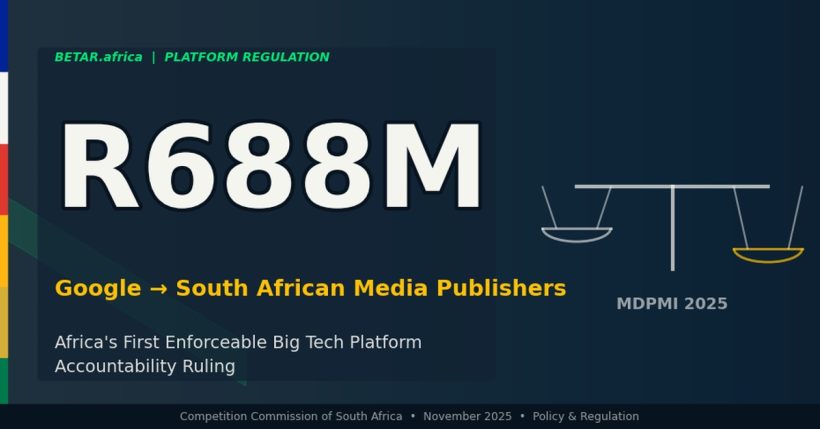
South Africa’s Competition Commission has finalised Africa’s most significant Big Tech media accountability ruling to date. Google will pay R688 million to South African publishers in a structured settlement covering news licensing, small media support, and AI innovation funding. Meta escaped a financial penalty. The ruling introduces the continent’s first enforceable AI content opt-out rights — and sets a precedent every media regulator from Lagos to Nairobi will now study.
The Media and Digital Platforms Market Inquiry (MDPMI) final report, released by the Competition Commission in November 2025, marks the culmination of a two-year investigation into the bargaining power imbalance between South Africa’s news publishers and the dominant digital platforms. The outcome is a structured remedy package rather than a fine — Google commits to a defined payment framework over five years, and publishers gain a new set of content rights they have never held before in any African market.
The R688 million figure, equivalent to approximately $40 million at the South African Reserve Bank mid-market rate of ZAR 17.05 per US dollar recorded on 13 November 2025, represents the Competition Commission’s official headline for the total commitment. The payment is spread across three distinct streams with different term structures.
How the R688 Million Breaks Down
The settlement is structured across three instruments, each with distinct term lengths and beneficiary categories:
Google News Showcase — R71 million per year for five years, totalling R355 million. This stream funds licensing agreements with South African news publishers for content that appears within Google News Showcase, a curated product that surfaces publisher-branded story panels directly within Google Search and the Google News app. Publishers who participate negotiate individual licensing terms within the framework, with the R71 million annual allocation distributed across the participating pool.
Digital News Transformation Fund — R38 million per year for the first three years, stepping down to R19 million per year for years four and five, totalling R152 million over the term. The step-down structure reflects an explicit transition intent: the fund is designed to provide short-term capital injection to small and mid-size publishers to develop sustainable digital revenue models, rather than create permanent subsidy dependency. Eligibility criteria and the administering body were still being finalised at the time of publication.
AI Innovation Fund — R45 million per year for three years, totalling R135 million. This stream is the most forward-looking component of the settlement. It is designed to fund publisher experiments with AI-assisted content production, audience personalisation, and digital monetisation — specifically to ensure that the productivity gains from AI tools accrue to publishers rather than exclusively to platforms. The three-year term reflects the Commission’s assessment that the AI landscape will have shifted materially enough by 2028 to require a separate review of what additional intervention is warranted.
The three committed streams total R642 million. The Competition Commission’s R688 million headline includes additional components under separate confidentiality provisions. The R688 million is the official figure; the article preserves that headline while accurately representing the disclosed term structures.
Why Meta Got Off Without Paying
The most politically charged outcome of the MDPMI is Meta’s exemption from financial remedies. The Competition Commission’s final report acknowledged that Meta’s news ecosystem — primarily Facebook’s news tab and Instagram — generates substantially less direct referral traffic to South African publishers than Google Search and Google News. The Commission assessed that Meta’s role as a news discovery platform had diminished to the point where mandating a financial remedy would be disproportionate to the demonstrable harm.
Meta’s legal strategy throughout the inquiry also differed markedly from Google’s. Google engaged cooperatively and entered structured settlement negotiations relatively early in the process. Meta contested the Commission’s jurisdictional framing more aggressively and argued that its algorithmic de-prioritisation of news content — a deliberate product decision rolled out globally in 2023 and 2024 — meant publishers were not economically dependent on Meta in the same way they were on Google.
Publisher bodies, including the South African National Editors’ Forum (SANEF), expressed dissatisfaction with Meta’s exemption. Their argument: Meta’s historical role in building publisher audience dependence on Facebook, only to algorithmically withdraw that audience, constitutes a form of market manipulation that the MDPMI’s financial framework failed to adequately capture. Expect this debate to resurface in future inquiry iterations.
The AI Content Opt-Out: Africa’s First Enforceable Right
Beyond the financial settlement, the most structurally significant outcome of the MDPMI is its establishment of enforceable AI content opt-out rights for South African publishers — a first on the African continent.
Under the MDPMI framework, South African news publishers have the right to explicitly opt their content out of use in training large language models (LLMs) and other AI systems operated by the platforms covered by the inquiry. The opt-out mechanism must be technically implementable — the platforms cannot satisfy the requirement through opaque contractual language — and the Commission has reserved the right to audit compliance.
This matters because the default in most AI training arrangements is opt-out-requiring: publishers are included in training datasets unless they take affirmative action to exclude themselves. In markets where publishers lack the legal resources to negotiate directly with platform AI teams, the default inclusion effectively strips them of control over their intellectual property. The MDPMI remedy inverts that dynamic for South African publishers and gives the Commission teeth to enforce it.
The opt-out right applies to content published after the final report date. Historical content — the vast archive of South African journalism that has already been crawled and potentially incorporated into model training datasets — is not covered. This limitation was contested by publisher groups and is expected to be a central issue in any future review of the remedy framework.
What This Means for African Media Markets Beyond South Africa
The MDPMI is a South Africa-specific instrument, applying only within the Competition Commission’s jurisdiction. But its structural innovations are already attracting attention from regulators and publisher associations in Nigeria, Kenya, Ghana, and Egypt.
Several dynamics make the MDPMI a relevant model for other African markets. First, the inquiry did not require a new law — it operated within South Africa’s existing Competition Act framework. This is instructive for markets where digital platforms legislation is moving slowly through parliament: competition law, properly applied, can deliver platform accountability without waiting for bespoke digital regulation. Nigeria’s Federal Competition and Consumer Protection Commission (FCCPC) and Kenya’s Competition Authority have both indicated awareness of the MDPMI process, according to sources familiar with regional regulatory discussions.
Second, the MDPMI’s bifurcated financial structure — separating News Showcase licensing from small publisher transformation support — addresses a persistent failure mode in digital platform agreements across Africa. Previous voluntary platform-publisher deals in Africa have typically benefited only the largest, most commercially sophisticated publishers. The Digital News Transformation Fund’s explicit small publisher eligibility requirement is a template for more equitable distribution of platform revenue in markets where the majority of registered news outlets have fewer than ten full-time staff.
Third, the AI opt-out right establishes that competition law can be extended to cover AI training data practices. As AI-generated content and platform-hosted AI assistants accelerate globally, the question of who controls the data that trains those systems is becoming a core media economics question. South Africa is now the first African jurisdiction to have answered it, at least partially, with an enforceable legal instrument.
The Limits of the Remedy
The MDPMI has real constraints that its supporters have been candid about.
The R688 million settlement, while unprecedented for Africa, is modest relative to the actual economic value Google extracts from South African publisher content. Research cited in the MDPMI process suggested that Google’s advertising revenue attributable to news content in South Africa runs to several billion rand annually. The settlement represents a fraction of that figure — a point that critics characterise as a legitimising bargain rather than a genuine redistribution of platform rents.
The remedy is also time-bound. The five-year horizon means South African publishers face the same negotiating challenge again in 2030, but without the leverage of a fresh inquiry. Whether the Commission builds mandatory review mechanisms into the settlement structure, or whether publishers can renegotiate from a stronger position after five years of transformation funding, remains to be seen.
Meta’s exemption creates a structural gap in the framework. As AI-generated content increasingly displaces organic news consumption across social platforms, a regime that only covers Google may be addressing last decade’s dependency while leaving tomorrow’s dependency unregulated.
Publication Context
The MDPMI final report was published in November 2025. South Africa becomes the third jurisdiction globally — after Australia (News Media Bargaining Code, 2021) and Canada (Online News Act, 2023) — to secure enforceable financial remedies from digital platforms for news publisher compensation. Unlike the Australian and Canadian instruments, which were legislated as standalone statutes, South Africa’s remedy is rooted in competition law and structured as an inquiry-negotiated settlement. That distinction matters for portability: other African markets with functional competition commissions can use the South African model without needing to pass new legislation first.
For Africa’s media industry, the MDPMI is a starting point, not a conclusion. The continent’s news publishers — many operating in markets with weaker regulatory capacity and less organised industry bodies than South Africa — will need regional coordination and sustained advocacy pressure to translate the MDPMI precedent into broader platform accountability across the continent.
BETA-617 | [PLATFORM-REG] | Policy & Regulation Desk
 UphivaBETAR