
Maziv’s R9 Billion Fibre Pledge: Open-Access Infrastructure Execution After the Vodacom Deal
Maziv’s investment conference commitment signals what Africa’s largest open-access fibre operator plans to do with its recapitalised balance sheet — and why it matters beyond the headline number.
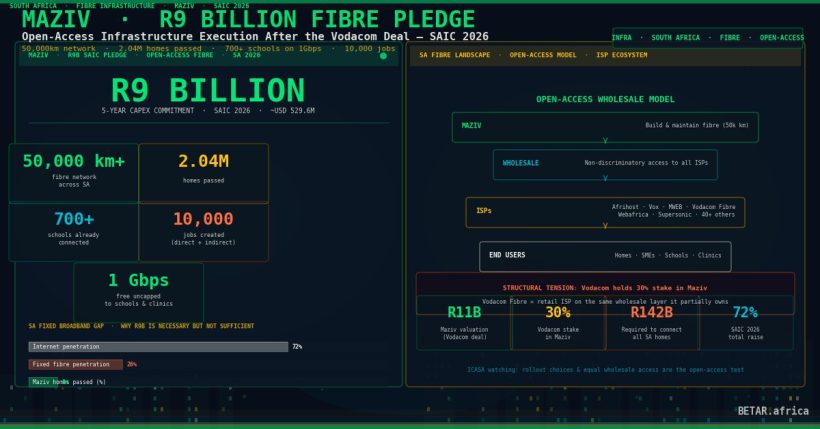
When Maziv CEO Dietlof Maré stepped up to address the sixth South Africa Investment Conference (SAIC 2026) in Johannesburg on 1 April, he came with a number: R9 billion. Over five years, the country’s largest open-access fibre network operator would deploy that capital to expand its infrastructure, create 10,000 jobs, and connect every school, clinic, and public library on its network to 1Gbps free uncapped broadband.
It was the investment execution moment that the Vodacom deal had been building toward.
The Competition Commission and ICASA had cleared Vodacom’s 30 percent stake acquisition in Maziv — the combined entity of Vumatel and Dark Fibre Africa — at an R11 billion valuation. That process raised questions about consolidation risk and wholesale market structure. The SAIC pledge is a different story: it is about what Maziv actually does now that the capital has landed.
What Was Pledged
The R9 billion (~US$529.6 million) capex commitment runs over five years. Maziv did not break the figure down by year at the conference, but the strategic logic is well-established: accelerate rollout in lower-income and underserviced areas, push toward the 8,000 unconnected towers the company has flagged as a priority corridor, and extend the wholesale fibre layer that independent service providers (ISPs) depend on to reach end customers.
The jobs figure — 10,000 direct and indirect over seven years — spans installer roles, SMME ecosystem participants, and community-based service providers. The longer horizon (seven years vs five for the capex) reflects the lagged employment multiplier typical of infrastructure deployment: direct construction jobs come first, followed by the secondary employment generated as active subscribers grow and ISPs expand their local operations.
The most concrete commitment is the connectivity pledge: 1Gbps free uncapped broadband to every school, clinic, and public library on the Maziv network. The company says it has already connected over 700 schools under this scheme. At scale — Maziv currently passes 2.04 million homes across South Africa with more than 50,000km of fibre — this represents public-sector connectivity at a standard well above anything government programmes have funded at equivalent scale.
“This investment isn’t just capital; it’s a powerful catalyst for true digital inclusion,” Maré said. “By scaling our infrastructure with this R9 billion investment, we are laying the essential foundation for widespread economic participation.”
Why the Timing Matters
Maziv’s pledge landed inside a broader SAIC 2026 total of R889.8 billion across 81 projects — the largest single-conference investment haul South Africa has recorded. MTN South Africa separately announced plans to invest nearly R22 billion over three years in network infrastructure and IT. The cumulative signal from the telecoms sector is that post-consolidation capital deployment is accelerating.
That consolidation context is important. Maziv’s open-access model — build and maintain the fibre layer, then lease wholesale access to competing ISPs at non-discriminatory rates — is structurally different from vertically integrated operators that build and retail. Vumatel and Dark Fibre Africa merged to create Maziv precisely to strengthen the wholesale layer’s financial viability; the Vodacom equity injection completed that capitalisation.
South Africa’s fixed broadband gap makes the investment necessary. Overall internet penetration sits at approximately 72 percent, but genuine fixed fibre penetration across homes and small businesses is closer to 26 percent. The country requires an estimated R142 billion to connect all households to 100 Mbps broadband by 2035 — a figure that places Maziv’s R9 billion in uncomfortable perspective. It is meaningful, but it is not sufficient on its own. It requires government programmes, competing fibre builders, and mobile operators investing in fixed-wireless access to work in parallel.
The Open-Access Accountability Question
The Vodacom deal raised a governance question that Maziv’s SAIC pledge does not fully resolve: can a network operator remain genuinely open-access when one of its largest shareholders is also one of the country’s biggest retail broadband competitors?
Maziv has been explicit — including in a March 2026 BusinessDay interview — that it intends to maintain the open-access model regardless of Vodacom’s equity position. Vodacom uses the Maziv wholesale layer for its Vodacom Fibre product, as do Afrihost, Vox, MWEB, Webafrica, Supersonic, and dozens of smaller ISPs. Maziv’s commercial model depends on ISP revenues; any shift toward exclusivity would damage the wholesale customer base that justifies the infrastructure investment.
But the structural tension exists, and the R9 billion rollout plan will be watched closely by competitors and ICASA. The specific areas Maziv chooses to build — and whether smaller ISPs retain equal access to new infrastructure at the same wholesale rates as Vodacom Fibre — will be the real test of the post-acquisition open-access commitment. The conference pledge is a public undertaking; execution is what counts.
What the School Connectivity Pledge Signals
South Africa’s SA Connect Phase 2, launched in late 2023, targets 18,000 schools, 5,700 clinics, and 8,200 traditional authority centres by 2026. Progress has been uneven. The government programme depends on public procurement cycles and cross-departmental coordination that have historically slowed delivery.
Maziv’s offer — 1Gbps free uncapped to every institution already on its network — does not require a government tender. It is a commercial decision by the operator to absorb the cost of public-sector connectivity in exchange for the goodwill, coverage density, and anchor-demand economics that institutional customers provide to surrounding residential rollout. That makes it faster and less administratively burdened than SA Connect, but also limited to the geography Maziv already covers or chooses to expand into.
The 700-school figure Maziv cited at SAIC suggests the programme is already operational at meaningful scale. How that number grows over the five-year capex horizon — and whether it reaches the clinic and library categories at comparable pace — will be measurable against the pledge.
The Bigger Picture
Maziv’s SAIC commitment is, at its core, a statement about what the post-Vodacom balance sheet is for. The R11 billion deal was not a sale to a strategic acquirer with integration ambitions — it was a capital injection into infrastructure that was already operating at scale. The question was always: what does Maziv build with it?
R9 billion over five years, 10,000 jobs, 1Gbps to schools and clinics, and a continued open-access commitment is the answer. It is an ambitious target and a useful public accountability benchmark.
The delivery phase starts now.
BETAR.africa covers business, technology, and innovation across Africa. Follow-on coverage of Maziv’s rollout execution will track quarterly progress against the R9 billion capex plan.

 UphivaBETAR