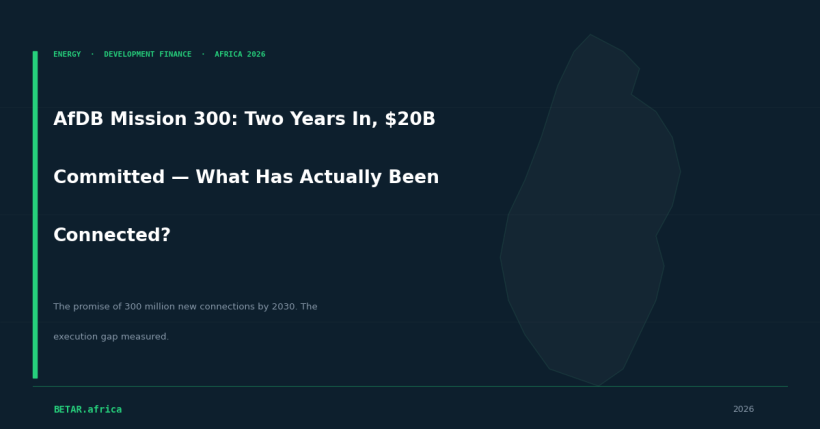

AfDB Mission 300: Two Years In, $20B Committed — What Has Actually Been Connected?
The African Development Bank and World Bank launched Mission 300 in November 2023 with a target of 300 million new electricity connections by 2030. Eighteen months on, $20 billion has been committed across 26 country compacts. The distance between committed capital and delivered connections is where the programme’s credibility — and Africa’s electrification trajectory — will be tested.
When the African Development Bank and the World Bank launched Mission 300 at the Africa Energy Summit in Nairobi in November 2023, the numbers were large enough to be credible and ambitious enough to be meaningful. Three hundred million people gaining electricity access by 2030, funded through a $20 billion joint commitment, supported by country energy compacts that would align government, DFI, and private sector investment behind national electrification plans. The initiative was explicitly framed as a response to the pace problem: Africa had been adding electricity access for decades, but not fast enough. At the pre-Mission 300 trajectory, universal electricity access on the continent was not achievable until the 2050s.
By March 2026, 26 African countries had signed energy compacts with Mission 300. The combined commitment from the AfDB and World Bank had reached approximately $20 billion across the compact portfolio. Country plans were in various stages of implementation, from Nigeria’s $500 million DARES solar mini-grid programme, which broke ground in early 2025, to smaller grid extension packages in Burkina Faso, Chad, and Niger. On the committed capital metric, Mission 300 is tracking broadly to plan.
The harder question — how many people have actually gained electricity access as a result of Mission 300 financing — is more difficult to answer, and the honest answer is: we do not yet know, and the data systems that would tell us are not fully in place.
The Commitment-to-Connection Gap
Development finance commitments and electricity connections are separated by years of procurement, construction, grid commissioning, metering, and connection fee collection. The $20 billion committed by the AfDB and World Bank is not $20 billion spent. It is $20 billion in financing that has been approved, allocated to country programmes, and is in various stages of disbursement and implementation.
In the best-documented case — Nigeria DARES — the $750 million World Bank programme was approved in 2022, with Mission 300 later providing additional framing for its 2025 deployment acceleration. DARES targets 750,000 solar mini-grid connections within eighteen months of its February 2025 start date. The first mini-grid clusters are operational; full deployment is scheduled for mid-2026. Even at that pace, the actual counted connections attributable to Mission 300 capital in Nigeria are in the tens of thousands as of Q1 2026, not the hundreds of thousands that the programme’s total headline would imply.
This is not a critique. It is the natural timeline of infrastructure development. The relevant question is whether the 2030 target is achievable given deployment lead times — and whether the institutional architecture of Mission 300 is structured to accelerate connection delivery, or primarily to aggregate financial commitments.
The Structural Constraints That Capital Cannot Solve
Three structural constraints limit the pace at which financial commitments convert into electricity connections in sub-Saharan Africa, and none of them are fully addressed by the Mission 300 framework.
The first is grid capacity and last-mile infrastructure. For countries pursuing grid extension strategies — which include most of Mission 300’s compact countries — the binding constraint is not the high-voltage transmission network but the low-voltage distribution infrastructure that reaches individual households. Building that infrastructure requires local construction capacity, materials supply chains, and skilled electricians at a scale that most compact countries do not currently have. Nigeria’s DARES programme works around this by using solar mini-grids precisely because mini-grids do not require the low-voltage distribution network that grid extension demands. That is a sensible adaptation, but it means the national grid is not being extended in those areas — a long-term limitation for the industrial electrification that economic development requires.
The second constraint is utility financial health. Grid extension programmes funded through Mission 300 compacts typically route new connections through national distribution utilities — the same utilities that, in Nigeria, Ghana, Kenya and elsewhere, are operating at significant financial deficits. A new grid connection financed by a DFI compact is only valuable to the recipient household if the utility can actually supply power reliably and collect revenue. In markets where utility viability is in question, Mission 300 connections risk becoming metered but under-served endpoints. This is why tariff reform — discussed above — is structurally linked to electrification targets even though the two policy levers are usually discussed separately.
The third constraint is the cooking energy gap. Mission 300 is an electricity access programme. Electricity access, as counted in national statistics and DFI metrics, typically means grid or solar home system connections. It does not mean clean cooking. The 600 million Africans without electricity include many who will gain some form of electricity access through Mission 300 mechanisms — but who will still cook on wood or charcoal, generating the household air pollution that is the continent’s largest energy-related health burden. The AfDB’s clean cooking agenda runs parallel to Mission 300 but is not integrated into it at the implementation level. That gap limits Mission 300’s total development impact relative to its financial scale.
What Success Looks Like By 2030
The 300 million target is a political commitment with a round number. The IEA’s Africa Energy Outlook 2022 estimated that achieving universal electricity access in Africa by 2030 would require connecting approximately 90 million people per year — a rate significantly higher than the continent’s historical pace of around 20–25 million connections annually. Mission 300, even fully executed, would cover roughly a third of the 2030 universal access gap.
That framing is more useful than treating 300 million as either a success threshold or a failure benchmark. The genuine measures of Mission 300’s performance over its first two years are not connection counts — those will not be auditable at scale until 2027 — but the institutional conditions that it has either built or failed to build: utility reform progress in compact countries, the pace of metering installation that converts connections into revenue streams, the share of compact financing reaching off-grid operators who can deploy faster than grid extension, and the degree to which national energy compacts have actually changed the planning and procurement practices of the energy ministries that signed them.
On those metrics, the Mission 300 picture is mixed. The DARES programme in Nigeria is genuinely innovative in scale and procurement design. The Zambia compact has moved slowly, in part because of the hydropower crisis that has consumed the Ministry of Energy’s bandwidth since 2024. The DRC compact — covering a country with one of the largest electrification gaps in the world — remains at early stages of implementation.
Mission 300’s real significance may be less about the 300 million number and more about whether it has changed the structural conditions of African electrification: the utility balance sheets, the regulatory frameworks, the local installation capacity, and the off-grid market conditions that determine whether DFI capital converts into durable electricity access. At two years, those conditions are changing — more slowly than the headline targets imply, but measurably.

 UphivaBETAR