
The Merch Gap: Why African Creators Leave Money on the Table With Physical Products
By BETAR.africa Creative Economy Desk
Filed: 4 April 2026 | Publication target: W/C 12 October 2026
When Afrobeats artist Ckay launched a limited-run merchandise drop during his 2024 world tour, the economics told a familiar story for African creators: the London and New York restocking windows sold out within hours; the Lagos drop moved slower, at a lower margin, and cost more per unit to fulfil. The artist had comparable audience sizes in all three markets. The economics were not comparable at all.
That asymmetry — large audiences, underdeveloped merchandise revenue — defines the creator merchandise economy across Africa. In markets where Afrobeats artists, YouTubers, lifestyle influencers, and social media personalities command followings that rival mid-tier Western creators, the physical product revenue stream consistently underperforms against global benchmarks. The reasons are structural, quantifiable, and in some cases, addressable. But they require an honest reading of the cost stack.
What Merchandise Production Actually Costs
The economics begin before a single item ships. Minimum order quantities for branded merchandise in Africa are higher relative to comparable markets, and the unit cost economics are less forgiving.
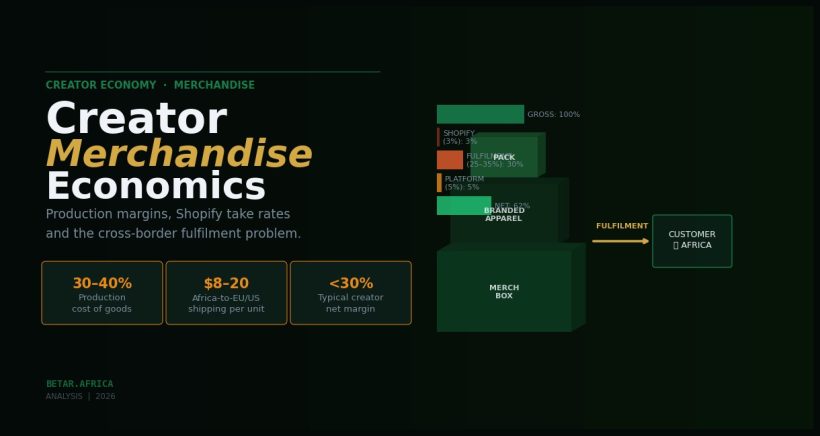
A Nigerian or South African creator ordering custom T-shirts from a local manufacturer typically faces a minimum order quantity of 100 to 200 units at a base production cost of ₦3,500 to ₦5,500 per unit in Lagos, or R85 to R140 per unit in Johannesburg — for a 180–200g cotton tee with single-colour screen printing. At a retail price of ₦12,000 to ₦15,000 (approximately $7.50 to $9.40 at current rates), the gross margin per unit runs between 55 and 65 percent before fulfilment, packaging, and payment processing costs are factored in. Those costs absorb between 15 and 25 percentage points of the headline margin.
Olumide Olusanya, CEO of Printivo — a Lagos-based print and branded merchandise platform serving thousands of Nigerian SMEs and content creators — describes the structural bind clearly. “The conversation with creators starting out is always about minimum quantities,” he told BETAR.africa. “At 50 units you are paying premium unit price. At 200 units the economics start to work, but then you carry inventory risk. Most African creators do not have the fanbase predictability to know their conversion rate in advance — so they either over-order and sit on unsold stock, or under-order and compress their margin further.”
Print-on-demand services — which eliminate inventory risk by producing items only on confirmed order — carry a premium cost structure. Printify’s Africa-compatible fulfilment network routes through South Africa, Turkey, or the UK, depending on the shipping destination. A basic T-shirt through Printify’s Africa-routed fulfilment costs $12 to $16 per unit base, versus $6 to $9 for equivalent US-routed production. For a creator pricing at $25 retail and absorbing $14 in production plus $3 in platform fees and $6 in shipping, the net margin is $2 per unit — an 8 percent return on a product that took weeks to design and weeks more to reach the buyer.
The alternative — bulk manufacture and hold inventory — requires capital upfront and creates the risk of unsold stock, which at Nigerian warehouse costs of ₦800,000 to ₦1.5 million per 20-foot container-equivalent per year is not a trivial write-off for a creator without a recurring merchandise volume baseline.
Platform Take Rates: Shopify vs. African Alternatives
E-commerce platform fees add a further compression layer. Shopify’s pricing structure for African merchants has a specific cost problem: the platform charges subscription fees in USD ($29 to $79 per month for its Basic to Shopify tiers) while most African creator audiences transact in local currency. At the current naira-dollar rate of approximately ₦1,620, Shopify’s Basic plan costs ₦47,000 per month — before payment processing. Shopify Payments is not available in Nigeria or most sub-Saharan African markets, meaning merchants must integrate third-party processors (Paystack, Flutterwave, Stripe) that add 1.4 to 2.5 percent transaction fees on top of the platform fee.
The effective all-in take rate for a Nigerian creator running a Shopify store — subscription fee amortised over monthly sales, plus payment processing — runs from 8 to 15 percent of gross merchandise value depending on volume, compared to 3 to 6 percent for a high-volume Western Shopify merchant on the same tier plan.
African-built alternatives compress the take rate but narrow the geographic reach. Emmanuel Eze, CEO of Selar — the Lagos-based creator commerce platform — describes the trade-off in operational terms. “We added physical product support to Selar because creators were asking for it,” Eze told BETAR.africa. “The take rate on Selar is competitive with anything available in Africa. But the honest conversation with creators is that platform fees are not their primary margin problem. Getting a box from Lagos to a buyer in London or Toronto costs more than the platform charges for a year.” Selar’s storefront product supports physical product listings with a 4 to 6 percent commission and Paystack-integrated checkout at 1.5 percent — an effective take rate of 5.5 to 7.5 percent — but its checkout experience is optimised for Nigerian buyers paying in naira rather than diaspora customers using foreign cards.
Paystack’s Commerce product offers a zero-platform-fee storefront with 1.5 to 2.9 percent payment processing — one of the most cost-efficient options for naira-denominated merchandise in Nigeria. But Paystack Commerce lacks the ecosystem integrations (Klaviyo email automation, Meta pixel, TikTok Shop) that drive conversion optimisation on Shopify.
The Cross-Border Fulfilment Problem
The diaspora merchandise opportunity is real. Nigerian and Ghanaian diaspora communities in the UK, US, and Canada represent a buyer segment with higher disposable income, stronger USD purchasing power, and demonstrated willingness to pay a cultural premium for artist-affiliated physical products. The fulfilment economics make serving them expensive.
A single garment shipped from Lagos to London via DHL Express costs approximately $35 to $45 in shipping alone — more than the retail price of a standard T-shirt at creator market pricing. Air freight consolidation services that aggregate creator merchandise shipments reduce per-unit cost to $12 to $18 at 5-unit-minimum thresholds, but require the creator to hold inventory near a consolidation hub and coordinate with a logistics partner.
Ubi Franklin, the Nigerian entertainment executive and artist manager whose roster has included top-tier Afrobeats acts, describes the diaspora fulfilment challenge as the defining structural barrier for African artist merchandise. “Every artist I have worked with has wanted to do merchandise,” he told BETAR.africa. “The conversation always hits the same wall — production costs in Lagos make the unit economics look good on paper until you factor in shipping to London or Toronto. Your diaspora fans want the product, but the landing cost to them often doubles what they paid for it.”
Import duties and VAT create an additional friction layer. Under the UK’s post-Brexit import rules, shipments from Nigeria with a declared value above £135 trigger UK import VAT at 20 percent, payable by the recipient at the point of customs clearance. Buyers who are not expecting a customs bill on a £40 T-shirt they ordered from their favourite artist create a customer experience problem that damages the relationship value of the merchandise purchase. UK-side fulfilment — warehousing and shipping from within the UK using bulk-imported inventory — eliminates this problem but requires capital to stock diaspora-facing inventory in advance.
South African creators have a marginally more favourable logistics position for UK and European fulfilment due to direct cargo routes and a rand-dollar dynamic that makes bulk export pricing competitive. However, SARS customs compliance requirements for commercial exports add administrative overhead that informal creator merchandise operations typically are not equipped to manage.
Limited-Drop Economics and Event Merchandise
Where African creators have found merchandise economics that work, the common pattern is demand compression: creating scarcity to sustain margins against the volume constraints that undermine continuous merchandise operations.
Limited-drop models — where a creator launches a 48-hour ordering window for a specific run of 200 to 500 units with no guarantee of restocking — allow creators to gauge demand before committing to bulk production. Average conversion rates on African creator merchandise drops, based on creator reports, range from 1.5 to 4 percent of engaged followers per drop — below the 3 to 8 percent reported on comparable US creator drops. Average order values for African creator merchandise in naira-denominated markets run from ₦8,000 to ₦22,000 ($5 to $14), against $25 to $65 for US and European creator merch drops.
Event merchandise operates differently. A Lagos-based music act selling merchandise at a headline show typically captures between 2 and 5 percent of gate receipts as merchandise revenue — lower than the 10 to 20 percent range reported at comparable Western festival and headline shows. The infrastructure friction is significant: card payment terminals at Nigerian event venues are unreliable, merchandise booth inventory is manually managed, and the post-show window — where impulse buying peaks at Western shows — is compressed by security and venue exit logistics.
Why the Gap Persists
The creator merchandise revenue gap is not explained by audience size or engagement quality. It is explained by the compound cost structure: elevated per-unit production costs, dollar-denominated platform fees, cross-border fulfilment premiums, and payment infrastructure that remains optimised for digital services rather than physical goods.
The structural unlocks are visible. Shopify’s Africa pricing has not adjusted to local currency realities; its competitors have partially filled the gap but not closed it. Print-on-demand infrastructure built specifically for African fulfilment — with sub-Saharan production nodes and diaspora-route shipping partnerships — does not exist at scale. Customs duty guidance for creator merchandise exports is not available in accessible form for creators who are not operating with a commercial logistics partner.
The creators who have built sustainable merchandise revenue in Africa — and some have — have done it by solving the logistics problem first, not the creative or audience problem. That inversion, where operational sophistication is the primary barrier rather than creative reach, captures the current state of the African creator merchandise economy: large audiences, constrained infrastructure, and a significant revenue gap waiting for the cost stack to catch up.
Sources: Platform fee schedules and public rate cards for Shopify, Selar, Paystack Commerce, Printify. Logistics cost benchmarks from DHL Africa, Aramex, and air freight consolidation operators serving West Africa. Emmanuel Eze, CEO, Selar (interview with BETAR.africa, April 2026). Olumide Olusanya, CEO, Printivo (interview with BETAR.africa, April 2026). Ubi Franklin, entertainment executive and artist manager (interview with BETAR.africa, April 2026). IFPI/Connecting Africa creator economy data; TechCabal and Techpoint Africa e-commerce coverage.

 UphivaBETAR
 Joseph Busari