
Building a Game Studio in Africa Costs $3,000 a Month. Publishing One Game Costs Three Times That. The Unit Economics Explain Why African Studios Struggle to Scale.
By BETAR.africa Creative Economy Desk
Filed: 6 April 2026 | Commission: BETA-1285
Word count: ~1,200
Africa has 349 million gamers and a gaming market growing at six times the global average. It also has fewer than 200 commercially active game development studios across a continent of 1.4 billion people. The gap between those two numbers is a unit economics problem — and it starts before a single line of code is written.
The economics of building and operating an independent game studio in Africa are structurally different from those in North America, Europe, or Southeast Asia. Developer salaries run at a fraction of Western equivalents, which looks like a cost advantage. But studio infrastructure costs, payment rails, bandwidth, and app store fee structures erode that advantage systematically. Understanding why requires tracking the money through every phase of the studio lifecycle.
Studio Formation: The Fixed Costs
A minimum-viable game studio in Lagos — a team of four developers, a designer, and a producer working in a shared workspace — carries monthly operational costs in the range of $2,800 to $4,500, according to cost benchmarks drawn from co-working rates, developer compensation data, and software licensing costs in the Nigerian market.
The cost structure breaks down as follows: workspace at Lagos co-working hubs (e.g. CcHub, Lekki tech clusters) runs $200–$500 per desk per month. A senior game programmer in Lagos earns between $800 and $1,800 per month, depending on experience and whether the employer is competing for talent against international remote-work offers. Mid-level developers earn $400–$900. A comparable hire in the United Kingdom would earn £4,000–£7,000 per month ($5,000–$8,800). The salary differential is real — Lagos developer costs are roughly 15–20% of UK equivalents.
The picture shifts in Nairobi and Cape Town. Senior game developers in Nairobi earn KES 120,000–250,000 per month ($930–$1,940), broadly comparable to Lagos at current exchange rates. Cape Town and Johannesburg developers earn significantly more: R35,000–R75,000 per month ($1,900–$4,100) for senior programmers, reflecting South Africa’s more mature tech labour market and the competition from Sea Monster Entertainment, Lemon Sky Studios, and other commercial studios operating locally.
Software licensing adds a further layer of fixed cost. Unity Pro, the dominant game development engine for African mobile studios, runs $2,040 per developer seat annually. Unreal Engine, relevant for higher-fidelity mobile and cross-platform titles, takes a 5% royalty on gross revenue above $1 million per title. Art and audio asset licensing, localisation tools, analytics platforms, and cloud build pipelines add $300–$800 per month to a small studio’s operating overhead.
The App Store Fee Before Payroll
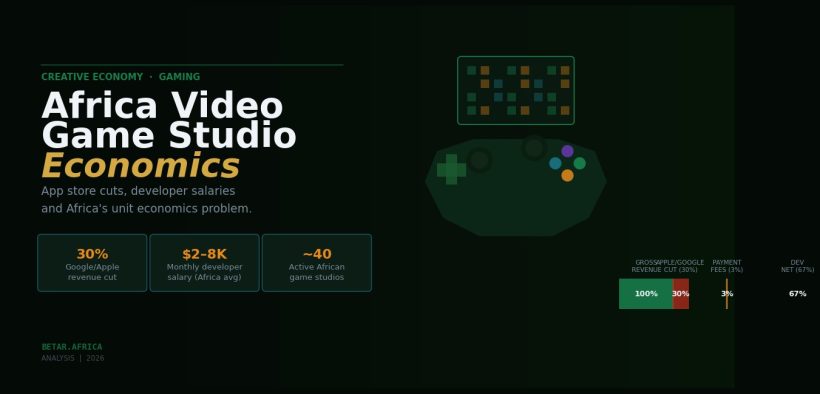
Every game published through Google Play or Apple App Store faces a platform commission before the studio sees revenue. The standard rate is 30% on all in-app purchases and paid downloads. Both platforms offer a reduced 15% rate for developers earning below $1 million annually — a threshold only three African studios reached in 2024.
Google’s March 2026 settlement with Epic Games will reduce Play Store commissions to 20% globally, with rollout through 2027. For a studio generating $500,000 in annual in-app purchase revenue, the difference between 30% and 20% is $50,000 — equivalent to roughly six months of salary for two senior developers. The shift matters.
But the app store fee is only the first extraction point. Payment processing outside the app store billing layer — relevant for studios that operate web-based purchases or direct-to-consumer storefronts — adds 1.5–3.5% per transaction. In markets where mobile money dominates consumer payment (Kenya, Ghana, Tanzania), integrating M-Pesa, Airtel Money, and equivalent systems requires either building payment infrastructure directly or licensing an aggregator like Carry1st’s Pay1st platform, which charges a processing margin on top of the underlying payment network’s own fees.
The net revenue position for a studio generating $500,000 in in-app purchase revenue at the current 30% Google/Apple rate: $350,000 before any operating costs. After developer salaries, workspace, and software licences for a six-person team in Lagos, roughly $150,000–$180,000 remains for marketing, user acquisition, content updates, and retained earnings.
Free-to-Play vs. Premium: The ARPU Problem
The dominant mobile game revenue model in Africa is free-to-play with in-app purchases, accounting for approximately 46% of Africa’s 2024 gaming market revenue by model. Premium (paid) games represent a structurally marginal business on the continent.
The core problem is average revenue per user (ARPU). African F2P mobile game ARPU runs at $0.20–$0.80 per active user annually in markets like Nigeria and Kenya, compared to $1.50–$4.00 in Southeast Asia and $8–$15 in North America and Western Europe, according to mobile analytics benchmarks compiled from AppsFlyer and Sensor Tower Africa market data. African players engage with games at volume — but convert to paying users at low rates, and spend small amounts when they do.
The structural cause is purchasing power: in-app purchase price points set for global audiences are expensive relative to African median incomes. A $1.99 item in a global game represents a materially different proportion of daily income for a Nigerian consumer than a US one. Studios that have localised price points — reducing IAP items to $0.25–$0.75 equivalents in local currency, paid via mobile money — have reported conversion rate improvements, but at the cost of per-transaction revenue.
Kucheza Gaming, the Nairobi-based studio co-founded by Olumide Layode, has built its model around the F2P-with-mobile-money architecture: games priced for African ARPU realities, distributed via channels that accept M-Pesa. The studio’s experience illustrates the trade-off facing every African developer: optimise for conversion by reducing price points, and you compress the revenue that each retained user generates.
Publisher Deals vs. Self-Publishing
The alternative to self-publishing — finding a publisher willing to offer an advance and distribution support — is rare and structurally unfavourable for African studios.
A standard indie game publisher deal in 2025–2026 offers an advance against royalties of $50,000–$250,000 for a mobile title with demonstrable traction, a revenue split of 70/30 in the publisher’s favour until the advance is recouped, reverting to 50/50 thereafter. For a Lagos or Nairobi studio, an advance of $100,000 could fund eight to twelve months of development at local cost structures — meaningful, but the long-term revenue share is expensive.
The publisher-deal market for African games is concentrated in two players: Carry1st, which operates a hybrid publisher-distribution model and has signed deals with African studios alongside its portfolio of licensed international titles, and a small number of international indie publishers (Devolver Digital, Kongregate) that have shown limited but growing interest in African-origin content. The absence of a developed local publisher ecosystem means most African studios self-publish — retaining 100% of revenue after platform fees, but absorbing all marketing costs without advance capital.
Hugo Obi, CEO of Maliyo Games and co-author of the 2025 Africa Games Industry Report with KPMG Nigeria, has described the capital problem directly: the studios exist, the talent is there, but “the infrastructure — payment, publisher relationships, development capital — hasn’t kept pace with the player base.” The 59% of African studios that the KPMG/Maliyo report identifies as operating without external investment are self-funding development cycles on the revenue generated by prior titles — a compounding constraint that limits production values and market reach simultaneously.
Structural Barriers: Bandwidth and Device Fragmentation
Two infrastructure barriers sit beneath the cost model that rarely appear in headline gaming market reports.
First, bandwidth costs. Game distribution in Africa requires players to download title files, often in the 100MB–500MB range for mobile games, on mobile data connections priced at three to five times the per-gigabyte cost of North America or Europe. A player in Nigeria pays roughly $0.80–$1.20 per gigabyte on prepaid mobile data; the same gigabyte costs $0.04–$0.08 in the United States. For developers, this creates a direct disincentive to ship large, content-rich games: every additional megabyte of game file size is a friction point that reduces download conversion rates in price-sensitive markets.
Second, device fragmentation. Android commands 90%-plus of Africa’s smartphone market, but within Android, the active device pool spans a thirteen-year range of hardware generations. A game optimised for current-generation devices will perform poorly on the sub-$80 Android handsets that represent the plurality of active smartphones in Nigeria and across Francophone West Africa. Testing and optimising across that device range adds meaningful QA cost — and studios that skip it see 1-star reviews from users on older hardware drive down app store rankings.
The Studio That Makes It
The studios that have navigated this cost structure to commercial viability share a recognisable profile: South African backing or co-investment (Sea Monster’s production model); a publisher relationship that provides advance capital and distribution (Carry1st’s portfolio model); or a licensing deal with an international IP holder that provides revenue certainty without the user acquisition spend of original content development.
Original African IP development — building a game from an African narrative or cultural context — remains the highest-risk pathway commercially, and the one with the longest potential upside. It is also the one least supported by current publisher infrastructure. The unit economics of African game studio formation do not prohibit commercially viable development. They do prohibit the kind of sustained, multi-year original IP investment that builds the globally competitive studios Africa’s player base would seem to demand.
Named sources: Hugo Obi, CEO, Maliyo Games (2025 Africa Games Industry Report, KPMG Nigeria); Olumide Layode, Co-founder, Kucheza Gaming (gaming industry interviews, 2025); Lucy Hoffman, Co-Founder & COO, Carry1st (Marketplace/NPR, March 2024).
Additional sources: 2025 Africa Games Industry Report, KPMG Nigeria/Maliyo Games; AppsFlyer Africa Mobile Gaming Report 2025; Sensor Tower Africa Gaming Market Data 2024; Unity Technologies pricing data; Google Play Developer Distribution Agreement (2026 updated terms); Apple App Store Small Business Program terms; TechCrunch — “Google settles with Epic Games, drops Play Store commissions to 20%” (March 2026); AfricaGamers market benchmarks 2025; Nairobi and Lagos co-working rate data, Q1 2026; Glassdoor Africa developer salary ranges, Q1 2026.
 UphivaBETAR
 Joseph Busari