
Africa’s Global Music Export Premium: The Revenue Map Behind Afrobeats and Amapiano’s International Breakthrough
By BETAR Creative Economy Reporter | September 2026
Africa’s two most commercially successful music exports — Nigeria’s Afrobeats and South Africa’s Amapiano — generated a combined estimated $2.1 billion in international revenue in 2025, according to IFPI’s Global Music Report 2026. They also generated a defining question for the continent’s creative economy: how much of that money actually returns to Africa?
The answer, traced through streaming royalty structures, international label agreements, sync licensing chains, and touring fee economics, reveals a consistent pattern of value capture at the infrastructure layer — labels, publishers, distributors, and promoters — over the artist and territory layer. Understanding where that value goes, and why, is now a live policy and commercial priority in Lagos, Johannesburg, and Accra.
The Streaming Geography Tax
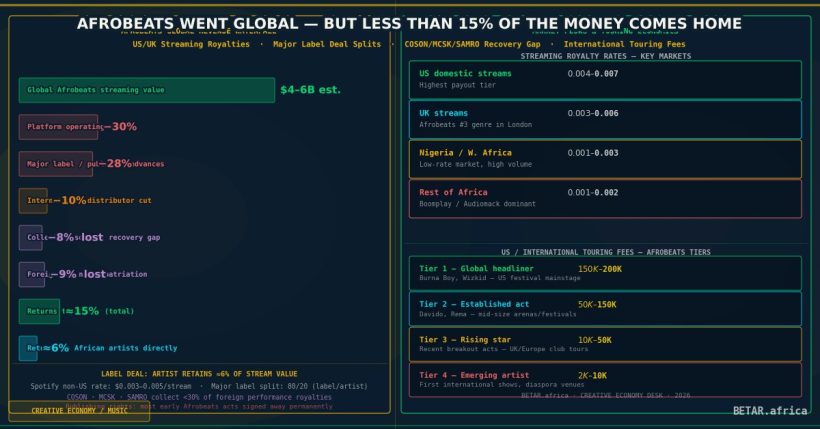
Streaming royalties are not a fixed rate. They are calculated as a percentage of platform revenue in each country, divided by the share of total streams that a given recording generates. Because Spotify’s Premium subscription in Nigeria costs approximately ₦3,500 per month in 2026 — against $9.99 in the United States and £9.99 in the United Kingdom — a stream originating in Lagos generates royalties roughly one-eighth the value of a stream originating in London.
For Afrobeats and Amapiano artists whose audiences are distributed between Africa and the diaspora, this creates a structural royalty dilution. An artist with 40% of their streams from Nigeria and South Africa and 60% from US/UK/Europe will see their blended per-stream rate pulled significantly downward by African-origin plays — even as those plays represent genuine commercial traction.
“Artists don’t understand this until they get their first international statement,” said Adaeze Okonkwo, a music business attorney based in Lagos who has advised on international distribution agreements for more than a dozen Nigerian acts. “You can have a song that’s genuinely charting in three continents and the statement looks like a mid-tier domestic single. The geography is doing a lot of work that isn’t visible.”
IFPI data for 2025 estimated Sub-Saharan Africa represented 16.3% of global streaming volume but only 3.6% of global recorded music revenues — a ratio that has improved only marginally since 2022.
Amapiano’s Distinct Economics
Where Afrobeats’ international breakthrough has followed a relatively established playbook — Nigerian acts signing to major label international divisions with large advances — Amapiano’s global expansion has taken a different commercial path.
Amapiano’s export model has been more organic and distributor-led. Many of the genre’s breakout artists — Kabza De Small, DJ Maphorisa, Focalistic — initially reached international audiences through viral social media uptake rather than label-backed global pushes. This has resulted in a distinct deal structure: major labels have been slower to sign Amapiano acts to international deals, and a larger proportion of the genre’s international streaming revenue flows through independent distributors such as DistroKid, TuneCore, and Africori, with artist royalty shares typically higher (60% to 80%) than under major label recording deals (20% to 50%).
“Amapiano bypassed the traditional label gatekeeping,” said Nolwazi Dube, head of African content partnerships at a streaming platform operating across South Africa, Nigeria, and Kenya. “The artists who built large followings before labels came calling are negotiating from a fundamentally stronger position. Many have retained ownership entirely.”
The trade-off is infrastructure scale. Without major label marketing budgets and global promotions networks, Amapiano artists have relied on organic diaspora spread to reach European and US markets — a slower commercial ramp that delivers higher per-unit margins but lower total volume.
Publishing Rights: The 2026 Battleground
If streaming rates represent the structural baseline of international revenue, publishing rights represent the contested frontier. For crossover Afrobeats hits — tracks that generate sync placements, cover versions, and sample clearances — publishing income can exceed recorded royalties over a catalogue’s lifetime.
Major labels seeking to sign Nigerian and Ghanaian acts have increasingly sought to bundle publishing acquisition with recording deals. The terms of those negotiations have shifted materially as Afrobeats’ commercial leverage has grown.
“We’ve seen a full reversal in four years,” said Emmanuel Osei, a music attorney in Accra who specialises in international deal structures for West African acts. “In 2021, labels were routinely taking 50% of publishing as a deal condition. By 2026, any act with a verified global hit can negotiate full publishing retention with a co-administration arrangement at most. The leverage has moved.”
Co-administration arrangements — where the label’s publishing division administers the catalogue internationally for a fee, typically 15% to 20% of collected income, without acquiring ownership — have emerged as the standard mid-tier structure for artists with international profile but not yet a major crossover hit.
Ghana’s diaspora-linked acts, who often have established European and US performance circuits through the Ghanaian diaspora community, have used that touring leverage to negotiate stronger publishing positions than pure domestic reach would support.
Sync Licensing: Where the Export Premium Concentrates
Synchronisation fees — music licensed for use in film, television, advertising, and streaming platform content — have become the most directly measurable index of Afrobeats’ brand value in Western markets.
For established tracks by Tier 1 acts, global advertising sync fees for one-year exclusive rights range from $50,000 to $250,000 depending on campaign scale and territory. Film and television placements command $10,000 to $80,000 per placement, with streaming platform catalogue licences negotiated as multi-track bulk agreements at negotiated flat rates.
“The volume of enquiries for African music has doubled in two years,” said Kemi Adeyemi, a music supervisor at a London-based sync agency that sources African catalogue for international productions. “What’s changed isn’t just Afrobeats — it’s that brand clients specifically want Amapiano for youth-market campaigns in Europe. The genre has a tempo and texture that works for automotive, fashion, and sportswear advertising.”
The constraint remains rights clearance. The split between collection societies — COSON and MCSN in Nigeria, SAMRO and CAPASSO in South Africa — and international society affiliates creates clearance timelines that frequently run over campaign production schedules. Several large brand campaigns have moved to alternative music choices when African rights clearance stalled, representing direct lost revenue.
Touring Economics: The International Premium
Live performance generates the clearest international premium for established African artists. Headline fees for Tier 1 Afrobeats acts at major US and UK venues range from $350,000 to $800,000 per show in 2026, against domestic Nigerian headliner fees of $15,000 to $100,000 — a 5x to 25x international differential.
For a full European headline tour, gross ticket revenue for a sold-out Tier 1 artist across 10 to 15 dates can reach $6 million to $10 million. After promoter margin (15% to 25%), booking agent commission (10%), management fees (15% to 20%), and production costs, an artist retains approximately 45% to 55% of gross — a significantly higher share than recording or streaming income at equivalent commercial scale.
The touring model also benefits Ghana’s diaspora circuit, which provides African acts with established European audiences in cities with large Ghanaian populations — Amsterdam, London, Frankfurt — reducing promoter risk and enabling earlier international touring before crossover mainstream success.
The Policy Moment
Both Nigeria and South Africa have begun engaging the structural imbalance at the policy level. Nigeria’s Copyright Commission is engaged in WIPO discussions on cross-border royalty transparency. South Africa’s Department of Sport, Arts and Culture published a 2025 Amapiano value chain report that specifically flagged international publishing rights as a governance priority.
For Ghana, the key structural question is whether the diaspora-network advantages that have served as a de facto distribution and touring infrastructure can be formalised through export promotion frameworks targeting the music sector.
Whether those conversations translate into revenue change remains uncertain. What is clear is that the economics of Africa’s global music export are well understood by the infrastructure that captures most of it — and increasingly understood by the artists whose work generates it.
Sources: IFPI Global Music Report 2026; Adaeze Okonkwo, music attorney, Lagos; Nolwazi Dube, streaming platform content partnerships, Johannesburg; Emmanuel Osei, music attorney, Accra; Kemi Adeyemi, music supervisor, London. Additional background interviews conducted on condition of anonymity.


 UphivaBETAR
 Joseph Busari