
Ethiopia Is Selling Electricity to Half of East Africa. Here Is What That Actually Means.
The Ethiopia-Kenya HVDC interconnector is live and exporting hundreds of megawatts south. Tanzania and Uganda are next in line. Ethiopia’s 45-gigawatt hydropower potential is being converted into a regional trade asset — but the economics, the climate risks, and the political dependencies are more complicated than the development finance pitch suggests.
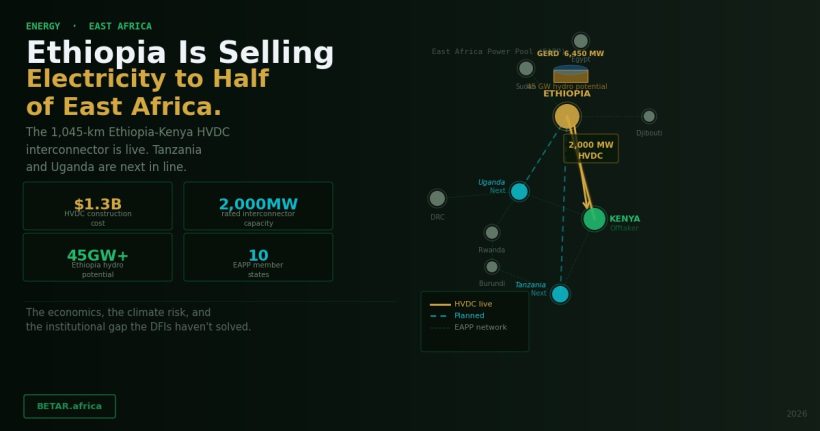
Somewhere beneath the floor of the Great Rift Valley, 1,045 kilometres of high-voltage direct current cable connects two of East Africa’s most important electricity systems. The Ethiopia-Kenya interconnector — built over six years, financed by the World Bank, the African Development Bank, and a constellation of European bilateral lenders, at a total cost approaching $1.3 billion — has been operational since late 2023. It is rated at 2,000 megawatts of eventual capacity. It is currently moving somewhere between 200 and 400 megawatts south from Ethiopia’s grid to Kenya’s, depending on hydrology, dispatch schedules, and bilateral power purchase agreements that neither government publishes in full.
This is, by any measure, one of the most significant pieces of electricity infrastructure built on the African continent in the past decade. And yet it has received almost no analytical attention proportionate to its importance — partly because the headline story (“Africa’s longest HVDC line connects two clean-energy grids”) has been told, and partly because the more interesting and more difficult questions sit underneath that headline.
Those questions are: Who actually benefits from the economics of this trade? What happens to the regional grid when Ethiopian hydrology turns hostile? And is the East Africa Power Pool — the institutional framework that is supposed to govern all of this — functioning well enough to manage what comes next?
The Supply Side: Ethiopia’s Hydro Surplus and Why It Needs Somewhere to Go
Ethiopia’s Grand Ethiopian Renaissance Dam, on the Blue Nile in Benishangul-Gumuz region, has a nameplate capacity of 6,450 megawatts. It is the largest hydropower plant in Africa by installed capacity, and it was built almost entirely by Ethiopian state capital over sixteen years of construction, political confrontation with downstream Egypt and Sudan, and two consecutive years of reservoir filling that placed the country in open diplomatic conflict with Cairo. The dam is now generating electricity. The question Ethiopian Electric Power faces is what to do with all of it.
Ethiopia’s domestic electricity demand is substantial but structurally constrained. Grid connectivity in rural areas remains below 50 per cent. Industrial demand is growing — the country has invested heavily in industrial parks at Hawassa, Bole Lemi, and Kilinto — but absorbing 6,450 megawatts of new generation capacity requires either a massive acceleration of domestic grid expansion or significant electricity exports, or both. The government has chosen both, but the export route is the faster revenue path.
Ethiopian Electric Power’s export strategy is explicit: electricity from the GERD and from the country’s existing hydropower system — which includes major stations at Gilgel Gibe III (1,870 MW), Tekeze (300 MW), and Tana Beles (460 MW) — is being positioned as a hard-currency export commodity. Ethiopia’s electricity export revenues are denominated in US dollars. In a country running a persistent current account deficit and managing chronic foreign currency shortages, power exports are not merely an energy policy — they are a balance-of-payments instrument.
The interconnector to Kenya provides the first major export corridor. Discussions with Tanzania, Uganda, and South Sudan are at varying stages of advancement. The EAPP framework, which includes all of these countries plus the DRC, Rwanda, Burundi, Sudan, Egypt, and Libya, is the institutional structure through which multilateral energy trading is supposed to be governed. Ethiopia sits at the centre of that architecture — geographically, hydrologically, and politically.
The Demand Side: Why Kenya Buys Power It Doesn’t Strictly Need
Kenya’s grid situation is, on its face, paradoxical. The country already generates approximately 76 per cent of its electricity from renewable sources — geothermal, wind, and hydropower — at costs that are competitive by any regional standard. As BETAR has previously reported, Kenya’s clean grid paradox is not a generation problem; it is a distribution and cost-recovery problem. Yet Kenya Power and Lighting Company is a buyer of Ethiopian electricity, and the government has committed to offtake that will likely grow as the interconnector reaches fuller utilisation.
The rationale is partly about baseload security and partly about tariff arithmetic. Ethiopia’s hydropower, dispatched in bulk across an HVDC line with low transmission losses, arrives at the Suswa substation in Kenya’s Rift Valley at a contracted rate that is reportedly competitive with the marginal cost of Kenya’s own thermal peakers — the diesel and heavy fuel oil plants that KPLC still dispatches at the peak demand margin, despite their high operating cost. Displacing those thermal plants with Ethiopian hydro, even at a modest scale, reduces the weighted average cost of generation across the portfolio. It also reduces the carbon intensity of the grid margin.
For KPLC, which is under continuous regulatory pressure from EPRA to justify its tariff levels, any reduction in the marginal cost of electricity supply is worth pursuing. The political optics of buying electricity from a neighbouring state while Kenya still has thermal plants under take-or-pay contracts is awkward — but the commercial logic is defensible.
The Climate Risk That Regional Power Trade Introduces
The Ethiopia-Kenya interconnector is a clean-energy infrastructure project financed on the premise that Ethiopian hydropower is reliable, baseload, and low-carbon. Each of those three premises deserves scrutiny.
On reliability: Ethiopia’s hydropower system is highly concentrated on the Blue Nile and its tributaries. The Blue Nile headwaters in Ethiopia’s highlands receive between 70 and 80 per cent of their annual precipitation in a four-month season between June and September. Years of weak rainfall — which climate modelling suggests will become more frequent and more severe under 1.5°C and 2°C warming scenarios — produce sharp drops in reservoir levels and generation capacity. The GERD reservoir’s fill rate has already been slower than the Ethiopian government’s original projections, partly due to below-average rainfall in the 2023 wet season.
This is not a hypothetical risk. The Southern Africa Power Pool has already demonstrated, through the Kariba and Cahora Bassa drought crises of recent years, that hydropower-dependent regional grids can fail catastrophically when the climatological assumptions embedded in power purchase agreements turn out to be wrong. The EAPP is building its regional energy trade architecture on an assumption of hydrological stability that the climate science community is not prepared to endorse.
On the carbon accounting: Ethiopian hydropower is classified as renewable and zero-emission in standard energy statistics. Large reservoir hydropower is, however, a source of methane emissions from the decomposition of submerged organic material — a factor that is not well-quantified in the GERD context and that has been underweighted in the climate finance due diligence applied to the interconnector project. For projects financed partly on climate rationale, this is a disclosure gap.
The Institutional Question: Is EAPP Ready for What Comes Next?
The East Africa Power Pool was established in 2005 with a mandate to develop a competitive regional electricity market across its ten member states. Twenty years later, it functions primarily as a technical coordination body rather than a genuine market institution. Bilateral power purchase agreements — negotiated government-to-government, with terms that are not publicly disclosed — remain the dominant mechanism for electricity trade. There is no spot market. There is no transparent pricing mechanism. There are no common grid codes enforced across the interconnected systems. There is no supranational regulator.
This matters because the next phase of East Africa’s regional grid integration will require institutional infrastructure that EAPP does not yet provide. Tanzania is currently negotiating interconnector terms with both Ethiopia (via a proposed northern corridor) and with Zambia (via the SAPP system). Uganda’s government has committed to purchasing Ethiopian power. Rwanda’s grid is physically small but sits at the intersection of the DRC, Uganda, Burundi, and Tanzania systems. Coordinating dispatch across five or six bilateral interconnectors without common market rules will produce exactly the kind of inefficiency, undersupply, and cross-border conflict that regional power pools are designed to prevent.
The African Development Bank’s Interconnection Master Plan for Eastern Africa, published in updated form in 2024, identifies the institutional gap as the primary constraint on deeper integration — ahead of financing and ahead of technical infrastructure. That diagnosis has been consistent across multiple reviews. The action has been consistently inadequate.
What This Means for Climate Finance
For development finance institutions and climate funds looking at East Africa’s energy transition, the Ethiopia-Kenya interconnector and the EAPP architecture represent a partial success and a structural warning.
The partial success: a major piece of cross-border clean energy infrastructure was financed, built, and brought into operation. The East Africa Power Pool now moves real megawatts across an international border. Ethiopia has a hard-currency revenue stream from a renewable asset that cost the country enormous political and financial capital to build. Kenya has a marginal-cost advantage at the peak demand boundary.
The structural warning: the regional energy trade being built in East Africa is underpinned by climate assumptions that deserve stress-testing, institutional arrangements that are not ready for scale, and a concentration of hydrological risk in one country’s river basin that could propagate grid instability across multiple sovereign systems simultaneously.
The follow-on infrastructure — Tanzania, Uganda, South Sudan — is now being designed and financed. The institutional reform of EAPP is not keeping pace with the physical build-out. That mismatch is, historically, the pattern that produces expensive failures in African infrastructure. It is worth naming it before the next round of interconnector financing closes.


 UphivaBETAR