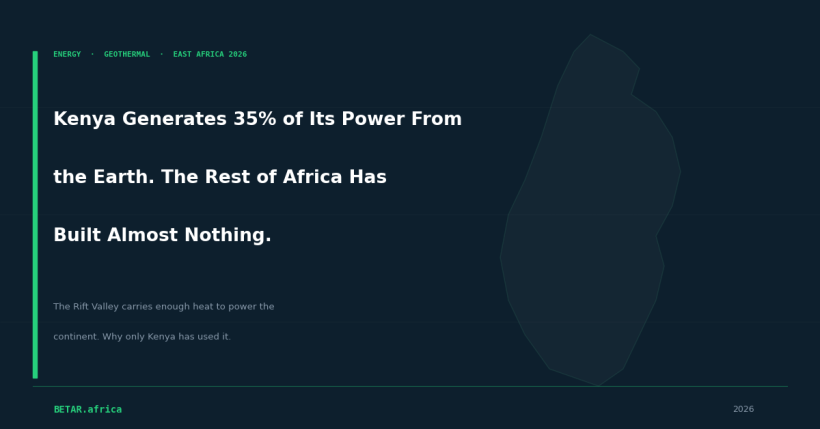

Kenya Generates 35% of Its Power From the Earth. The Rest of Africa’s Rift Valley Has Built Almost Nothing.
The Great Rift Valley runs 6,000 kilometres through the heart of Africa, carrying volcanic heat sufficient to power the continent’s most reliable low-carbon grid. Kenya has proved the model works — 750MW installed, 35% of electricity generation, 24-hour output regardless of clouds or rainfall. Ethiopia, Tanzania, Uganda and Rwanda share the same geological inheritance. They have done almost nothing with it. BETAR investigates why Africa’s most credible baseload energy source remains its most neglected.
At the Olkaria geothermal complex in the Rift Valley, 120 kilometres northwest of Nairobi, the steam never stops. It rises from more than two dozen wellheads drilled into the same volcanic system that created the East African Rift over millions of years, passes through heat exchangers, drives turbines, and feeds Kenya’s national grid continuously — rain, cloud, drought or drought. On a typical afternoon, Olkaria and the newer Menengai field together provide more than a third of Kenya’s electricity at some of the lowest production costs in Africa.
No other country in the continent has managed anything close to this. The Great Rift Valley, the 6,000-kilometre volcanic fracture that runs from the Afar Triangle in Ethiopia through Kenya and Tanzania before forking across Uganda and Rwanda into the Congo basin, carries the same geological heat source beneath every country it crosses. IRENA’s 2025 assessment of Africa’s geothermal potential estimates the continent’s total exploitable resource at over 15,000MW — enough to supply reliable baseload power to every major city from Addis Ababa to Kampala. Installed capacity outside Kenya is negligible.
The gap is not explained by geology. It is explained by financing architecture, political risk, and a set of institutional decisions that Kenya made over four decades — decisions that no other rift valley country has yet replicated at scale.
How Kenya Built a Geothermal Industry
Kenya’s geothermal success traces to a structural choice made in the 1980s: the government allowed KenGen, the state utility, to develop geothermal as a core national infrastructure project rather than treating it as a commercially discretionary investment. Olkaria I came online in 1981 with 45MW. Each subsequent expansion — Olkaria II, III, IV, and V — added capacity through a combination of government balance-sheet financing, multilateral debt from the European Investment Bank, KfW, and the Agence Française de Développement, and concessional loans from the World Bank Group.
The model mattered as much as the money. Because KenGen carried the exploration risk on its own balance sheet — backed by the government — there was no private developer demanding a risk premium that would have made the project economically impossible at the exploration stage. Geothermal economics are brutally front-loaded: drilling a confirmation well costs $5–8 million and carries a genuine probability of a dry result. A private developer pricing that risk into a power purchase agreement produces a tariff that no East African utility can afford. A state entity absorbing the exploration cost as a public investment produces levelised costs that are among the cheapest electricity in Kenya’s mix.
The Geothermal Development Company, created in 2008 specifically to decongest KenGen’s balance sheet and accelerate development, extended the model to Menengai, a caldera near Nakuru with a mapped resource estimated at over 1,600MW. GDC drills the wells, proves the resource, and then licences steam to independent power producers who build the power plants — splitting the exploration risk from the generation investment and making the latter bankable to private capital. Phase 1 of Menengai produced 105MW. GDC is currently in advanced discussions with DFI partners including the African Development Bank for Phase 2 financing, targeting an additional 300–400MW.
Ethiopia’s Stalled Ambition
Ethiopia has more mapped geothermal potential than any other country on the African continent. The Afar Triangle in the northeast is one of the world’s most volcanically active zones. The central Ethiopian Rift hosts dozens of mapped hydrothermal fields. Two large-scale projects have been under development for most of the past decade — and neither has reached commercial operation.
The Corbetti geothermal project, in the southern Ethiopian Rift, has a mapped resource estimated at over 500MW. A consortium led by Reykjavik Geothermal won the development concession in 2013. Thirteen years later, Corbetti has not commissioned a single megawatt of commercial generation. The project has passed through multiple rounds of financing restructuring, force majeure claims during the Tigray conflict, and disputes over the power purchase agreement terms with Ethiopian Electric Power. As of early 2026, the project is nominally alive — but with no committed FID date.
Tulu Moye, a separate 150MW Phase 1 project led by TMGO (a consortium including Meridiam and Électricité de France), was further along the financing curve and reached financial close in 2022 with backing from a consortium of European DFIs. Construction has progressed — but the project has faced repeated delays from transmission interconnection issues, grid capacity constraints, and questions about Ethiopian Electric Power’s ability to take and pay for generation at contractually agreed volumes. Phase 1 commissioning, originally expected in late 2024, has been pushed into 2026 at the earliest.
The Ethiopia story is not a story of absent resource or absent investor interest. It is a story of state offtaker risk that European DFIs have found challenging to de-risk without sovereign guarantees that the Ethiopian government has been reluctant to provide in forms acceptable to lenders. The irony is considerable: Ethiopia has more raw geothermal potential than Kenya, but Kenya’s institutional clarity has produced a functioning industry while Ethiopia’s more complex political and commercial environment has produced a decade of delays.
Tanzania, Uganda, Rwanda: The Rift Valley’s Latent Resource
Tanzania’s portion of the Rift Valley includes the Ngozi and Kiejo-Mbaka fields in the southwest, mapped at a combined potential of over 600MW. The country has conducted resource assessments and drilling programmes with Japanese JICA funding over more than two decades. Progress toward a bankable project has been negligible. The Tanzania Electric Supply Company (TANESCO) faces the same structural challenge as every utility in the region: it cannot credibly commit to a long-term power purchase agreement that satisfies project finance lenders without sovereign backing that the finance ministry views as contingent fiscal liability.
Uganda’s western rift branch crosses the Bwindi highlands and several mapped geothermal prospects near Fort Portal, with resource estimates in the 450–500MW range. Exploration has been conducted in phases since the early 2000s, again largely with bilateral donor funding. Uganda Electricity Generation Company Limited has conducted surface studies and some shallow drilling. No deep confirmation drilling programme is currently funded.
Rwanda is the smallest potential holder but has the most active recent government engagement. The Rwanda Energy Group has been working with Icelandic Geothermal (IGC) and others on resource characterisation at Gisenyi and Bugarama in the west. Rwanda’s geothermal potential is modest — estimated at 170–340MW — but in a country of 14 million with a 250MW total installed capacity, a 100MW geothermal baseload plant would be transformational.
What all three countries share is the same financing problem. The exploration phase — the period between surface survey and the drilling of enough confirmation wells to establish that a commercial resource exists — costs $30–60 million and produces no power. No private developer will absorb that cost at an acceptable equity return given African political risk premiums. Without a state entity like GDC that is explicitly capitalised to carry exploration risk as a public investment, the private capital that would build the power plants never gets a proven resource to finance.
The Baseload Case
The urgency of this failure is sharpening as climate change degrades the continent’s other sources of reliable generation. East and southern Africa’s hydropower systems, which have historically provided the baseload backbone for Kenya, Uganda, Zambia, Zimbabwe, and Mozambique, are under sustained stress from declining rainfall and reduced reservoir levels. The Zambia-Zimbabwe Kariba crisis in 2024 and 2025 forced electricity rationing of up to 18 hours per day in countries that had relied on Kariba for 70% of their power. Tanzania’s Mtera and Kidatu reservoirs have operated below their design water levels for three of the past five years.
Solar and wind, which international climate finance has directed most of its Africa energy investment toward, address a different part of the problem. Both are intermittent: solar generates during daylight hours and is curtailed by cloud cover; wind output is variable and location-constrained. Adding intermittent generation to a grid that lacks baseload stability does not solve the reliability problem — it can worsen it if transmission and storage are insufficient to manage the variability. East Africa currently has minimal utility-scale battery storage capacity.
Geothermal is the one low-carbon resource that runs continuously, at consistent output, in the same geological zones where the demand centres of Ethiopia, Kenya, Tanzania and Uganda are located. Kenya’s experience demonstrates a capacity factor of approximately 85–90% — comparable to nuclear, without the waste management and proliferation complications, and at a production cost that, once built, is among the cheapest on the continent.
IRENA’s 2025 assessment calculated that if the rift valley countries outside Kenya were to develop even 3,000MW of their mapped geothermal potential by 2040 — roughly 20% of the estimated exploitable resource — the impact on grid reliability across East Africa would be greater than any other single energy investment scenario modelled. The scenario has not attracted a dedicated DFI financing programme.
The Financing Gap That Persists
European DFIs — AFD, KfW, EIB, OFID — have collectively financed Kenya’s geothermal industry with over $1 billion in concessional and semi-concessional debt across the Olkaria and Menengai programmes. That capital has produced 750MW of operational baseload generation. The same institutions have funded resource assessments in Tanzania and Uganda without committing equivalent capital to development programmes.
The structural barrier is well understood and has been for years. Geothermal project development requires what the industry calls a “two-company model”: one entity with a public-sector mandate and balance sheet to absorb exploration risk, and a second entity with private sector capital discipline to build and operate the generation plant once the resource is proven. Kenya’s GDC/KenGen architecture is the model. No other rift valley country has built an institution equivalent to GDC — an entity explicitly capitalised, staffed, and mandated to drill confirmation wells and carry the results.
The African Development Bank’s Mission 300 electricity access initiative, announced in 2024, has committed to expanding energy access for 300 million Africans by 2030. Its financing framework has prioritised off-grid solar, mini-grids, and transmission investment. Geothermal — which would provide the most cost-effective long-run baseload solution for the urban centres whose demand is growing fastest — has received negligible dedicated capital in the Mission 300 framework.
Until a DFI consortium or a bilateral donor commits to an exploration risk-absorption fund equivalent to what the World Bank and European lenders provided for Kenya’s Menengai programme — structured as a grant or deeply concessional instrument that covers the cost of drilling non-productive wells — the rift valley’s geothermal potential will remain a geological fact and an energy planning footnote. Kenya built 35% of its grid from the same rock formation that runs through five of its neighbours. The continent’s grid cannot afford to leave the rest of the resource in the ground indefinitely.
What Needs to Happen
The prescription is not complex, but it requires political will from both African governments and their DFI partners that has not yet materialised. Three things would unlock the rift valley’s geothermal potential at scale.
First, each rift valley country needs a GDC equivalent — a ring-fenced state entity with a mandate to drill confirmation wells and carry exploration risk, capitalised with concessional DFI equity that does not appear as sovereign debt under IMF debt sustainability frameworks. This is a solvable structuring problem that has been solved before; the political will to prioritise it over faster-disbursing solar programmes has been absent.
Second, Ethiopia’s existing projects need to reach commercial operation. Tulu Moye’s commissioning in 2026, if it proceeds, would provide the continent’s most important geothermal data point outside Kenya — demonstrating that an IPP-led model with DFI debt can function in a complex East African regulatory environment. Its success or failure will shape investor appetite for the next round of geothermal development across the region.
Third, the Just Energy Transition Partnership frameworks that South Africa, Nigeria, Kenya, and Senegal have negotiated with OECD donors should include a geothermal exploration facility as a dedicated financing instrument. The JETP architecture has allocated capital to solar, wind, and EV infrastructure. It has not addressed the baseload gap that intermittent renewables cannot fill. Geothermal exploration financing is the single most high-leverage intervention available — and it is not in any current JETP work plan.
The earth beneath the Great Rift Valley does not require subsidies, battery storage, or favourable weather. It requires investment in drilling equipment, institutional capacity, and the political decision to treat geothermal development as infrastructure rather than a commercial opportunity. Kenya made that decision forty years ago. The continent has been waiting for others to follow ever since.


 UphivaBETAR