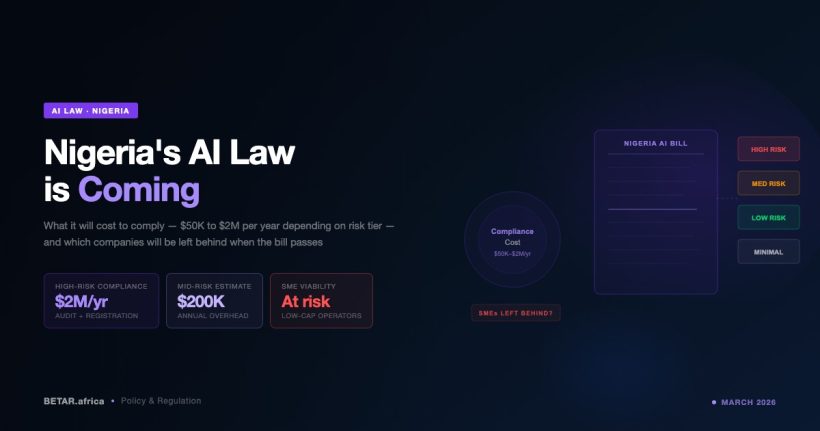

27 March 2026, Abuja — Nigeria has signed its first binding artificial intelligence law, becoming the first major African economy to mandate risk-based licensing for AI systems. President Bola Ahmed Tinubu on Thursday signed the National Digital Economy and E-Governance Bill into law, requiring companies that deploy AI in finance, healthcare, and public services to register with a new National AI Council and complete annual impact assessments before their products go live.
The law passed both chambers of the National Assembly in November 2025. Its signing marks the culmination of a years-long push by Nigeria’s National Information Technology Development Agency (NITDA) to establish a governance framework for AI — and puts Nigeria ahead of every other African country in legislating binding AI obligations.
What the Law Does
At the heart of the legislation is a tiered classification system modelled on the EU AI Act’s risk logic. The National AI Council — with NITDA serving as technical super-regulator — will classify AI products according to their potential for harm. Systems deemed “high-risk” — including AI used in credit scoring, fraud detection, clinical diagnosis, biometric identification, and automated decisions affecting individual rights — must obtain a licence from the Council and submit annual algorithmic impact assessments. All AI systems serving Nigerian users, including those developed abroad, fall within scope.
Companies that fail to comply face fines of up to ₦10 million — roughly $7,000 at current exchange rates — or 2% of their annual gross revenue in Nigeria, whichever is higher. NITDA has authority to suspend product licences, demand data access, and take non-compliant systems offline.
Ecosystem Reaction
The law has drawn a mixed reaction from Nigeria’s startup ecosystem. Investors and founders who have welcomed a clearer regulatory environment acknowledge that the compliance framework — mandatory registration, annual audits, and an undefined approval timeline — places a structural burden on early-stage companies operating on constrained cash runways. Nigeria currently hosts more than 120 AI-focused startups, many operating in the high-risk categories the law targets.
NITDA has not yet published an accredited auditor list or approval processing timelines, leaving the cost and pace of compliance uncertain. Market estimates put first-year compliance costs for a Nigerian fintech with an AI credit-scoring or fraud detection product at ₦13 million to ₦35 million ($9,000–$24,000).
Context
NITDA has been building toward this regulatory moment since publishing Nigeria’s National AI Strategy in August 2024. The agency has positioned itself as a digital economy super-regulator and has signalled ambitions to position Nigeria as Africa’s AI governance standard-setter. The bill’s sponsors, Senator Shuaib Afolabi Salisu in the Senate and Hon. Adedeji Stanley Olajide in the House, framed the legislation as a job-creation and competitiveness measure.
Full compliance requirements are expected to take effect in Q3 2026, pending the National AI Council’s formal establishment and the publication of implementing regulations.
BETAR.africa will publish a detailed analysis of what Nigeria’s AI law means for startups, fintechs, and investors. Read our in-depth compliance guide: Nigeria’s AI Law: What It Will Cost to Comply — and Who Gets Left Behind.
Reporting by BETAR.africa Technology Desk. Published 27 March 2026; updated 5 April 2026.


 Joseph Busari

 UphivaBETAR