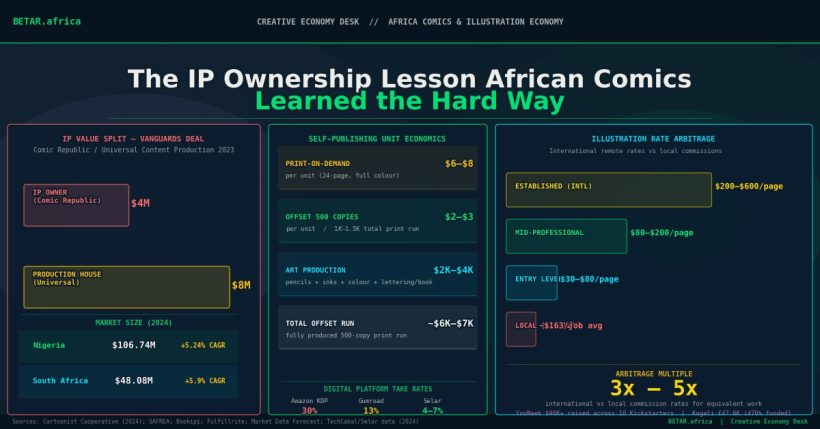

When Universal Content Production signed a deal with Lagos-based Comic Republic in 2023 to develop its Vanguards universe for television, the Nigerian comics publisher walked away with approximately $4 million from the arrangement. The production house that packaged and managed the adaptation reportedly earned nearly twice that amount. Comic Republic owned the IP; someone else owned the production value chain. The gap between those two numbers is the central economic lesson of Africa’s comics and illustration industry.
The Size of the Market
Nigeria’s comic book and graphic novel market was valued at approximately $106.74 million in 2024, growing at a 5.24 percent compound annual growth rate toward an estimated $169.53 million by 2033. South Africa’s market sits at $48.08 million, expanding at 5.9 percent annually. These figures from market research aggregators represent indicative scale, not audited transaction data — no pan-African clearing system tracks actual comics sales receipts — but the directional picture is consistent with what publishers and platform operators report on the ground.
Digital formats account for roughly 35 to 42 percent of African consumption; manga, primarily consumed through scanlation sites (platforms hosting unauthorised translated versions) rather than paid channels, represents 42 to 48 percent of readership. The commercially addressable paid market is narrower than total readership implies.
Self-Publishing: The Unit Economics
For the majority of African comic creators who have not landed a licensing deal or a publishing partnership, self-publishing defines the business reality.
Print-on-demand at true one-off volumes costs $6 to $8 per unit for a standard 24-page full-colour comic. Offset printing at 500 copies brings that to $2 to $3 per unit — a total print run cost of $1,000 to $1,500 — but requires upfront capital and inventory management. Add professional art production (pencils, inks, colours, lettering) at market rates of $2,000 to $4,000 for a 24-page book, and a professionally produced 500-copy offset run represents a total investment of approximately $6,000 to $7,000 before any revenue returns.
Digital distribution changes the economics substantially. Amazon KDP offers a 70 percent royalty on eBooks priced at $2.99 to $9.99, with delivery fees reducing the effective rate slightly. Gumroad charges a flat 10 percent plus payment processing, leaving creators with approximately 87 percent of each sale. Selar, the dominant African digital commerce platform, operates at 4 to 7 percent commission — meaningfully better economics for creators selling to African audiences in local currencies. Selar paid out ₦9.8 billion (approximately $6.4 million at 2024 rates) to 241,000 creators across all digital product categories in 2024.
Roye Okupe, founder of YouNeek Studios in Lagos, built the most commercially documented African comics self-publishing operation over a decade. His Malika: Warrior Queen series has sold more than 100,000 copies worldwide since 2016 across a mix of Kickstarter campaigns and retail distribution. He is precise about the early years: “For the first four years, I didn’t make a dime from YouNeek Studios. I didn’t pay myself.” Okupe funded the studio’s early period from freelance web development income and cashed out his retirement savings to keep production running. The business did not reach financial stability until he secured a full-time employment income alongside it — a common dual-track structure for African comics entrepreneurs.
YouNeek raised more than $90,000 across ten Kickstarter campaigns since 2015, with individual campaigns ranging from $10,093 to $20,555 per project. Kugali Media, the Nigerian-Ugandan studio behind Iwájú, raised £47,576 from 1,384 backers on a £10,000 goal for its NANI: African Mythology Graphic Novel campaign in 2020 — 476 percent funded. The Kickstarter ceiling for African comics is determined by global diaspora audience size rather than production quality; £10,000 to £50,000 per campaign is the realistic range for established creators with international followings.
The Licensing Architecture
The deals that generate the most significant revenue in African comics involve IP licensing to international entertainment companies — and the structure of those deals determines who captures most of the value.
Okupe’s 2021 arrangement with Dark Horse Comics is the most creator-favourable documented structure in African comics: a ten-book publishing deal (later extended to twenty) in which Dark Horse handles printing, distribution, and retail placement while Okupe retains 100 percent IP ownership. He has compared it explicitly to Robert Kirkman’s Skybound relationship with Image Comics — a model where the creator uses a major publisher’s infrastructure without surrendering ownership. The financial terms (advance, royalty rate) have not been disclosed, but the IP retention principle is the operative economic decision.
The Kugali/Disney collaboration for Iwájú worked differently. Disney Animation partnered with Kugali in what Disney described as a “first-of-its-kind” arrangement — the first time the studio collaborated with an outside company in its hundred-year history. Hamid Ibrahim, Kugali’s co-founder, has described how the partnership originated: “Just imagine you’re sitting there. A young creative, right? You just called out the grandaddy of visual entertainment. You just said you’re going to kick their ass. Then somebody reaches out and says ‘hi’ and wants to talk.” A BBC interview in which Ibrahim discussed wanting to challenge Disney had reached Disney’s Chief Creative Officer Jennifer Lee, who made contact. The resulting structure preserved Kugali’s cultural consultation authority while Disney Animation provided production infrastructure and global distribution on Disney+. Financial terms remain undisclosed.
Somto Ajuluchukwu, founder of Vortex Corp in Lagos, has built a model that attempts to capture both ends of the licensing chain. “The industry here in Africa is largely underfunded,” he told ART AFRICA Magazine. “It was a Herculean task for us to raise funding, but we pushed through.” Vortex Corp operates VX Animation as a B2B animation services business for music industry clients — the commercial revenue stream that funds the studio’s IP development — while maintaining an in-house digital comics platform (Vortex247) and pursuing international production deals. The Hollywood Reporter reported a 2022 exclusive production deal between Vortex Corp and Los Angeles-based Emagine Content for screen adaptations of the Vortex catalogue; financial terms were not disclosed.
Illustration Rates: The Global Arbitrage
African illustrators working for international clients through global freelance platforms occupy a structural position between Southeast Asian and Latin American market rates and Western European rates.
Comic book illustration at the mid-professional level commands $80 to $200 per finished page for African illustrators working remotely for international publishers, based on data from the 2024 Cartoonist Cooperative Comics Worker Survey and Vox Illustration’s 2025 benchmarks. Entry-level work runs $30 to $80 per page; established professionals with major publisher credits reach $200 to $600. The Cartoonist Cooperative’s survey, drawn primarily from US respondents, found average pencilling and inking rates of $87 per page, colouring at $68 per page, and lettering at $43 per page — rates that African illustrators working for US publishers can approximate but rarely exceed.
Local commission rates are materially lower. South Africa’s SAFREA (Southern African Freelancers’ Association) guidelines recommend R400 to R500 per hour for illustration, translating to approximately R4,000 per full day — roughly $215 to $270 at current exchange rates. Nigerian illustrators on global platforms average approximately $163 per job across all categories, the lowest average among African peers surveyed by Bookipi in 2024, reflecting both lower project values and a concentration in entry-level digital work.
The arbitrage is real: an African illustrator taking international remote commissions can earn three to five times what local brand or publishing clients will pay for equivalent work. The constraint is access to those international clients, which requires portfolio visibility in markets where African illustrators remain underrepresented.
The Convention Revenue Layer
For creators without licensing deals or platform scale, Comic Con Africa in Johannesburg and Cape Town functions as the primary direct-to-reader revenue event. The 2024 Johannesburg edition drew 70,000 visitors over its run, with more than 300 exhibitors and 97.3 percent of Cape Town exhibitors indicating plans to return the following year. Individual vendors describe the convention circuit as “the biggest sales outlet of the year” — generating not only direct sales but post-event custom order relationships that extend revenue across the following months.
No public data exists on individual booth costs or average vendor revenue per event. Comic Con Africa has not published booth-level P&L benchmarks, and the fragmented nature of the exhibitor base — ranging from established publishers to individual artist tables — makes aggregate data difficult to construct. The convention economics remain opaque in the same way that most of Africa’s comics business remains: visible in deal announcements, invisible in margin data.
The Structural Lesson
The Comic Republic/Universal case quantifies what the IP retention conversations are really about. Four million dollars to the IP licensor; nearly eight million dollars to the production house. Comic Republic now operates its own content studio (CR Motion+) specifically to capture the production chain value that the Universal deal revealed it was leaving on the table. YouNeek retained full IP on its Dark Horse deal and received VC backing from Impact X Capital for animation development. Kugali negotiated cultural authority and co-production status rather than a rights sale.
The pattern is consistent: the studios and creators who have built durable businesses have structured every international deal around the same principle. African comics IP is valuable enough to attract Disney, Universal, and Dark Horse — and sufficiently undervalued in cash terms that every deal the industry has done in the past five years functions as a lesson in how much more there was to ask for.
Sources: Roye Okupe, YouNeek Studios (SYFY Wire); Somto Ajuluchukwu, Vortex Corp (ART AFRICA Magazine; Publishers Weekly); Hamid Ibrahim, Kugali Media (VFX Voice; OkayAfrica); Comic Republic/Universal deal analysis; CNN, Disney-Kugali Iwájú partnership (December 2020); Hollywood Reporter, Vortex/Emagine Content deal (January 2022); Cartoonist Cooperative Comics Worker Survey (2024); SAFREA freelance rates (2022); Fulfillrite, self-publishing cost analysis; Vox Illustration, comic book page rates (2025); TechCabal, Selar creator payout data (2024); RX Global, Comic Con Africa 2024 attendance; Market Data Forecast/Grand View Research, Africa comics market estimates.
 UphivaBETAR

 Joseph Busari