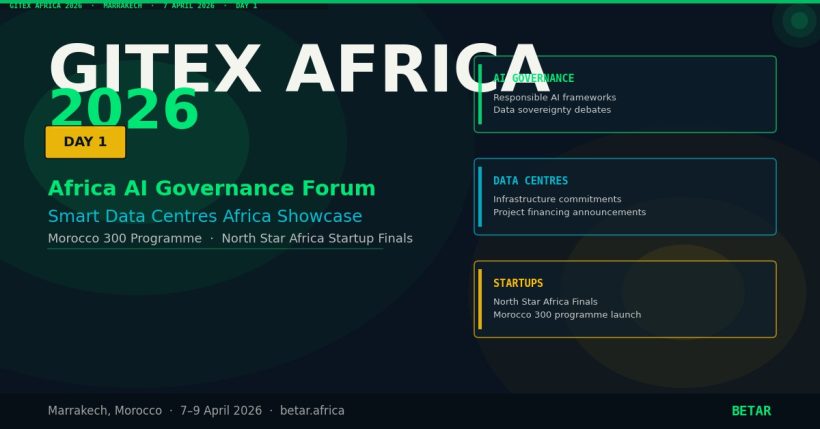

MARRAKECH — When Africa’s largest technology gathering opened its fourth edition in Marrakech on Tuesday, the question at the centre of the hall was not whether artificial intelligence would reshape the continent — but who would write the rules.
Day 1 of GITEX Africa 2026 brought together more than 55,000 delegates from over 130 countries — including first-time delegations from Croatia, Czechia, Denmark, Guinea, Hungary, Luxembourg, Thailand, and Zambia — under the patronage of King Mohammed VI. The programme was built around a single binding anxiety: Africa has a digital sovereignty problem, and the window to act is closing.
Alongside the Africa AI Governance Forum, the event opened parallel conference tracks — the GITEX Africa Executive Summit, the Connected Future Summit, and the Founders’ Room — giving the day an unusual density of simultaneous proceedings across policy, infrastructure, and startup capital.
Morocco’s Moment
Morocco’s Minister Delegate for Digital Transition and Administrative Reform, Amal El Fallah Seghrouchni, has spent the past year positioning her country as what she calls Africa’s “third voice” on global AI governance — distinct from the Washington consensus and from Beijing’s infrastructure-for-data model.
Her keynote on Tuesday set the terms for the day. In her pre-event remarks, the Minister had laid out Morocco’s ambition without ambiguity: “Artificial intelligence represents a structuring opportunity for Africa, driven by a young human capital, rapidly expanding innovation ecosystems, and increasing investments in digital infrastructure. The Kingdom of Morocco’s ambition, in line with the High Directives of His Majesty King Mohammed VI, is to make AI a pillar of digital sovereignty, economic competitiveness, and territorial inclusion through the development of talent, the strengthening of technological capacities, and the promotion of an innovative and responsible ecosystem.”
The backdrop is Morocco’s Digital X.0 framework — legislation that embeds AI governance, data protection standards, and a new national digital identity architecture into a single legal structure. The law is the legal backbone of Morocco’s Maroc Digital 2030 strategy, which targets AI as a $10 billion economic pillar by decade’s end.
In a notable signal of where Morocco is placing its bets, the Ministry earlier this year announced a partnership with French AI startup Mistral to establish a multilingual AI laboratory in Rabat — developing models in Arabic, Amazigh, and other African languages. It is a direct challenge to the dominance of English-first large language models that have limited commercial AI applicability across North and West Africa.
The Data Centre Reality Check
If AI governance was the ideological heart of Day 1, data infrastructure was its money conversation.
A dedicated Smart Data Centres Africa showcase put hard numbers on the table: Africa’s hyperscale data centre market currently stands at $6.7 billion and is projected to surpass $28 billion by 2030. Analysts estimate the continent needs at least 1,000 MW of new data centre capacity across some 700 facilities to meet surging AI workload demand — a buildout that requires binding capital commitments, not letters of intent. That trajectory requires roughly $3.5 billion in annual investment — a figure that sits well above current committed capital.
Morocco is positioning itself as the continent’s edge computing launchpad. The country leads Africa with 23-plus operational data centre facilities and passed a landmark data sovereignty law in 2021 requiring sensitive data to be stored within national borders — a regulatory anchor that gives hyperscalers unusual certainty when scoping African deployments. With a 5G rollout accelerating and a new wave of national edge infrastructure deployments, Rabat’s pitch is regulatory clarity plus geographic advantage: the shortest submarine cable route between Africa and Europe passes through Moroccan waters.
BETAR has previously reported on the 3x cost premium African developers pay for compute versus their counterparts in the US or Europe. The data centre commitments at GITEX signal that closing that gap is moving from aspiration to balance sheet.
Morocco 300: Startups as Sovereignty
The Morocco 300 programme — an expansion of last year’s Morocco 200 — sent 300 Moroccan startups to the GITEX floor, with the Ministry of Digital Transition and the Digital Development Agency (ADD) covering 95% of their participation fees. That is a 50% increase in domestic company presence in a single year, and a deliberate political statement: Morocco’s digital ambitions are not just about attracting foreign capital; they are about building companies that stay.
Across the hall, North Star Africa — the continent’s largest startup showcase — drew more than 800 local and international startups competing for investment from over 400 global investors collectively managing $350 billion in assets. The backdrop was a strong 2025: African startup funding reached $3.9 billion last year, its highest level since 2022, and GITEX Africa’s investor base was primed to find the next cohort of breakout companies. The Supernova competition’s $100,000 prize pool added competitive weight to what is already the continent’s highest-density investor access point for early-stage founders.
Key Day 1 Numbers
| Metric | Figure |
|---|---|
| GITEX Africa 2026 edition | 4th |
| Expected attendees | 55,000+ |
| Exhibiting companies & startups | 1,800+ |
| Countries represented | 130+ |
| Event dates | 7–9 April 2026, Marrakech |
| Investors attending | 400+ ($350B AUM) |
| Morocco 300 startups | 300 (95% fees covered) |
| North Star Africa startups | 800+ |
| Africa hyperscale data centre market (2025) | $6.7 billion |
| Africa hyperscale data centre market (2030 projection) | $28 billion+ |
| AI projected contribution to Africa’s economy (2030) | $1.2 trillion |
| Morocco AI pillar target (2030) | $10 billion |
| North Star Africa Supernova prize pool | $100,000 |
| New-entry countries (debut 2026) | 8 |
BETAR.africa is reporting live from GITEX Africa 2026 in Marrakech. This article will be updated as Day 1 proceedings conclude.
 UphivaBETAR
 Joseph Busari