
Africa’s data centre landscape is undergoing its most dramatic transformation in history. From Lagos to Nairobi, Cairo to Cape Town, a wave of hyperscale investment is landing on the continent — and the stakes extend far beyond server racks and fibre cables. In 2026, who builds Africa’s cloud infrastructure will shape who controls its digital future.
The Numbers Behind the Boom
The scale of investment is striking. Africa’s data centre market, valued at approximately $2.22 billion in 2026, is forecast to reach $4.36 billion by 2031 — a compound annual growth rate of 14.46%, well above the global average. McKinsey projects that data centre capacity across the five largest African markets will jump from around 400 megawatts today to between 1.5 and 2.2 gigawatts by 2030.
Yet the continent remains vastly underserved. Africa currently hosts just 223 operational data centres across 38 countries — less than 0.02% of the global total of more than 11,800 facilities. That gap represents both a challenge and, for investors, an enormous opportunity.
The Big Players Moving In
Global hyperscalers are accelerating their African footprints.
Microsoft has committed $300 million to cloud and AI infrastructure in South Africa by end-2027, making it one of the largest single-country tech infrastructure pledges in Africa’s history. In Kenya, Microsoft has partnered with UAE-based G42 to develop a 100 MW data centre campus powered by geothermal energy drawn from the Olkaria field — a $1 billion investment that would make it one of the greenest hyperscale facilities on the continent.
Equinix, the world’s largest data centre operator, announced a new $22 million facility in Lagos in late 2025 — the LG3 — as the first phase of a broader $100 million commitment to transform Nigeria’s digital infrastructure. The Lagos campus is expected to come online in Q1 2026.
Africa Data Centres, one of the continent’s largest indigenous operators, is expanding aggressively across South Africa and Nigeria, while Teraco, owned by Digital Realty, has plans to launch four new South African facilities in 2025–2026 at a combined investment of approximately $877 million. Nxtra by Airtel, which broke ground on a 38 MW hyperscale facility in Lagos in early 2024, is targeting operational status in 2026.
Geographic Concentration — and Its Limits
South Africa remains the clear leader, hosting 56 data centres and accounting for over 40% of the continent’s total market share. Kenya (19 centres) and Nigeria (17) follow, with Egypt emerging as the fastest-growing market in North Africa — anchored by Huawei’s $300 million, five-year commitment to its Cairo cloud region.
But concentration is also a vulnerability. Africa’s “Big Four” — South Africa, Kenya, Nigeria, and Egypt — account for nearly half of all continental data centre capacity, leaving the remaining 50-plus countries severely underserved. Analysts expect secondary markets including Ghana, Ethiopia, and Côte d’Ivoire to attract increased investment through 2028, driven by improving regulatory frameworks and undersea cable connectivity.
Hyperscale vs Edge: A Dual-Track Build-Out
Africa’s data centre expansion is playing out on two tracks simultaneously.
Colocation facilities — where multiple tenants share physical infrastructure — currently dominate, capturing an estimated 85% of revenue. But hyperscale and self-built campuses are growing fastest, projected to advance at a 25% CAGR through 2031 as AI workloads and cloud-native enterprise applications drive demand for dedicated capacity.
Edge computing is also gaining attention, particularly in markets where latency is a barrier to services like real-time payments, health diagnostics, and autonomous systems. Several operators are exploring micro-data centres closer to population centres — a model that could extend the digital economy’s reach to secondary cities and rural areas.
The Sovereignty Imperative
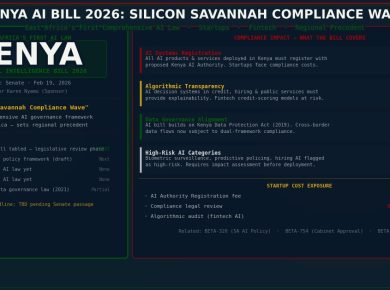
The investment surge is arriving alongside a new wave of data localisation regulation. By early 2026, 44 African countries have enacted data protection laws, and 38 have established functional data protection authorities — a dramatic shift from just five years ago when enforcement was largely symbolic.
Nations including Kenya, Ghana, Nigeria, and Algeria now mandate that certain categories of data be stored or processed within their borders. Nigeria’s National Digital Economy Bill, expected to be signed into law in Q2 2026, will create a comprehensive regulatory framework with direct implications for where multinationals locate their infrastructure.
For foreign investors, these requirements add compliance complexity. For local operators and African governments, they create leverage — the ability to require that infrastructure investment translates into genuine in-country capacity, not merely regional routing through South Africa or Europe.
The question facing Africa’s infrastructure build-out is no longer whether the continent needs data centres — it is whether it can build them fast enough, and on its own terms.
The Power Problem
None of this buildout is straightforward. Energy remains the defining constraint.
Nigeria’s national grid delivers an average of roughly four hours of reliable power per day in major urban centres — an impossible baseline for mission-critical infrastructure. Across the continent, operators are investing heavily in on-site redundancy: diesel generators, lithium-ion battery storage, solar arrays, and hybrid power systems.
The cost burden is significant, but it is also catalysing a parallel energy transition. South Africa’s Africa Data Centres is developing a 12 MW solar farm in partnership with Distributed Power Africa. Kenya’s data centre operators benefit from a national grid that is already more than 60% renewable — geothermal, solar, wind, and hydro — making Nairobi one of the most energy-sustainable data centre locations globally.
The African Energy Chamber has argued that data centre demand could be “the spark Africa’s power sector needs” — driving the scale of private investment in generation and transmission that government budgets alone cannot achieve.
The Bigger Picture
What is happening in Africa’s data centres is not merely an infrastructure story. It is a contest over who shapes the continent’s digital stack — and, by extension, its economic sovereignty in an increasingly AI-driven global economy.
The continent is building fast. The challenge is to build smart: ensuring that investment flows create local jobs, develop indigenous engineering talent, comply with African regulatory frameworks, and leave the continent better positioned to host its own data — not just route it offshore.
The boom is real. The harder question is whether it will be transformative.

 UphivaBETAR