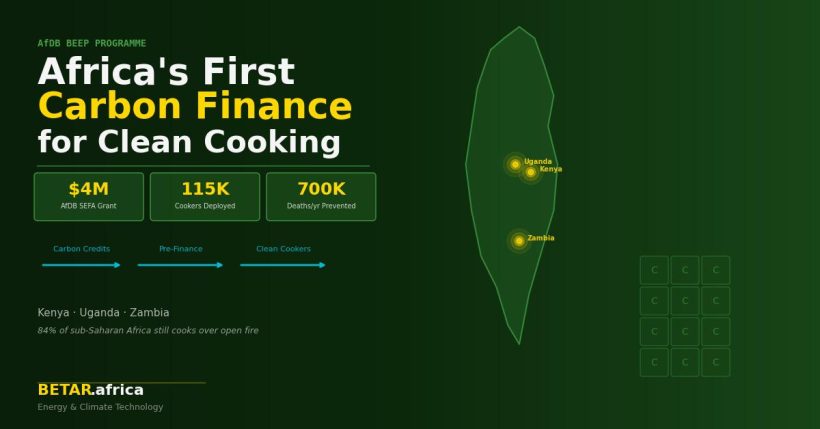

Across sub-Saharan Africa, 84 percent of the population still cooks over open fires or on inefficient charcoal stoves. It is a fact that has barely shifted in decades, and the cost is staggering: nearly 700,000 premature deaths a year from indoor air pollution, the majority of them women and children inhaling toxic smoke inside their own homes.
Clean cooking has long been treated as an intractable problem — one that aid organisations understand viscerally but that commercial investors have consistently walked past. A new deal struck by the African Development Bank is testing whether carbon markets can rewrite that calculus.
Carbon Credits as the Mechanism
The African Development Bank’s Sustainable Energy Fund for Africa (SEFA) announced a $4 million reimbursable grant to fund what it is calling the Burn Electric Cooking Expansion Program — BEEP — a scheme to deploy 115,000 Burn ECOA Electric Induction Cookers across grid-connected low-income households in Kenya, Uganda, and Zambia.
The finance structure is the part worth watching. BEEP is capitalised through a Special Purpose Vehicle combining the $4 million SEFA grant, a $5 million loan from the Spark+ Africa Fund, and $1 million in equity from Burn Manufacturing itself. The critical innovation: the scheme uses voluntary carbon credit sales to pre-finance the cookers, dramatically reducing the upfront cost that has historically been the single biggest barrier to clean cooking adoption among low-income households.
For the African Development Bank, it is a milestone. BEEP represents the institution’s first-ever carbon finance transaction specifically targeted at electric cooking — a signal that AfDB is moving beyond traditional grant and debt instruments into the voluntary carbon market as a tool for development impact.
“Carbon finance can unlock what grants and loans alone cannot. By monetising the verified emissions reductions from switching households off charcoal, we can pre-finance the hardware and make clean cooking genuinely affordable at scale.” — AfDB/SEFA programme note
The Math Behind the Model
The logic is straightforward: each household that switches from charcoal to an electric induction cooker generates a measurable, verifiable reduction in greenhouse gas emissions and indoor pollutant exposure. Those reductions can be certified as carbon credits and sold on the voluntary market to companies seeking to offset their own emissions.
BURN’s ECOA cooker is IoT-enabled — meaning usage data is monitored in real time, allowing precise measurement of emissions reductions and supporting the credibility of carbon credit issuances. That digital backbone is not incidental; it is what makes the carbon finance layer possible at institutional quality.
The voluntary carbon market in Africa has expanded sharply. In 2023, Nairobi hosted the largest voluntary carbon credit auction ever held on the continent. Eveready East Africa has since announced a formal pivot into carbon markets and EV financing as core business lines. The ecosystem that BEEP needs to sell its credits into is, for the first time, actually there.
Scale of the Problem
The numbers demand urgency. Globally, approximately 2.1 billion people still cook with solid fuels — wood, charcoal, crop waste, coal, and dung. Sub-Saharan Africa has the highest concentration of any region. In 2021, household air pollution killed 237,000 children under five years old globally. Women and children represent 60 percent of all early deaths from cooking smoke in Africa.
The health economics are equally stark. According to the World Health Organisation, lower respiratory infections — the primary cause of cooking smoke deaths — cost African health systems billions in treatment costs annually, far exceeding the cost of clean cooking transitions if financing were available at scale.
The AfDB has pledged $2 billion over ten years to address the clean cooking gap, a commitment made at the Mission 300 Energy Summit where African leaders formally aligned behind electrification and clean cooking targets. The BEEP programme is among the first concrete disbursements under that umbrella.
Why This Matters Beyond One Programme
115,000 cookers is not a transformative number on its own. Sub-Saharan Africa has more than 800 million people without access to clean cooking. But the financial model is the story.
If BEEP demonstrates that carbon credit revenue can systematically reduce the upfront cost barrier — and that IoT-enabled devices can generate the data quality needed to satisfy voluntary market buyers — it creates a replicable template that can be applied across the continent at far greater scale than any single DFI grant programme could achieve.
Several questions remain. Voluntary carbon markets are notoriously volatile, and credit prices have faced headwinds since the 2023 Verra certification controversy. Whether carbon credit revenue can remain reliable enough to anchor a financing structure at scale depends partly on market conditions outside any programme designer’s control.
There is also the question of grid reliability. BEEP targets grid-connected households — a reasonable starting point, but one that excludes the rural households who are often the most charcoal-dependent. Future iterations of the model may need to integrate mini-grid or solar home system infrastructure to reach those communities.
The Signal
For Africa’s clean energy sector, the AfDB BEEP programme is a proof-of-concept moment. The continent generates an enormous volume of verifiable emissions reductions every day — in deforestation avoided, in solar replacing diesel, in charcoal replaced by electricity. Converting that environmental asset into upfront finance for the households and communities that generate it is a structurally attractive idea.
Whether carbon markets are reliable enough to carry that weight is the test that BEEP will run in Kenya, Uganda, and Zambia. The result will be watched closely by clean energy investors, development finance institutions, and the scores of clean cooking companies that have been waiting for someone to prove the model works.
Sources: African Development Bank / SEFA press release; Efficacy News; ESI-Africa; African Sustainability Matters; WHO Household Air Pollution Fact Sheet; IEA Clean Cooking Access Report; Nairobi Business Monthly.

 UphivaBETAR
 Joseph Busari