
Nollywood’s Streaming Economy: What the Platforms Paid, What They Didn’t, and What Comes Next
For a brief period between 2022 and 2023, it appeared that global streaming platforms had fundamentally rewritten the economics of Nigerian cinema. Netflix was commissioning Lagos originals. Amazon Prime Video signed multi-year exclusive output deals with three of Nigeria’s most commercially active studios. Showmax committed to more than 1,300 hours of African originals. The money flowing into Nollywood from international platforms looked, from the outside, like a structural transformation. The numbers, examined carefully, tell a more complicated story — and by March 2026, two of those three platforms have exited the market entirely.
What Netflix Actually Paid
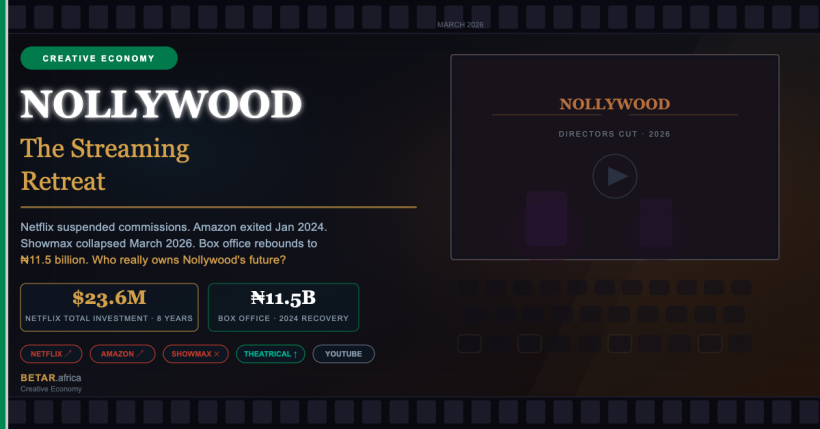
Netflix’s cumulative investment in Nigeria’s film industry between 2015 and 2023 totalled $23.6 million, according to figures the company released in early 2023. That investment supported approximately 283 licensed Nigerian titles and 5,140 jobs over eight years. Spread across that period, the average annual investment was roughly $2.9 million — a figure that, while significant to individual producers, is modest in the context of an industry that generates approximately ₦1.97 trillion ($1.2 billion at pre-devaluation rates) annually in combined revenues across film and music.
The deal structure varied significantly by type. For licensed titles — films the platform acquires rights to rather than commissions — Netflix pays Nigerian filmmakers between $10,000 and $90,000 per film, a range that reflects director profile, production budget, and projected audience fit. For commissioned originals, where Netflix finances production directly, the sums are larger but the terms are qualitatively different: Netflix funds 100% of production costs plus a 15 to 30 percent overhead margin, then acquires all global rights in perpetuity. Producers receive a production fee and, under standard contract terms, give up all backend participation and IP ownership. The commercial case for a Nigerian studio to pursue commissioning rested entirely on that production fee — the downstream life of the content generated no further income.
The structural problem with this model became apparent when Netflix’s subscriber economics in Nigeria were examined. Industry estimates, including a figure cited publicly by comedian and filmmaker AY Makun in December 2024 based on data he said he received from within the industry, put Netflix’s Nigerian paid subscriber count at approximately 300,000 — in a country of more than 200 million people, with a penetration rate below 1.5% of the population. South Africa, with a fraction of Nigeria’s population, holds approximately 1.17 million Netflix subscriptions. The revenue that could be generated from a 300,000-subscriber base at standard Nigerian pricing — approximately $1.99 to $3.99 per month — was insufficient to justify per-title commissioning fees in the range of $2 to $5 million.
In November 2024, Netflix suspended new commissioning and funding of Nigerian originals. The company publicly denied an exit — stating that it would continue licensing Nigerian content — but the practical distinction mattered: licensed titles carry far lower fees than commissioned originals, and the commissioning money was what had funded production at scale. By the end of 2024, several projects already in development had been cancelled. Netflix’s target of approximately 15 Nigerian originals per year, itself a reduction from earlier ambitions, had effectively been brought to zero for new greenlight decisions.
Amazon’s Entrance and Exit
Amazon Prime Video entered the Nigerian market in August 2022 with a more aggressive initial commitment than Netflix had made: two inaugural Nigerian originals — Gangs of Lagos and LOL: Last One Laughing Naija — plus multi-year exclusive output deals with Jade Osiberu’s Greoh Studios, Inkblot Productions, and Anthill Studios. These were the three studios behind some of Nollywood’s most commercially successful productions of the preceding five years. The exclusivity terms meant Amazon had effectively captured the production capacity that mattered most to Nigerian audiences. The financial value of those deals was never publicly disclosed.
In January 2024, Amazon shut its African and Middle East content operations as part of a broader restructuring. Existing commitments were honoured; future work was not. The exit came roughly 18 months after the market entry. ThisDay Live described the departure as leaving “a gaping investment hole in Nollywood” — a direct description of what the exclusive output deals had created: a pipeline locked to a platform that then withdrew. Greoh, Inkblot, and Anthill were each left to renegotiate their distribution strategy within a window already contracting.
The Showmax Collapse
Showmax was, by volume and ambition, the most committed commissioner of African content among global streaming platforms. Following its February 2024 relaunch as Showmax 2.0 — with NBCUniversal taking a 30 percent stake for $29 million — the platform committed to 1,300 hours of African originals, representing a 150 percent increase in production volume. In Nigeria, it grew from an initial original series to 82 African originals across its catalogue by 2025, positioning itself explicitly as the alternative to a retreating Netflix and a departed Amazon.
The economics of that commitment were not viable. Between 2023 and 2025, Showmax generated $204 million in cumulative revenue against $523 million in operating losses — losing approximately $2.50 for every dollar earned. In the financial year ending March 2025, trading losses surged 88 percent to R4.9 billion, approximately $270 to $300 million. NBCUniversal injected $85 million in 2025 to sustain operations. On March 5, 2026, Canal+ confirmed it was discontinuing Showmax after 11 years of operation. The platform had been the single most active commissioner of Nigerian content in the market at the time of its shutdown.
The combined effect of Amazon’s January 2024 exit and Showmax’s March 2026 closure is a streaming commissioning market for Nollywood that, as of the current moment, consists primarily of a Netflix operating in licensing-only mode. The total estimated annual value of streaming licensing to Nollywood across all platforms — a figure based on industry insider estimates rather than audited accounts — stands at $30 to $50 million per year. That aggregate is being squeezed on both sides: fewer commissioning buyers and a licensing market where the dominant remaining platform is actively managing its Nigerian exposure downward.
Theatrical Economics Now Lead
The shift in the streaming landscape has forced a re-evaluation of the theatrical-versus-streaming question that had appeared settled in favour of platforms just three years earlier. Nigeria’s 2024 cinema box office totalled ₦11.5 billion, a 60 percent increase from ₦7.2 billion in 2023, with cinema admissions rising to 2.66 million. Lagos accounted for ₦5.8 billion — more than half the national total. The top performer, Everybody Loves Jenifa, grossed ₦1.13 billion and became the first Nollywood title to cross the billion-naira threshold at domestic box office.
For major Nollywood productions with production budgets in the ₦300 to ₦600 million range — roughly $190,000 to $380,000 at late-2024 exchange rates — theatrical release now offers a more reliable revenue path than streaming commissioning. A film that performs at the top of the box office for three weeks can return multiples of its production cost before a streaming window opens. The standard licensing fee for a commercially successful theatrical title remains in the $50,000 to $200,000 range — a supplement to theatrical revenue rather than a primary exit. The industry has largely converged on a three-window strategy: cinema release first, followed by a streaming licensing deal, followed by YouTube for long-tail advertising revenue.
YouTube and the Volume Economy
Below the tier of productions that reach theatrical release lies the backbone of Nollywood’s volume: direct-to-digital releases that go straight to YouTube. Nollywood-focused YouTube channels collectively generated an estimated $10 to $15 million per month in AdSense revenue during 2024, with a 20 to 30 percent growth projection for 2025. This segment of the market — hundreds of films annually, produced by smaller studios at budgets that theatrical distribution cannot recoup — operates on a fundamentally different economics than the platform-commissioned originals that dominated coverage of the industry during the streaming era.
YouTube’s 40 to 45 percent revenue share with content creators is, on a percentage basis, more favourable than standard streaming licensing terms. The absolute dollar values are lower at the film level, but the distribution of value is broader: a greater number of producers participate. IrokoTV, which has positioned itself as the primary dedicated African streaming platform, operates on a 40 percent revenue share model — more favourable still than Netflix’s licensing structure, though with a smaller total revenue pool to divide.
The Structural Question for 2026
Nollywood produces approximately 2,500 films annually, employs 220,000 people directly and more than one million when indirect employment is included, and contributes to a combined film-and-music sector that added ₦1.97 trillion to Nigeria’s GDP in the most recent measured period. The streaming platforms that entered the market between 2019 and 2023 injected meaningful production capital and raised the profile of Nigerian content with global audiences. They also created a commissioning pipeline that, by design, extracted IP ownership and global distribution rights in exchange for production fees.
The withdrawal of Amazon and Showmax and the commissioning pause at Netflix have revealed the fragility of a production model that depends on platform capital rather than producer-owned rights. The studios that negotiated multi-year exclusivity deals with Amazon found themselves without a distribution partner 18 months after signing. The producers who built their business around commissioned originals for Showmax are now navigating a market where that buyer no longer exists.
What the streaming era confirmed, and what the current contraction is reinforcing, is that the most durable economic position in Nollywood is theatrical box office success owned by producers who retain their IP. The platforms are buyers — intermittent, terms-setting, and not permanent. The audience, which turned up in large enough numbers to generate ₦11.5 billion at the box office in 2024, is the asset. The question for Nollywood’s next commercial phase is how much of the value created for that audience flows back to the producers who built the stories that brought them to the cinema.
 UphivaBETAR
 Joseph Busari