Weego, a shared mobility platform operating across Morocco and Senegal, has closed a $1.1 million seed round led by the Azur Innovation Fund, making it the first deal BETAR.africa’s Q1 2026 African Tech Funding Tracker recorded for March. The raise arrives as investors in Francophone Africa increasingly look beyond fintech for the region’s next infrastructure play — and as the shared mobility thesis, battered by failed consumer apps elsewhere on the continent, finds a second life in structured, cross-border route networks.
A Cross-Border Bet on Francophone Mobility
Weego’s business is deceptively simple on the surface: it connects passengers to shared rides, intercity coaches, and last-mile transport on routes across Morocco and Senegal. Beneath that, it is doing something harder — building a unified booking, payment, and operations layer for transport operators who have traditionally run informal, cash-based businesses with no digital infrastructure.
The Moroccan-Senegalese footprint is not accidental. Both countries share French as a working language of commerce and administration, a similar regulatory approach to mobility licensing, and — critically — large diaspora movements between the two, tied to trade corridors that have deepened since Morocco opened its embassy in Dakar and accelerated investment in West Africa. For a mobility platform, the cultural continuity lowers the cost of market entry significantly compared to a North Africa–East Africa or North Africa–Anglophone West Africa expansion.
It also positions Weego within a geographic frame that few other startups have deliberately built for: Francophone Africa as a distinct market with coherent demand patterns, rather than a residual category left over after investors prioritise Lagos, Nairobi, and Johannesburg.
Azur Innovation Fund’s Thesis
The Azur Innovation Fund is a Morocco-anchored venture vehicle that backs early-stage startups across North and West Africa, with a stated preference for companies addressing real economy problems — logistics, mobility, trade facilitation, and financial services — rather than pure digital consumer plays. The fund has been building quietly, and its investment in Weego is among its more visible recent commitments.
For Azur, the logic here mirrors a pattern visible in other emerging markets: formal mobility infrastructure tends to attract durable, recurring revenue because people move regardless of macroeconomic conditions. When that infrastructure is digitised, it becomes both stickier and easier to finance — route operators can access working capital against booking data, insurance products can be priced against trip history, and regulators can issue permits with confidence. The platform becomes the trust layer for an entire sector.
That is the kind of infrastructure bet that seeds the next layer of financial services. It is also defensible in ways that consumer apps rarely are.
The Market Context
Africa’s urban mobility market is one of the most consequential — and most consistently underfunded — infrastructure problems on the continent. The International Finance Corporation estimates that African cities need over $1 trillion in transport infrastructure by 2040 to accommodate population growth and urbanisation. Most of that will be driven by road transport, not rail, and shared vehicles will remain the dominant mode for the foreseeable future.
In Francophone Africa specifically, the structural opportunity is acute. Morocco’s transport sector is expanding rapidly off the back of the country’s infrastructure investment drive and its growing role as a transit hub between Europe and sub-Saharan Africa. Senegal, building on the momentum of its oil and gas revenues, is investing in road upgrades that will shorten intercity travel times and widen the addressable market for tech-enabled mobility services.
Weego enters this market at a moment when the informal transport operators it is targeting — bus owners, shared taxi networks, minibus cooperatives — are under growing pressure from fuel costs, insurance mandates, and city licensing reforms. Digitalisation is no longer a value-add; for many, it is the only path to regulatory compliance and continued operation.
What the Seed Round Does
At $1.1 million, this is a lean seed — designed to prove the cross-border model, deepen product-market fit on core route corridors, and build enough data to support a Series A conversation with regional and pan-African funds. The capital will primarily fund technology development and operations expansion, according to the company’s round positioning.
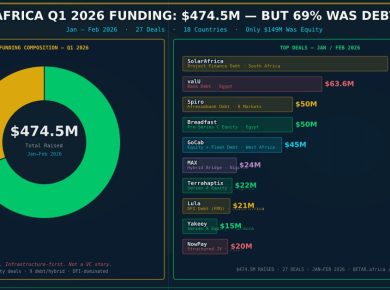
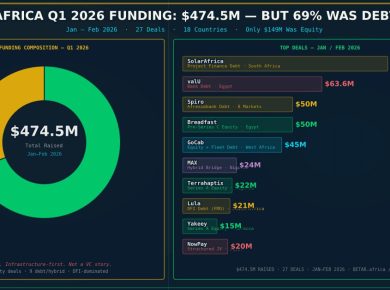
The deal is also the second Moroccan startup to make BETAR.africa’s Q1 2026 tracker, reinforcing Casablanca’s emergence as a genuine early-stage capital hub — not just for North Africa, but for cross-regional plays targeting the Francophone West African corridor. Azur’s backing here is a marker of local conviction that the next generation of African mobility infrastructure will not be built by the same operators who built the last one.
— Business Reporter, BETAR.africa


 UphivaBETAR


 Joseph Busari