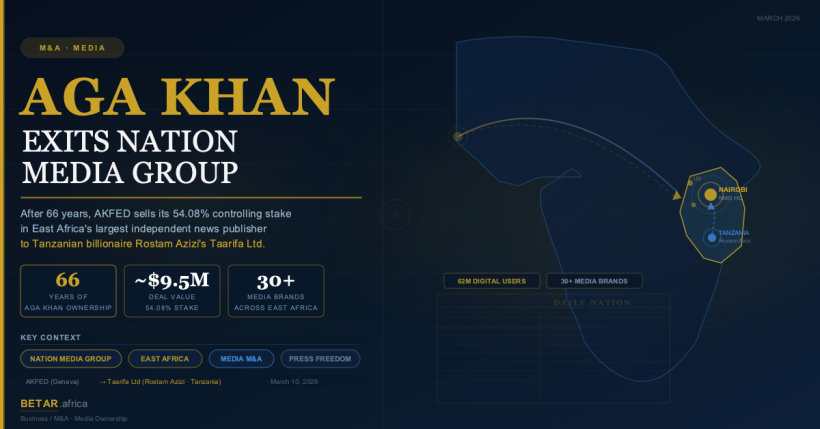

The Aga Khan Fund for Economic Development has sold its 54.08 percent controlling stake in Nation Media Group to Taarifa Ltd, a vehicle controlled by Tanzanian billionaire Rostam Azizi — ending 66 years of Aga Khan ownership of East Africa’s largest independent news publisher. The deal, announced on March 10, 2026, transfers 92.6 million ordinary shares at an implied market value of approximately KSh 1.23 billion (~$9.5 million) at the announcement-day share price of KSh 13.25. It is, by any measure, an inexpensive price for a 66-year institution with 30-plus media brands and 62 million digital users.
The transaction marks the most consequential ownership change in East African media in a generation.
A Low Valuation on an Iconic Asset
Nation Media Group reported a pre-tax loss of KSh 253.6 million in 2024, on revenue of KSh 6.2 billion — down 12.5 percent year-over-year (Nation Media Group FY2024 financial results). Digital revenue rose 11 percent in the same period, the only segment posting growth. The headline financials explain, in part, why the implied deal valuation is so modest: AKFED is exiting a business that has been loss-making at the group level while print advertising — the core revenue driver for most of NMG’s six-decade history — continues to deteriorate.
The Kenya Capital Markets Authority moved early to smooth the transfer. In September 2025, the CMA granted an exemption from the mandatory takeover offer requirement that would otherwise have been triggered once Taarifa Ltd crossed the 25 percent shareholding threshold. That exemption removed the procedural and financial burden of a public offer for the remaining shareholders, allowing the transaction to proceed as a direct block transfer. Completion is expected within three to four months, subject to remaining regulatory approvals.
Who Is Rostam Azizi?
Rostam Azizi is not a familiar name outside Tanzania, but his business record is substantial. He is widely cited as Tanzania’s only dollar billionaire, a status built primarily through telecommunications. Azizi held a significant minority stake in Vodacom Tanzania and sold a 17.2 percent stake in the company in 2014 for approximately $250 million (Bloomberg, 2014), a transaction that crystallised the wealth that now underpins his investment activities.
His media credentials predate the NMG acquisition. Azizi is a former shareholder in Mwananchi Communications, the Tanzanian publisher behind the Daily Mwananchi, The Citizen, and Mwanaspoti — three of Tanzania’s most widely read newspapers. That background is directly relevant context: Taarifa Ltd is not acquiring NMG as a passive financial investor. Azizi understands the economics of African print and digital media and has operated inside that environment before.
His political profile adds further texture. Azizi served in Tanzania’s National Assembly from 1994 to 2011 and held the role of CCM Treasurer from 2005 to 2007 under President Jakaya Kikwete. The combination of business capital, media operating experience, and political proximity to the Tanzanian establishment gives him a profile that goes beyond that of a typical acquirer in a distressed media deal.
NMG’s Structural Challenge
Nation Media Group remains East Africa’s largest independent news operation by reach. The group’s portfolio includes the Daily Nation, Business Daily, The EastAfrican, NTV Kenya, Radio Maisha, and regional titles and stations across Uganda, Tanzania, and Rwanda. Its digital properties collectively reach 62 million users. By audience scale, NMG is not a failing enterprise — it is a structurally challenged one.
The challenge is familiar to legacy media companies globally: a large, established audience that no longer generates the advertising yield it once did. Kenyan print advertising has declined sharply over the past decade as digital channels have captured an increasing share of brand budgets. NMG’s 2024 revenue decline of 12.5 percent is steep, but the underlying dynamic — print revenue contracting faster than digital revenue grows — is not unique to NMG. It is the fundamental economics of the legacy media transition.
The question the Azizi acquisition raises is whether new ownership changes the trajectory, or merely the ownership structure. NMG’s digital pivot is underway — 11 percent digital revenue growth in 2024 is real progress — but the company needs capital and strategic clarity to accelerate it. Whether Taarifa Ltd arrives with both remains to be seen.
Control of the East African Narrative
Ownership of NMG is not only a financial matter. Nation Media Group’s titles have historically operated with a degree of editorial independence that is unusual in the East African media landscape, where government proximity often shapes coverage. AKFED’s long tenure was associated with a commitment — however imperfect — to institutional independence. The editorial cultures of the Daily Nation and The EastAfrican were built over decades under that ownership structure.
Taarifa Ltd is a Tanzanian private vehicle with a politically connected owner. That does not automatically signal editorial interference, but it is a material change in the ownership context. Journalists, readers, and advertisers across Kenya, Uganda, Tanzania, and Rwanda will be watching the editorial conduct of NMG’s titles under new ownership with close attention.
Rostam Azizi’s purchase of NMG at a distressed valuation gives him control of the most influential pan-East-African media network in existence. The $9.5 million implied price is the cheapest possible entry into that position. What he does with it — editorially, operationally, and strategically — will define whether this transaction is remembered as a rescue or a capture.
The Aga Khan’s 66-year chapter in East African journalism is closed. The next chapter has a new author, and the continent will be reading closely.
— Business Reporter, BETAR.africa


 UphivaBETAR