
The Commission Economy: What Africa’s Talent Intermediaries Actually Take
By BETAR.africa Creative Economy Desk
Filed: 12 March 2026 | Publication target: W/C 27 April 2026
Word count: ~1,150
Every revenue figure in Africa’s creative economy passes through at least one intermediary before reaching the artist. The Afrobeats act whose streaming royalties we tracked in SAMRO’s record-breaking 2024 collection. The influencer whose brand deal economics we mapped against Lagos market rate cards. The author whose advance from a London publisher will be collected, in part, by a New York agent. In each case, between 10 and 40 cents of every dollar changes hands before the creator sees it.
The commission economy — artist managers, booking agents, multi-channel networks, literary agents, and brand deal intermediaries — is the connective tissue of the African creative economy. It is also one of its least examined commercial layers. This piece addresses that gap: what the intermediary layer extracts, from whom, at each point in the value chain, and how African commission structures compare to global industry norms.
Music Management: The 20% Standard
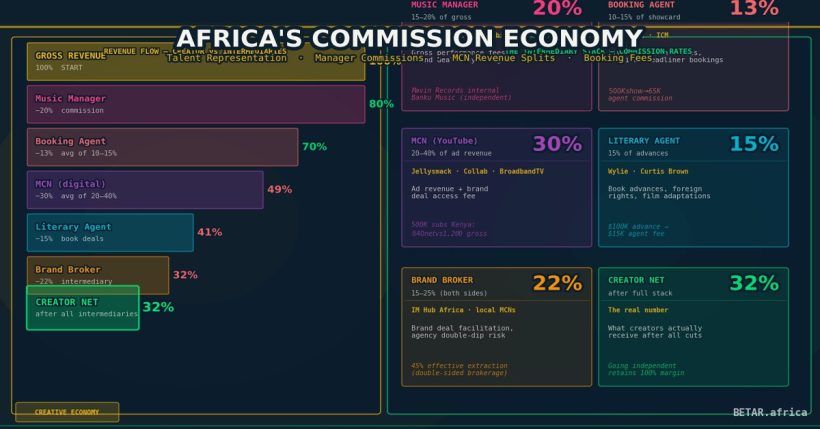
The global music management commission rate runs 15 to 20 percent of an artist’s gross earnings. In African markets, the upper end of that range is the norm. A Lagos-based manager working with a Tier 2 Afrobeats act — one earning $200,000 to $500,000 per show on the international circuit — takes 20 percent of gross performance fees, brand deal income, and sync licensing revenue.
What the 20 percent buys varies significantly. At the top of the market, managers are doing commercially sophisticated work: negotiating with CAA and WME on behalf of African artists seeking placement on global tours, structuring sync licensing deals with US television networks and European advertising agencies, and building the relationship infrastructure that converts a domestic Nigerian act into a global booking asset.
Mavin Records — home to Rema, Ayra Starr, and Jonah — has historically managed its roster internally, with the label’s management arm operating as both publisher and manager. That vertically integrated structure concentrates margin within the label at the cost of creator bargaining power. Black Sherif’s representation through Banku Music takes a narrower view: the management company operates independently of any label, which gives the artist greater leverage in deal-making but requires the manager to source revenue across multiple income lines rather than benefiting from a label’s promotional infrastructure.
The difference between a day-to-day manager — who coordinates schedules, social media, and logistics — and an executive producer manager, who participates in the creative process and takes a backend share of composition royalties, is economically significant. The latter’s commission can extend into the music publishing stack: if the manager receives a co-production credit on a Spotify-distributed track, they are extracting royalties from the performance rights stream, not just the booking fee. For artists who sign those arrangements early in their careers — when leverage is low — the compounding effect can mean the manager continues to earn from recordings made years after the management relationship ends.
Booking Agents: 10 to 15 Percent of the Showcard
The booking agent’s function is narrower than a manager’s but no less commercially consequential. A booking agent sources live performance opportunities, negotiates the performance fee and rider, and takes a commission of 10 to 15 percent of the agreed artist fee. On a $500,000 Afrobeats headliner booking, that is $50,000 to $75,000 for securing the deal.
The market for African live performance bookings at the global level is dominated by the major US talent agencies. CAA, WME, and ICM represent the most commercially significant African artists for their international touring dates; an African promoter staging a Lagos concert for an artist with international representation typically negotiates through those agencies, even when the event is on the continent. The continental booking agency market — African-native agencies representing African artists for African dates — is thin and concentrated in South Africa’s established live industry infrastructure.
That asymmetry has cost implications. When a Lagos promoter books through a New York agency for a local show, the booking commission is denominated in dollars and remitted offshore. The naira economics of the deal — how the artist’s fee converts at prevailing CBN or parallel-market rates, and whether the promoter’s ticket revenue denominated in naira can service a dollar-denominated fee obligation — creates the hedging problem that underlies much of the volatility in Nigerian concert economics covered in our earlier analysis of headliner fee inflation.
MCNs: The Creator Revenue Trade-Off
Multi-Channel Networks, which aggregate YouTube creators to negotiate better ad revenue rates, brand deal access, and production support, extract the highest commission rate of any creative intermediary: 20 to 40 percent of a creator’s total ad revenue.
The trade-off, in theory, is worth it. An MCN can negotiate better CPM rates with YouTube through aggregate traffic volume, offer production resources a solo creator cannot afford, and provide access to brand campaigns that require credentialled partners rather than direct creator outreach. Jellysmack, Collab, and BroadbandTV are among the international MCNs with operations in African markets, though their presence remains limited relative to Southeast Asia or Latin America.
In practice, African creators face a structural MCN problem: the subscriber thresholds at which MCN economics become viable for both parties are difficult to reach in markets where YouTube CPMs for African audiences are significantly lower than US or European benchmarks. A Kenyan creator with 500,000 subscribers generating 2 million monthly views earns approximately $600 to $1,200 per month in ad revenue at prevailing East African CPM rates; an MCN taking 30 percent extracts $180 to $360 of that, leaving the creator with $420 to $840 before production costs.
African creators who have exited MCN arrangements — a phenomenon common enough to generate its own discourse in Nigerian and South African creator communities — consistently describe the MCN’s value proposition as deteriorating once the initial contract term runs: the brand deals the MCN promised were either lower-value than represented, or the brand relationship was held by the MCN rather than transferred to the creator. Going independent requires building that brand relationship infrastructure from scratch, but it retains 100 percent of the margin.
Literary Agents: A Thin but Expensive Market
The African literary agent market is structurally underdeveloped. With the exception of a small number of South African literary agencies — including Blake Friedmann’s South Africa affiliate and individual literary consultants in Cape Town and Johannesburg — African authors seeking international publishing representation must route through London or New York agencies.
Chimamanda Ngozi Adichie is represented by the Wylie Agency, which charges the standard literary agent commission: 15 percent on domestic deals, 20 percent on foreign rights sales. On a $200,000 publishing advance — the reported floor for established African literary voices at major London and New York houses — a 15 percent commission generates $30,000 for the agent. For a debut Nigerian author securing a $50,000 advance, the equivalent is $7,500 in agent commissions before tax.
The absence of African-native literary agencies means commission payments are flowing to intermediaries based in markets that bear no cost exposure to the African publishing environment. The African Publishers Network has documented the thin domestic market for secondary rights licensing — translation rights, film adaptation rights, audio rights — in African publishing, which limits the scope for agents based locally to generate the multiple-deal income that makes literary agenting viable as a business in the US or UK context.
Brand Deal Brokers: The Agency Commission Stack
Brand deal intermediaries — the creator management agencies and influencer marketing platforms that broker deals between brands and creators — charge brands 15 to 25 percent of total campaign spend as a management fee, while simultaneously taking 15 to 20 percent from the creator as a representation fee.
In a $10,000 brand deal campaign, the economics stack as follows: the brand pays $12,500 (the $10,000 deal value plus a 25 percent agency margin); the intermediary keeps $2,500 from the brand’s side and takes a further 20 percent from the creator’s $10,000 payout — $2,000. The creator nets $8,000. The agency captures $4,500 on a $10,000 creator deal, or 45 percent of the total value at both ends of the transaction.
Nigerian creator economy participants have described this double-sided commission structure as the industry’s most significant economic friction point. “The brands are paying for access to my audience. I’m the one with the audience. But I’m the one getting the worst deal in the room,” is how one Lagos macro-influencer, speaking for background at an industry event, described the dynamic. It is a complaint structural to the intermediary model — agencies hold the brand relationships and the market data — and resolving it requires the kind of creator-side leverage that only comes with significant following scale or the ability to source and close brand deals directly.
The Intermediary Layer in Sum
Africa’s creative economy gross revenue figures — the €90 million in music royalties, the $206 million in influencer ad spend, the $900,000 gross from a sold-out Lagos concert — overstate what artists actually net. The commission economy is not an add-on; it is built into the structure of how creative value is traded in African markets, and it is calibrated to extract maximum value at each transaction point.
The commercial case for intermediaries is real: African markets have thin information infrastructure, weak payment rails, and fragmented brand relationships. Managers, agents, and MCNs solve real coordination problems. But the commission stack — 20 percent to a manager, 10 to 15 percent to a booking agent, 20 to 40 percent to an MCN, 15 percent to a literary agent — can aggregate to a situation where an artist generating $500,000 in gross revenue retains less than $300,000 after intermediary costs, before tax and production overhead.
Closing that gap is partly an infrastructure problem — better data, more transparent rate cards, payment rails that reduce friction — and partly a market power problem that only scale and creator leverage can address.

 UphivaBETAR
 Joseph Busari