
Africa’s Green Bond Premium: Why Borrowing to Go Green Costs Six Times More in Lagos Than London
By BETAR Energy & Climate Tech Desk | 13 March 2026
When Nigeria raised ₦115 billion ($75 million) through its fourth sovereign green bond in October 2023, the coupon rate was 14.5 percent. That is not a misprint. To borrow money for solar plants and climate resilience projects, Africa’s largest economy was paying interest rates that a European government would regard as a credit crisis.
In Germany, comparable sovereign green bonds priced at 2.8 percent that quarter. In France, 3.1 percent. The gap — more than 11 percentage points — means that for every $100 million Nigeria borrows to fund its energy transition, it pays roughly $14.5 million in annual interest. Germany pays $2.8 million.
This is the hidden tax on Africa’s green economy. And almost nobody in the climate finance conversation is talking about it.
The Green Bond Boom Nobody Is Celebrating
Africa’s sovereign green bond market is growing. That is the good news.
Since Kenya issued the continent’s first sovereign green bond in 2019 — a $41 million, 12-year instrument through the Nairobi Securities Exchange — the market has expanded to include Nigeria, South Africa, Rwanda, Côte d’Ivoire, Morocco, and Egypt. The African Development Bank’s Climate Bonds Initiative tracker counts 17 African sovereign and quasi-sovereign green bond issuances between 2020 and 2025, with aggregate proceeds exceeding $4.8 billion.
The bad news: Africa still represents less than one percent of global green bond issuances by volume, according to the Climate Bonds Initiative’s 2025 State of the Market report. In 2025, global green bond issuance hit $1.1 trillion. Africa’s share was approximately $9 billion.
But the deeper problem is not volume. It is price.
The Interest Rate Differential: A Five-Country Comparison
The data is stark. Reviewing sovereign green bond issuances from 2022 to 2025, the cost of local-currency green capital across five African markets versus European comparators reveals a structural chasm:
| Country | Green Bond Rate | Year | European Comparator | Differential |
|---|---|---|---|---|
| Nigeria | 14.5% | 2023 | Germany 2.8% | +11.7pp |
| Kenya | 12.5% | 2024 | France 3.1% | +9.4pp |
| South Africa | 9.7% | 2023 | Netherlands 3.4% | +6.3pp |
| Côte d’Ivoire | 7.9% | 2024 | Belgium 3.2% | +4.7pp |
| Rwanda | 8.5% | 2025 | Austria 3.3% | +5.2pp |
Sources: AfDB Capital Markets, Climate Bonds Initiative 2025, IMF Article IV Staff Reports, respective national treasuries.
The IMF’s January 2026 Regional Economic Outlook put the average African sovereign risk premium at 7–8 percentage points over equivalent US Treasury yields. For green bonds specifically, which are often longer-dated instruments, the premium is compounded by duration risk — African investors demand additional yield for locking capital in 10- or 15-year instruments in economies with historically volatile currencies.
South Africa is the relative outlier. Its developed capital markets infrastructure, JSE listing standards, and SARB credibility compress its risk premium compared to Sub-Saharan peers. Côte d’Ivoire benefits from CFA franc monetary stability and WAEMU regulatory frameworks. Nigeria and Kenya carry the full weight of standalone currency risk.
What the Money Is Actually Paying For
Despite the cost, African sovereigns continue to issue because the projects need financing and domestic capital markets offer one advantage that DFI lending does not: no foreign currency obligation.
The 2023 Nigerian green bond financed three categories of projects: solar streetlighting in rural electrification corridors (₦38 billion), afforestation under the Great Green Wall programme (₦31 billion), and climate-resilient agricultural infrastructure (₦46 billion). The allocation was certified under the ICMA Green Bond Principles.
Kenya’s 2024 green bond channelled proceeds to the Lake Turkana Wind Power grid connection completion, a seven-year-old project finally receiving the last tranche of domestic financing. Kenya’s Ministry of Finance told BETAR the green bond label was “primarily a marketing exercise to attract ESG-mandate institutional investors” — an unusually candid admission that the label matters more for investor optics than for project additionality.
Rwanda’s 2025 green bond, the smallest on the list at approximately $180 million equivalent, was the most structurally interesting. The National Bank of Rwanda incorporated a partial guarantee mechanism from the AfDB’s Room2Run synthetic securitisation facility, reducing the effective rate by approximately 1.2 percentage points. Without the guarantee, the bond would have priced at 9.7 percent.
The Real Cost of the Premium: A Climate Arithmetic Problem
The interest rate differential is not merely a sovereign budget line item. It reshapes the economics of every project financed by that capital.
A 100 MW solar plant in Nigeria financed at 14.5 percent debt needs to generate electricity at a tariff of approximately $0.09–0.12/kWh to service debt and provide investor returns, according to IRENA’s Renewable Power Generation Costs 2025 methodology applied to West African solar conditions. The same plant financed at European rates — 3–4 percent — is viable at $0.04–0.06/kWh.
Nigeria’s current electricity tariff for Band A customers (the highest and most reliably served) is approximately $0.073/kWh after the 2024 tariff reform. A project financed at Nigerian sovereign rates is borderline viable at best. At European rates, it would be one of the cheapest electricity sources on the continent.
This is not a hypothetical. It explains why, despite abundant solar resources, Nigeria’s utility-scale solar pipeline is dominated by multilateral-backed projects — financed in dollars at concessional DFI rates — rather than locally financed ones.
The Currency Trap Beneath the Interest Rate Gap
The interest rate differential does not exist in isolation. It is a symptom of deeper structural conditions that make African local-currency climate finance expensive at every level of the capital stack.
Inflation dynamics. Nigeria’s average inflation rate in 2025 was 23.1 percent, per the National Bureau of Statistics. A 14.5 percent nominal green bond rate is actually a negative real interest rate for lenders — which helps explain both why the government can offer it and why the market for domestic green bonds remains thin. Institutional investors with real return mandates cannot accept sub-inflation yields.
Currency risk. The naira lost approximately 42 percent of its value against the dollar between January 2023 and December 2025. A foreign investor holding a Nigerian naira green bond at 14.5 percent would have seen total returns in dollar terms turned sharply negative after currency translation. This structural currency risk is what closes most international ESG-mandate funds out of African local-currency instruments entirely — despite the label.
Shallow capital markets. The total capitalisation of Nigeria’s corporate bond market is approximately $8.5 billion, compared to Germany’s $2.1 trillion. Liquidity is thin, secondary market price discovery is unreliable, and institutional investor bases are dominated by pension funds with domestic allocation mandates and risk committees that are not designed for long-dated green instruments.
The Partial Solutions: Guarantees, Blended Finance, and Currency Hedges
Three mechanisms are being deployed — with limited but real success — to compress African green bond premiums.
First-loss guarantee facilities. The AfDB’s Room2Run programme (which Rwanda used) and the Guarantee Facility under the Just Energy Transition Partnership (JETP) instruments provide partial first-loss coverage that lowers perceived credit risk and compresses yields. The challenge: guarantee facilities are finite and over-subscribed. The AfDB’s total guarantee capacity across all instruments was approximately $6 billion as of late 2025 — a fraction of Africa’s estimated $200 billion annual climate finance need.
Currency hedging through TCX. The Currency Exchange Fund (TCX), a Development Finance Institution-backed facility, provides hedging instruments that convert local-currency green bond exposure to hard-currency equivalent. This allows international ESG investors to hold Nigerian naira or Kenyan shilling instruments without direct currency risk. TCX coverage costs approximately 3–5 percent per annum — reducing but not eliminating the effective rate gap. TCX’s capacity is also constrained: its current portfolio ceiling is approximately $5 billion outstanding.
Concessional-rate anchor investors. Several recent African green bond issuances have incorporated cornerstone tranches from DFIs or climate funds at below-market rates, allowing the overall bond to price lower while maintaining market access. Côte d’Ivoire’s 2024 green bond included a $50 million anchor tranche from IFC at 5.5 percent — blended with market tranches, this compressed the overall bond to 7.9 percent from an estimated market-only rate of approximately 9.5 percent.
The Structural Question: Can Africa’s Green Bond Market Scale?
The honest answer, based on current trajectories, is: not fast enough.
The Climate Bonds Initiative projects that Africa’s annual green bond issuance needs to reach $50–60 billion by 2030 to maintain pace with continental decarbonisation targets. Current issuance is approximately $9 billion per year. Even at the most optimistic scenario — continued blended finance support, expanded guarantee facilities, deepening capital markets — the trajectory does not reach that target.
The deeper constraint is political economy. Domestic institutional investors — pension funds, insurance companies — in most African markets are required by regulation to hold significant portions of assets in sovereign instruments. This creates demand for green bonds. But it also means the green bond market is partially a regulatory compliance exercise rather than a market-driven capital allocation mechanism.
More fundamentally: green bonds are debt. At 14.5 percent, they are expensive debt. At 19 percent — the secondary market yield on Nigerian sovereign instruments in late 2025, at the height of the naira stability crisis — they are prohibitively expensive debt. A programme designed to finance the energy transition through debt instruments at these rates is, as our BETA-421 analysis found, creating a climate finance debt trap that future African treasuries will inherit.
What Would Actually Help
Three structural shifts would meaningfully reduce the green bond premium in African markets:
1. Scaling guarantee capacity to match ambition. The JETP partnership promised $8.5 billion for South Africa, Indonesia, Vietnam, Senegal, and India. Three years on, disbursement remains well below commitment. Expanding working guarantee facilities — particularly Room2Run and its equivalents — to a minimum $30 billion capacity would allow systematic premium compression across multiple markets simultaneously.
2. Dedicated Africa green bond liquidity facility. A secondary market liquidity facility — modelled on ECB green bond purchase programmes — would provide price discovery, reduce investor risk perception, and attract international capital that currently avoids the market for liquidity reasons. This would require AfDB capitalisation and a mandate change, but the architecture exists.
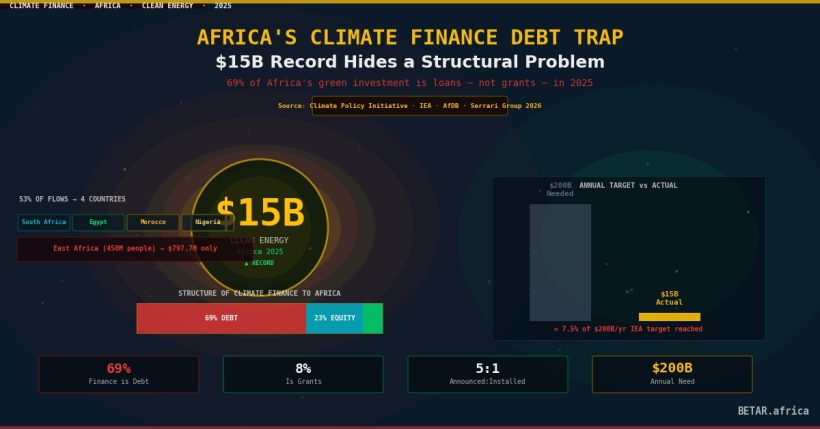
3. Reforming the grant-loan split in climate finance architecture. The COP29 New Collective Quantified Goal set a $300 billion per year target for 2035, of which a large but unspecified portion was expected to be concessional. As our BETA-421 analysis documented, 69 percent of climate finance reaching Africa is already loan-based. Adding more loans — at commercial rates, channelled through instruments like sovereign green bonds — deepens the structural problem rather than solving it. Advocates at COP30 in Belém will need to push for a hard floor on grant and near-grant financing as a percentage of the headline target.
The Bottom Line
Africa’s green bond market is real, growing, and — for the projects it finances — genuinely important. But the interest rate premium embedded in every local-currency climate bond is a hidden toll on the continent’s energy transition that compounds across every project, every year, every repayment cycle.
Until the structural conditions that produce those premiums — inflation, currency volatility, shallow capital markets, and insufficient first-loss guarantee capacity — are addressed at their roots, Africa will continue financing its green future at terms that make that future more expensive and more indebted than it needs to be.
The Lagos-to-London interest rate gap is not just a financial statistic. It is a measure of how much the global climate finance architecture costs the people it claims to serve.
BETAR.africa covers Africa’s technology, business, and innovation economy. This article cites data from the Climate Bonds Initiative 2025 State of the Market Report, IMF Regional Economic Outlook January 2026, IRENA Renewable Power Generation Costs 2025, AfDB Capital Markets Division, respective national treasury issuance documents, and the Currency Exchange Fund (TCX) annual report 2025.

 UphivaBETAR
 Joseph Busari