
In markets where smartphone penetration sits at 35–50% and mobile data costs remain among the highest in the world relative to income, radio reaches the audiences that streaming never touches. It does so profitably — and the commercial mechanics behind that reach, from airtime pricing to music copyright fees, form one of Africa’s least-examined media businesses.
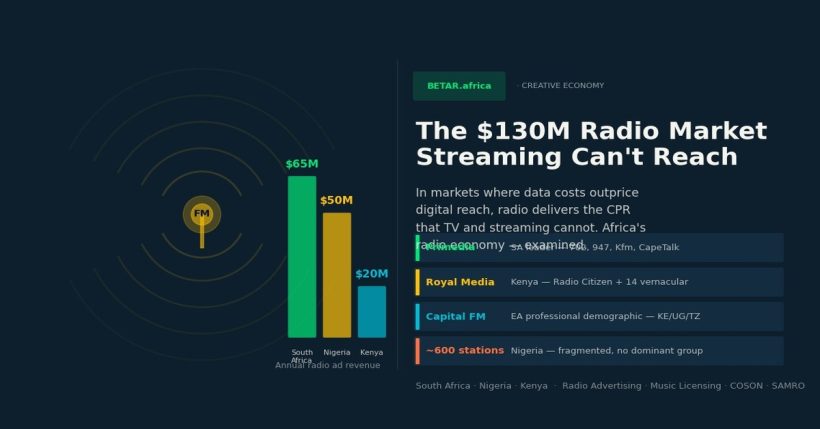
Africa’s radio advertising market generates over $130 million annually across South Africa, Nigeria, and Kenya alone, according to Statista market data. South Africa leads at approximately $65 million in annual radio ad revenue; Nigeria follows at $50 million; Kenya contributes roughly $20–25 million. The numbers are modest by global standards — global radio advertising was a $27.8 billion industry in 2025 — but they represent dedicated budget from advertisers who have made a calculated choice: in many African markets, radio delivers cost-per-reach that television and digital cannot match.
Who Owns the Frequencies
South Africa’s commercial radio landscape is dominated by two major groups. Primedia Broadcasting controls the country’s highest-revenue commercial stations: 702 (Johannesburg talk/news), 947 (Johannesburg contemporary), Kfm 94.5 (Cape Town), and CapeTalk, alongside digital news brand EWN. Within its geographic footprint, 947 commands 40% audience penetration — the largest commercial breakfast show in South Africa by reach. Kfm 94.5 holds 60% penetration in the Western Cape. Kelvin Storie, Primedia’s Chief Commercial Officer, has characterised the group’s strategic direction as extending beyond the FM band: “Our evolution is about much more than technology; it is about forging meaningful connections in a fragmented media environment.” Mediamark operates as the advertising sales representative for a range of community and commercial stations outside the Primedia portfolio, and functions as the effective commercial intermediary for a significant portion of the market’s inventory.
The South African Broadcasting Corporation (SABC) operates public radio stations — including Radio 2000 and regional-language services — that reach audiences commercial players do not. The SABC’s commercial stations compete directly with Primedia’s portfolio for advertiser spend.
In East Africa, Capital FM operates across Kenya, Uganda, and Tanzania, holding dominant positions in the urban professional demographic in Nairobi. Royal Media Services — the company behind Radio Citizen and fourteen vernacular-language stations — commands the largest aggregate listenership in Kenya through its regional-language networks, demonstrating that African radio’s audience map is more complex than its capital-city commercial leaders suggest.
Nigeria’s commercial radio sector is fragmented. The country has approximately 600 licensed radio stations, according to COSON’s own licensing census, spanning federal, state-owned, and private broadcasters. Consolidation at the ownership level is limited: unlike South Africa, no single commercial group commands a nationally dominant position, and advertising buying is complicated by the absence of a standardised national audience measurement system equivalent to South Africa’s Radio Audience Measurement Survey (RAMS).
The Advertising Revenue Model
South Africa’s radio advertising market operates with a well-developed infrastructure. The Broadcast Research Council of South Africa (BRC) administers audience measurement, and in June 2025 awarded the RAMS contract to GfK Media Measurement — transitioning from the previous system to a model combining computer-aided telephonic interviewing with supplemental passive data. First-wave data is expected in Q1 2026. Primedia and other commercial broadcasters sell airtime against these audience numbers; rate cards are issued bi-annually through media buying platform Media Manager.
Primedia’s rates are not publicly disclosed in detail, but the market standard for a 30-second primetime spot on a major Johannesburg commercial station has historically been priced at R6,000–R12,000 per insertion, with breakfast show premiums adding 20–40% above standard daytime rates. Radio’s primary competitive claim against digital is reach-per-rand: a primetime radio buy in Gauteng can achieve a cost-per-thousand (CPM) of R8–15, compared to R40–80 for equivalent television reach, making it the lowest-cost mass medium per contact in South Africa’s formal advertising market.
The total advertising context matters for understanding radio’s position. Africa’s advertising market is estimated at $1.5 billion to $2 billion annually, concentrated heavily in South Africa ($4.5 billion entertainment and media economy), Nigeria (~$450 million), and Kenya (~$350 million). Radio competes in an environment where digital’s share is growing — digital now accounts for 40% of South Africa’s ad spend and 20–25% in Nigeria and Kenya — but where radio continues to attract brand budgets precisely because of its reach advantage with offline-first audiences.
What Radio Pays for Music
Every song broadcast on a commercial station in Africa’s major markets carries a legally mandated royalty obligation, collected by the relevant performing rights organisation and distributed to songwriters, composers, and publishers. The mechanism is the same infrastructure that underlies Africa’s music publishing economy — but the broadcaster-facing side of that equation has a distinct character.
In South Africa, SAMRO (Southern African Music Rights Organisation) licences commercial broadcasters through blanket agreements, under which stations pay an annual fee calculated as a percentage of their qualifying revenue. SAMRO’s total licensing revenue reached R683.8 million ($37 million) in 2024, a 14.1% year-on-year increase — the highest in the organisation’s history. At SAMRO’s December 2024 Annual General Meeting, CEO Annabell Lebethe highlighted the efficiency gains underpinning those distributions: “Seven years ago, the cost-to-income ratio stood at 40%, and reducing it to 22.9% demonstrates our steadfast dedication to ensuring that more royalties go directly to members.” In its most recent financial year, SAMRO distributed R242 million specifically to the radio and general category — a 62% increase from the prior year’s R149 million distribution — reflecting both increased broadcaster licence compliance and higher declared revenues from commercial stations.
The practical mathematics of the SAMRO broadcast royalty are defined by a formula based on unit values and duration of play, with each broadcaster assigned a different unit value depending on the blanket licence negotiated. What this means for a commercial station is predictable annual cost certainty: rather than paying per-song needle-drop fees (the US model), South African broadcasters pay a proportion of revenue, distributing risk and cost smoothly across the content schedule.
COSON in Nigeria administers performing rights across the country’s 600-plus licensed stations, but the gap between the licensable universe and collections reality remains wide. COSON’s total 2024 distribution of approximately $291,000 across all categories — covering radio, television, live venues, and hospitality — signals that the broadcasting royalty collection rate in Nigeria is a fraction of what the sector’s commercial scale suggests it should generate.
In Kenya, music copyright collection is in active transition. MCSK (Music Copyright Society of Kenya) has been subject to a royalty collection ban since late 2025 following regulatory findings of financial accountability failures. Replacement societies PAVRISK and KAMP now hold collection licences; Kenya’s commercial stations are still licensing, but the distribution pipeline to Kenyan composers remains suspended pending the transition’s legal resolution.
Streaming: Competition or Complement?
The industry’s working conclusion — most clearly articulated at the Radio Broadcasters Convention held in Johannesburg in February 2026 — is that streaming and radio are complementary, not substitutive, in most African markets. “The future of African broadcasting isn’t a choice between linear and digital — it’s a layered ecosystem,” the convention’s framing document stated, reflecting a consensus that radio’s reach advantages over streaming remain structurally durable where data costs are high.
The data supports that framing. 75% of South Africans aged 15 and above listen to radio weekly, with an average daily listening time of 5 hours and 12 minutes, according to BRC audience data. Notably, 76% of music streamers also listen to radio weekly — evidence that radio and streaming audiences are not distinct populations. Capital FM in Kenya now reports that more than 25% of its consumption occurs via online streaming simulcast, demonstrating that commercial radio brands are successfully converting their FM audiences into digital audio listeners without losing the core broadcast base.
Africa’s music streaming market is projected to grow from $1.25 billion in 2025 to $4.96 billion by 2031 at a CAGR of 25.5%. That growth will eventually compress radio’s share of audio time — particularly among the 18–34 urban demographic that both streaming and radio platforms compete for. But in the near term, radio’s dominance in markets where smartphone penetration is below 50% means that the broadcasting revenue model, for all its structural inefficiencies in royalty collection and advertiser measurement, remains the primary commercial audio medium across sub-Saharan Africa.
The question the Radio Broadcasters Convention was really debating is not whether streaming will displace radio — it will, over the long arc — but whether African commercial radio groups can layer digital revenue on top of their FM base before that compression arrives. The economics of programmatic digital audio advertising, podcast monetisation, and simulcast streaming represent the growth channels. Broadcast FM spot revenue is the stable cash flow funding the transition.
What This Story Connects
Africa’s radio industry sits at the intersection of three of the continent’s most significant media economics stories: advertising market development, music collecting society revenue, and the structural tension between broadcast and streaming audio that will define the next decade of African creative economy revenue. Its economics are neither glamorous nor well-reported — but they fund the commercial radio brands whose reach underpins the advertising market, and the collecting society revenues whose growth is central to what African musicians actually receive.
Sources: SAMRO Integrated Report 2024; SAMRO 2024 AGM press release (December 2024); Annabell Lebethe, SAMRO CEO, public statement at 2024 AGM; Kelvin Storie, Primedia Broadcasting CCO, Bizcommunity (2025); CISAC Global Collections Report 2025; Statista Radio Advertising Market Forecasts (South Africa, Nigeria, Kenya); PwC Africa Entertainment and Media Outlook 2025–2029; Broadcast Research Council of South Africa; NIQ-GfK (RAMS contract award, 2025); Broadcast Media Africa Radio Broadcasters Convention coverage (February 2026); Mobilityforesights Africa Music Streaming Market 2031.


 UphivaBETAR