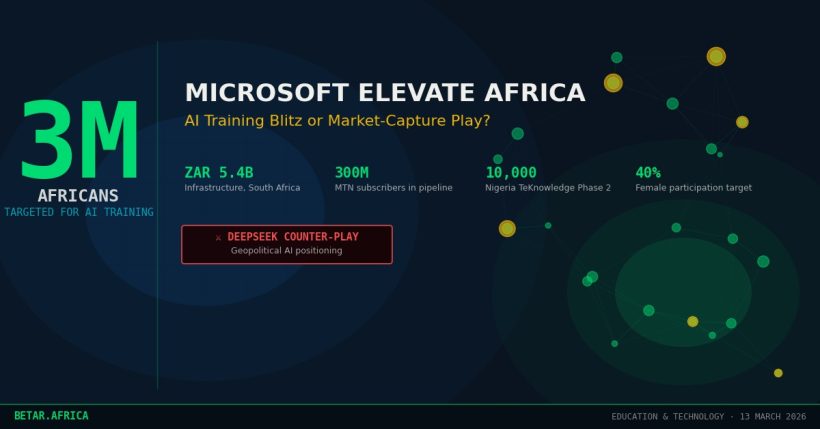

When Microsoft announced on 12 March 2026 that it would train three million Africans in artificial intelligence skills this year, the company was careful to frame the initiative in the language of social impact — youth empowerment, gender inclusion, and digital transformation. What received less attention in that announcement was the name of the programme’s most prominent adversary: DeepSeek.
The Chinese AI lab, whose R1 model has been gaining traction across African universities and government ministries as a cost-competitive alternative to OpenAI and Microsoft’s own Copilot, sat clearly in the backdrop of what Microsoft is calling Microsoft Elevate Africa. In briefings to journalists, Microsoft executives drew explicit comparisons to China’s AI footprint on the continent. Bloomberg, reporting from Johannesburg, framed the initiative plainly: Microsoft is pushing Africa AI adoption “in challenge to DeepSeek.”
The question is not whether three million training certificates will be issued — they almost certainly will be. The question is who this programme is ultimately designed to benefit.
What the Programme Actually Is
Microsoft Elevate Africa is structured across several interconnected workstreams:
MTN Group integration is the centrepiece. Microsoft has bundled Microsoft 365 and Copilot into MTN’s consumer and enterprise product offerings — a distribution channel with approximately 300 million subscribers across 19 African markets. The training isn’t a standalone programme; it is being seeded into MTN’s existing customer base, creating a pipeline from skilling to product adoption.
Infrastructure commitment underpins the push. Microsoft has committed ZAR 5.4 billion — roughly $330 million at current exchange rates — to cloud and AI infrastructure in South Africa, with completion expected by end-2026. A geothermal-powered data centre is also planned for Kenya, adding a second continental anchor.
Nigeria is the operational front. Under the TeKnowledge + Microsoft partnership now entering Phase 2, 10,000 Nigerians will receive direct AI training, with a stated focus on youth, women, and developers. Phase 1, which ended in late 2025, trained several thousand participants in cloud fundamentals and Azure administration — the building blocks for Microsoft’s cloud services stack.
Across all programmes, Microsoft has set a 40 percent female participation target — a figure that represents genuine ambition in markets where digital gender gaps remain severe, but that also ensures a broader market for Microsoft’s consumer productivity tools.
Skills Programmes as Market Infrastructure
The conflation of workforce development and market access is not unique to Microsoft in Africa. Google, AWS, and Meta have all deployed similar architectures — training programmes designed to cultivate ecosystems of users, developers, and administrators who, once trained, are also customers or platform dependents.
What makes the current Microsoft push distinctive is its scale and its explicit geopolitical framing. The company appears to be treating Africa not merely as an emerging market but as a contested space, where AI platform allegiance is still being formed.
“We are past the era where skills programmes were charity,” said one Nairobi-based technology policy researcher who asked not to be named because they work with multiple tech multinationals. “Every major AI company is training African developers because trained African developers become users, and users become data, and data trains the next model.”
This is not a reductive read of Microsoft’s intentions. The company does employ thousands of Africans and has contributed meaningfully to enterprise software capabilities on the continent. But it is an incomplete picture to present Elevate Africa purely as philanthropy when Microsoft’s own Africa head has stated publicly that the training will accelerate Copilot penetration across the MTN subscriber base.
What DeepSeek Has to Do With It
DeepSeek’s emergence changed the calculus for every major AI vendor operating in Africa. The R1 model, released in January 2025, demonstrated performance comparable to OpenAI’s models at a fraction of the inference cost — an advantage that matters enormously in markets where compute access is expensive and institutional budgets are constrained.
African universities in Ethiopia, Egypt, and Nigeria were among the earliest non-Chinese institutions to deploy DeepSeek for research assistance. Several East African fintech companies have been piloting R1-based customer service automation. In Nairobi’s Westlands tech corridor, conversations about “which AI” now routinely include DeepSeek alongside ChatGPT and Gemini.
For Microsoft, which is betting billions that African enterprises and institutions will route their AI workloads through Azure, DeepSeek represents a threat that is not primarily technological — it is economic. A government ministry that trains its civil servants on Microsoft Copilot is a government ministry that is unlikely to migrate to a Chinese-hosted alternative, even if the alternative is cheaper. Elevate Africa is, among other things, a switching-cost programme.
The Real Skills Gap
None of this diminishes the genuine workforce need that Elevate Africa is responding to. Africa faces a structural mismatch between the skills its educational institutions produce and the skills that digital economy employers need.
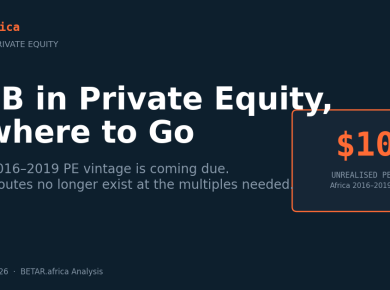
The AfDB’s recent $10 billion AI initiative with the UNDP projected 40 million AI-adjacent jobs on the continent by 2035 — a figure that implicitly requires training volumes that no single corporate programme can deliver. UNESCO data on Africa’s current STEM graduate output indicates a significant gap between projected demand and pipeline capacity, particularly at the mid-level technical roles — data annotators, prompt engineers, AI systems auditors — that will constitute the majority of new AI-related employment.
Microsoft’s three-million target, if achieved, would represent meaningful progress on that pipeline. The question is whether training for Copilot proficiency constitutes the kind of transferable, foundational AI literacy that serves workers across platforms and over time — or whether it produces a generation of proficient Microsoft users who are exposed when the next DeepSeek emerges.
“We need African governments to anchor training programmes on open standards, not proprietary systems,” said Dr. Chika Ezeanya-Esiobu, principal education adviser at the African Union Commission, speaking at a conference in Addis Ababa last month. “The continent cannot afford to train its workforce for a single vendor’s ecosystem.”
That tension — between the practical benefits of large-scale corporate training and the strategic risks of platform dependency — is the defining question that African education ministries, donor bodies, and universities will need to navigate as Microsoft, Google, Amazon, and their Chinese counterparts scale their African skills programmes through 2026 and beyond.
Three million trained workers is an outcome worth having. The terms under which that training is delivered will determine whether the continent built capability — or a customer base.
Related coverage: AfDB/UNDP $10B AI Initiative — 40 Million Jobs by 2035 | TVET in Africa: Can Technical Training Scale to Meet Digital Economy Demand? | Africa’s AI Skills Gap: The Race to Build a Workforce

 Joseph Busari
 UphivaBETAR