
Africa’s Comedy Economy: The Business Behind the Laughter
BETA-595 | Creative Economy Desk | Filing deadline: 30 April 2026 | Target: 1,000–1,200 words
Africa’s comedy industry has produced some of the continent’s most-subscribed YouTube channels, sold out venue tiers priced at ₦5 million per table, and attracted Netflix commissioning relationships stretching from Lagos to Johannesburg. But behind the viral clips and sold-out ballrooms lies a monetisation structure that is structurally top-heavy, platform-dependent, and far less lucrative at the base than headline figures suggest.
The YouTube Tax
For African comedy creators, YouTube is simultaneously the primary distribution engine and the least efficient revenue channel. The structural problem is not subscriber counts — it is CPM geography.
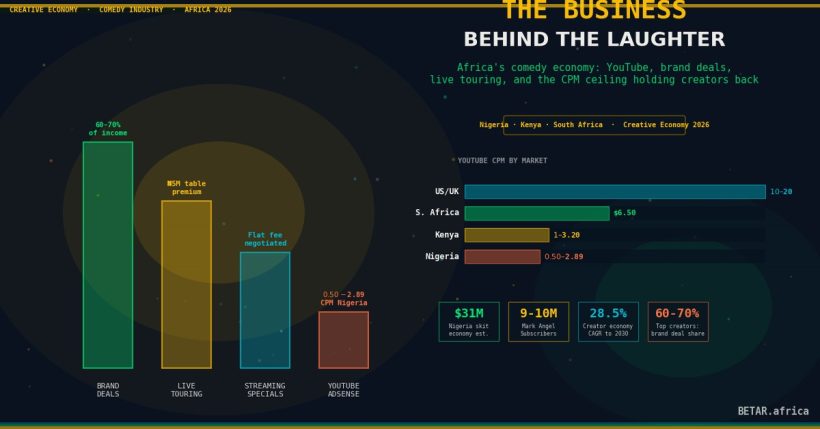
YouTube advertising rates are determined by the viewer’s location, not the creator’s. In Nigeria, CPMs — the rate advertisers pay per 1,000 views — average between $0.50 and $2.89. In Kenya, $1.00 to $3.20. South Africa, with its more developed digital advertising market, reaches approximately $6.50. Compare this to comedy content CPMs in the United States or United Kingdom, which run $10 to $20, and the arithmetic becomes unambiguous: an African comedy channel with a predominantly African audience earns five to eight times less per view than an equivalent channel with a Western audience, regardless of output quality or subscriber base.
Mark Angel Comedy, which became the first African comedy channel to surpass 1 million subscribers — a milestone reached in 2017 — now operates at approximately 9 to 10 million subscribers. Third-party revenue estimators, which extrapolate earnings from public view-count data and assumed RPMs, place the channel’s AdSense income at approximately $435,000 to $590,000 annually. That figure is almost certainly an undercount of total income but overstates what YouTube advertising alone delivers: the effective RPM (revenue per mille, after YouTube’s 45% share) on predominantly Nigerian-audience content likely sits between $0.30 and $1.80 per 1,000 views.
The CPM gap is why brand deals have become the real revenue engine. For established creators, brand income now accounts for an estimated 60 to 70 percent of total earnings — with YouTube AdSense a secondary line item.
The Brand Deal Premium
Brands commissioning African comedy content are paying a premium for something display advertising cannot replicate: authentic integration into a trusted entertainment format. Nigerian skit comedy — performed in Pidgin English, rooted in local social dynamics — delivers cultural recall that a pre-roll ad does not.
The rate card reflects this. Top-tier Nigerian comedy creators with one million or more followers command ₦5 million to ₦14 million per sponsored post (approximately $3,000 to $8,500 at current exchange rates). Oga Sabinus, one of the most commercially active skit makers, earns an estimated ₦1.5 million to ₦2 million per social media post and up to ₦10 million per month from brand placements, according to industry reporting by BusinessDay. Mid-tier pages — 100,000 to 500,000 followers — clear $1,000 to $4,000 per video campaign.
The brands running these deals skew toward sectors where trust and recall matter: fintechs, telcos (MTN, Airtel, Glo), fast-moving consumer goods, and increasingly, sports betting operators. For each of these categories, a comedy skit integration carries conversion potential that banner advertising cannot match.
Nigeria’s digital skit-making sector — a category that did not meaningfully exist a decade ago — has been estimated at $31 million in aggregate net worth, according to Bell Ihua’s 2024 industry study Skit Economy. That figure captures Nigerian digital comedy only and excludes live touring, television licensing, international markets, and diaspora revenue streams. The true addressable market is larger and unmeasured.
Live Touring: The Premium Tier
Africa’s large-format comedy concerts operate a tiered-pricing model that explicitly segments audiences by willingness to pay — with the top tier priced to extract maximum value from corporate entertainment budgets rather than individual buyers.
AY Live, the annual franchise run by comedian AY Makun and held at Eko Hotels & Suites in Lagos, has priced its seating across four commercial bands: general admission at ₦7,000; VIP at ₦30,000; Gold Table at ₦2 million; Platinum Table at ₦5 million. At a venue with a convention-hall capacity of up to 2,000 persons, revenue from even partial platinum and gold table sales — purchased by corporations, high-net-worth individuals, and brands seeking live activation presence — can exceed what the lower-tier seats generate in aggregate.
Nigeria’s longest-running comedy franchise, Nite of a Thousand Laughs (Opa Williams, founded 1995), operates a similar though more modest structure, with its 30th anniversary edition in November 2025 held at The Dome Event Centre in Asaba. Historical ticket data from its Abuja editions shows Regular at ₦4,000, VIP at ₦10,000, and table packages at ₦250,000 for a table of eight — a price architecture that has tracked Nigerian disposable income levels more conservatively than the Lagos flagship events.
The economic underside of live comedy economics was articulated by Basketmouth, who said of his early appearances at Nite of a Thousand Laughs: “It made me popular, left me poor.” Supporting act fees at major shows are not publicly disclosed, but the comment points to a structurally familiar dynamic in live entertainment globally: headline formats concentrate revenue at the top of the bill.
Streaming Special Economics
Netflix pays flat licensing fees for comedy specials — no revenue share, no viewership data provided to talent, no backend. That structure has become more transparent as the streaming era has matured. At its peak in 2018 to 2021, Netflix paid $500,000 to $20 million for headline American comics. By 2022, Axios reported the platform had cut fees materially, with standard licensing deals for new and mid-tier comics running $100,000 to $200,000 for two-year terms.
For African comedians, Netflix has moved in two directions: commissioning specials and building broader content relationships. Basketmouth, one of Nigeria’s most commercially established comedians, hosted Netflix’s “Lights, Camera…Naija” event in 2023 — a relationship that extends beyond a single special transaction. Specific licensing fees for African comedy specials are under NDA and have not been publicly disclosed.
Showmax, the MultiChoice-backed streaming service now in partnership with Canal+, has taken a different structural approach. Rather than pure flat-fee licensing, Showmax has operated a hybrid model for some African comedy specials: licensing fees supplemented by payments linked to sponsorship revenue the platform generates from advertisers attached to specific content. The practical implication for creators is deferred revenue, paid months after release once platform sponsorships are settled. The upside is potential earnings above a flat fee; the downside is income predictability.
The Distribution Paradox
Africa’s creator economy is projected to grow from $3.08 billion in 2023 to $17.84 billion by 2030, a 28.5 percent compound annual growth rate. Comedy is the continent’s highest-earning content niche on both YouTube and Facebook by most industry measures. Yet six in ten African creators earn less than $100 per month, according to Techpoint Africa’s 2026 creator economy report.
The economics are functioning as designed — concentrated returns at the top, marginal returns at the base. What distinguishes comedy from other creative verticals is the speed at which its top tier has built multi-stream businesses: AdSense as the baseline, brand deals as the primary income, live touring as the premium event revenue, and streaming specials as the credibility and international reach vehicle.
The challenge for the next generation is the CPM ceiling. Until African digital advertising markets deepen — which requires mobile internet penetration, formal digital ad infrastructure, and advertiser confidence — YouTube will remain a distribution platform that converts African viewership into Western-scale revenue only for those who can build diaspora audiences or secure premium brand deal relationships. For the rest, the comedy economy is a business built on volume, hustle, and hope that a brand manager is watching.
Word count: ~1,150
Cross-references: BETA-453 (influencer brand deal economics), BETA-400 (live music promoter margins), BETA-454 (pan-African streaming revenue economics)
Sources cited: BusinessDay NG (Oga Sabinus brand deal rates); Bell Ihua, Skit Economy (2024) (Nigeria digital comedy sector valuation); Axios (Netflix special fee reporting, 2022); TransferXO/event listings (AY Live ticket pricing); Nollywoodgists (Basketmouth quote); Techpoint Africa (Africa creator economy report, 2026); Lenostube/Shopify Nigeria (YouTube CPM rates by country); Youtubers.me/Networthspot (Mark Angel Comedy revenue estimates — third-party, not confirmed by channel); Technext24 (Showmax licensing model, 2023)

 UphivaBETAR
 Joseph Busari