
Girls in STEM: Why a Decade of African Targets Failed — and What Three Countries Are Doing Differently
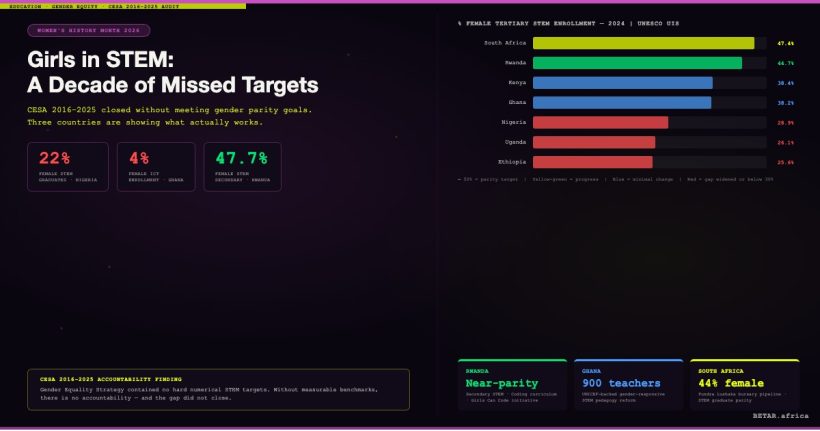
The AU’s Continental Education Strategy for Africa closed in 2025 without meeting its STEM gender parity goals. In Nigeria, women account for just 22 per cent of STEM graduates. In Ghana’s university ICT programmes, the figure is 4 per cent. Rwanda, Ghana, and South Africa offer three distinct policy mechanisms that are producing measurable results — but the absence of binding targets, chronic underfunding, and structural barriers have kept Africa’s most replicable successes from spreading at anything close to the pace the crisis requires.
March 2026
In 2016, the African Union set out a ten-year continental education strategy with gender equity at its core. CESA 2016–2025 committed member states to “accelerating processes leading to gender parity and equity” across education systems, including in STEM. The decade has now closed. The verdict is unambiguous: the gap did not close. In several key economies, it widened.
UNESCO data tells the story. Women represent only 35 per cent of STEM graduates globally, with no measurable progress over the prior decade. In Sub-Saharan Africa, the disparities are severe. Nigeria: 22 per cent of STEM graduates are female, with women comprising approximately 5 per cent of practicing engineers. Uganda: 23.6 per cent of secondary-level STEM teachers are women. Ghana: at one of the country’s principal teacher training institutions, women accounted for 4 per cent of first-year ICT education students in 2022/23. In West and Central Africa, women comprise fewer than 15 per cent of engineering and technology researchers.
The accountability picture is complicated by an uncomfortable institutional finding: CESA 16-25’s Gender Equality Strategy — developed by the Forum for African Women Educationalists and adopted in Nairobi in 2018, two years into a ten-year plan — contained no hard numerical STEM gender targets. The strategy called on member states to “deliberately and urgently promote gender socialisation for STEM” but set no measurable benchmarks. Without targets, there is no accountability. The AU’s successor framework, CESA 2026–2035, explicitly designates “gender, equity, and inclusion” as a named strategic area — an implicit acknowledgement that this architecture was missing for the decade that just closed.
Rwanda: Near-Parity at Secondary Level, a Widening Gap at University
Rwanda is the continent’s most cited success story on girls in STEM, and the data at secondary level justifies that framing. Education Minister Valentine Uwamariya placed female representation in STEM at secondary level at 47.7 per cent in 2023 — close to parity, and substantially above the continental norm. The government’s target is 50/50 gender balance in STEM by 2026.
The mechanisms are deliberate and multi-layered. Rwanda’s national curriculum incorporates ICT as a core subject across all schools, supported by over 735 smart classrooms. The Rwanda Coding Academy, established in 2019, enrolled near-parity cohorts from its first intake. The African Girls Can Code Initiative — launched in July 2023 through a partnership between Rwanda’s Ministry of Education, UN Women, and Siemens — has run bootcamps selecting top female STEM achievers from every district in the country, equipping participants with laptops, connectivity, and entry into global mentorship networks.
The critical caveat is that secondary-level success has not translated to university. At higher education level, STEM subjects account for 48 per cent of female students’ enrolments compared with 63 per cent of male students’ enrolments — meaning men remain significantly more likely to pursue STEM at degree level even as secondary-level parity has improved. The secondary mechanism is working; the university transition mechanism is not.
Ghana: Teacher Reform With Measurable Reach, Structural Barriers Intact
Ghana’s approach has centred on teacher training and classroom culture. The UNICEF-backed Undaunted Women Support Project trained 900 teachers in gender-responsive STEM pedagogy across five districts, directly supported over 13,800 girls, and reached more than 15,000 community members. Approximately 96 per cent of 1,000 vulnerable girls in the programme transitioned to upper secondary; of those, 33 per cent pursued science-related programmes — a meaningful STEM retention signal against a national university ICT enrollment baseline of 4 per cent female.
The Ghana Education Service has extended teacher training through a KOICA-funded project that reached 140 teachers across 40 public schools in one district in 2023. A broader Senior High School curriculum overhaul — the first major reform in a decade — incorporates STEM and competency-based learning as central pillars.
The structural constraint teacher training cannot solve is infrastructure access. Only 13 per cent of Ghana’s public junior high schools have functional ICT facilities. Training teachers to deliver gender-responsive technology education in schools without functional computers produces limited outcomes. The programme results are real; the system-wide gap remains wide.
South Africa: A Strong Pipeline Into a Leaking System
South Africa’s Fundza Lushaka bursary scheme is the continent’s most coherent use of public finance to build a gender-inclusive STEM teaching pipeline. The programme funds full initial teacher education at 24 public universities, with Mathematics, Natural Sciences, and Physical Sciences as priority subjects. South Africa’s teacher workforce is approximately 67 per cent female; the bursary composition reflects that baseline. The result is that South Africa achieves a 43–44 per cent female share of STEM graduates at undergraduate level — the strongest performance among large African economies.
But the pipeline leaks. Dr. Zamambo Mkhize, a senior lecturer at the African Gender Institute at the University of Cape Town, has documented how Black African women with strong STEM credentials encounter barriers not at the point of entry but within the systems supposed to retain them. “Thirty years into democracy, STEM fields remain dominated by white men in South African universities,” she has written, describing them as “politicised, racialised, and gendered to systematically oppress African people, especially African women.” Her research, published in Gender and Education in 2025, shows that inclusion without structural change produces attrition rather than advancement.
The Fundza Lushaka absorption data makes the leakage structural. The placement rate for bursary graduates in state-funded school posts fell from 83 per cent in 2019 to approximately 17 per cent in 2024 — not because graduates failed to qualify, but because provincial budget pressures eliminated the posts. Women trained at public expense for priority STEM subjects are completing a programme that works and entering a system that cannot absorb them.
Why These Models Are Not Being Replicated Faster
The three country models are not secrets. Rwanda’s secondary-level results have been documented by UN Women and the Ministry of Education. Ghana’s teacher training outcomes are published by UNICEF. South Africa’s bursary design is openly accessible. The question the CESA decade did not answer — and the CESA 2026–2035 framework must — is why demonstrably effective mechanisms remain country-contained rather than continental.
Three structural reasons dominate. First, finance: most African governments allocate below 10 per cent of national budgets to education, against the internationally recommended 15–20 per cent. Rwanda, which reached 15.6 per cent in 2023/24, is an outlier. Without adequate baseline investment, gender-specific interventions compete for a budget share that does not exist. Second, the absence of binding targets: the CESA decade’s accountability failure is a design failure. A strategy without measurable benchmarks cannot be enforced. Third, the transition gap: Rwanda demonstrates that secondary-level and university-level parity require different policy mechanisms. Most countries are not yet running both.
What Post-CESA Policy Must Do Differently
CESA 2026–2035 designates gender equity as a named strategic area with a mandate to embed it across the framework. Whether the new strategy moves from directional language to numerical commitments — with monitoring mechanisms capable of holding member states accountable — will determine whether 2035 produces a different outcome than 2025.
The evidence from Rwanda, Ghana, and South Africa is a case for specificity. Teacher training works, if the schools those teachers enter have functioning equipment. Bursary pipelines work, if the state creates the posts graduates were trained to fill. Secondary-level inclusion works, if a distinct mechanism bridges the transition to university. Each intervention solves one part of a problem requiring all parts to be solved simultaneously. The continent has proof of concept. It does not yet have replication at scale.


 UphivaBETAR
 Joseph Busari