
South Africa’s JETP: America Exited, Germany Doubled Down, and the Money Is Still Not Moving
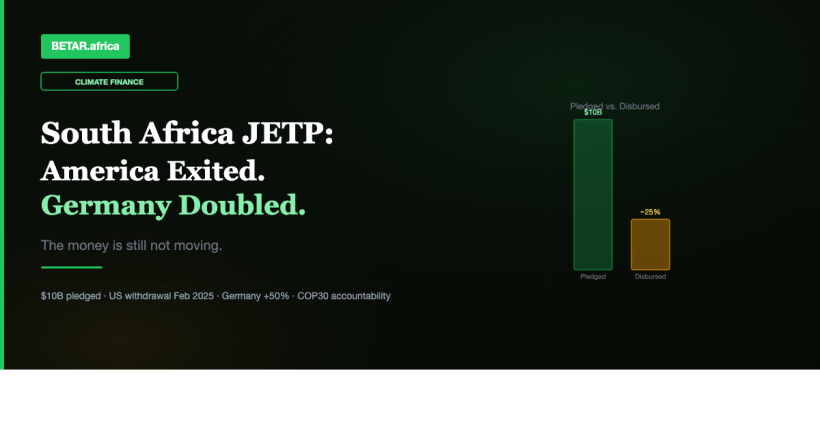
The Just Energy Transition Partnership was billed as the model for global climate finance. America has since walked away, Germany has nearly doubled its commitment, and the total pledge has grown to $10 billion. The fundamental problem — disbursement lagging pledges by years — remains unsolved heading into COP30.
When the Just Energy Transition Partnership for South Africa was announced at COP26 in Glasgow in November 2021, it was the most ambitious bilateral climate finance package in history. The United States, European Union, United Kingdom, France, and Germany pledged an initial $8.5 billion — in grants, concessional loans, and mobilised private investment — to accelerate South Africa’s transition away from coal, the fuel that generates roughly 80 percent of the country’s electricity and sustains the most carbon-intensive power sector among G20 nations.
Four years later, the partnership looks structurally different from what was announced. In February 2025, the United States formally withdrew from the JETP, cancelling its unallocated grant balance of $56 million and walking back approximately $1 billion in potential commercial investments that were counted in the original pledge. The exit reflected the broader US foreign climate policy reversal, but it removed the partnership’s most symbolically significant member and raised questions about the durability of rich-country commitments.
Germany responded by increasing its commitment by roughly 50 percent, to approximately $1.8 billion, becoming the largest single concessional contributor. The International Partners Group — the coalition of wealthy nations behind the JETP — reaffirmed collective commitment. The total pledge is now approximately $10 billion, with bilateral additions pushing headline figures toward $12.4 billion and MDB pledges from the World Bank and African Development Bank taking the full stack to $13.7 billion.
The question that the headline numbers obscure is the one that matters for African climate negotiators heading into COP30 in Belem: how much has actually been disbursed?
The Disbursement Gap
Tracking actual disbursement against JETP pledges is complicated by the structure of the deal itself. The $10 billion is not a single fund that can be checked against a disbursement ledger. It is a composite of bilateral government commitments, multilateral bank pledges, and private sector investment mobilisation targets — each with different legal instruments, disbursement conditions, and timelines. Some elements are grants; the majority are loans and private finance that are conditional on South Africa meeting specific policy milestones.
Data from the Climate Policy Initiative’s South African Climate Finance Landscape, the IEEFA’s South Africa energy transition analysis, and the SA JETP Secretariat’s own reporting point to a consistent pattern: grant funding has disbursed at a higher rate relative to commitments, but grants are a small fraction of the total pledge. The bulk of the $10 billion — concessional loans and private mobilisation — remains largely undisbursed, with disbursement conditional on policy actions that South Africa has struggled to implement at the required pace.
The policy conditions are specific and technically demanding. They include Eskom unbundling milestones, distribution grid upgrades enabling private power purchase agreements, accelerated coal plant retirement schedules, and regulatory reforms in the Independent Power Producers programme. Progress on these milestones has been real but uneven. Eskom’s operational and financial restructuring has advanced more slowly than the JETP investment plan assumed. Grid upgrade backlogs persist. The coal retirement timeline has slipped in the face of power supply reliability concerns — South Africa experienced over 200 days of loadshedding in 2023, creating political pressure to maintain rather than retire coal generation capacity.
Grants vs. Loans: The Composition Problem
Beneath the disbursement tracking question lies a more fundamental critique that African civil society organisations and climate finance analysts have raised consistently: the JETP is not primarily a grant programme, and the gap between “climate aid” rhetoric and debt-instrument reality matters enormously for South Africa’s fiscal position and for the precedent it sets.
Of the $10 billion headline commitment, approximately $3.5 billion is in grants and highly concessional loans from bilateral government sources. The remainder — a majority — is commercial and semi-commercial finance, private sector investment mobilisation, and multilateral development bank lending at near-market terms. South Africa will service that debt. The energy transition the JETP finances will be partly funded by South African taxpayers and electricity consumers, through Eskom’s balance sheet, for decades.
This is not a secret embedded in the fine print. The JETP’s South Africa Investment Plan, published by the JETP Secretariat, is explicit about the composition. But the political communication around JETP commitments — particularly at successive COP summits — has consistently led with the $8.5 billion and then $10 billion headline, without the composition detail that would allow a lay audience to assess what the partnership actually costs South Africa. For a country whose Eskom debt burden already required a $20 billion sovereign bailout package, the distinction between grant and loan matters acutely.
What the US Withdrawal Stress-Tested
The US withdrawal in February 2025 was significant not for its financial scale — $56 million in cancelled grants is small relative to the total package — but for what it tested. The JETP was premised on sustained political commitment from the International Partners Group across multiple government cycles in multiple rich nations. The US exit demonstrated that this commitment is not binding, is subject to domestic political shifts, and can be reversed unilaterally with limited consequence for the withdrawing party.
Germany’s response — scaling up its commitment substantially and absorbing part of the political slack — was a meaningful signal of European intent. The AfDB and World Bank reaffirmations provided institutional continuity. But the episode exposed the absence of any enforcement mechanism. There is no penalty for a JETP partner that reduces or withdraws its commitment. There is no compensation mechanism for South Africa if the investment plan it has built around JETP inflows is disrupted by unilateral partner exits.
This matters beyond South Africa. The JETP model has been extended to Senegal, Indonesia, Vietnam, and India. Each of those deals carries the same structural vulnerability: political commitments by rich-country governments that may change with election cycles, with no binding legal obligation and no consequence for non-delivery. If the South Africa JETP’s execution record and the US withdrawal are studied seriously in Dakar, Hanoi, and New Delhi, the conclusions will likely include harder negotiating demands for grant-heavy front-loaded finance, shorter disbursement timelines, and some form of commitment mechanism that the current model entirely lacks.
The COP30 Implications
Climate finance accountability is expected to be a defining battleground at COP30 in Belem in November 2026. The global stocktake process initiated at COP28 has already surfaced the gap between rich-country climate finance pledges and actual flows to developing nations — a gap the OECD’s own tracking has estimated at tens of billions of dollars annually.
South Africa’s JETP is the highest-profile bilateral climate finance experiment in the world. If its disbursement record arrives at COP30 as a cautionary tale — pledges inflated by loan reclassification, disbursement lagging by years, policy conditionality used to defer obligations — it will harden developing country negotiating positions on climate finance architecture considerably. The African Group of Negotiators and the Like-Minded Developing Countries bloc have consistently pushed for grant-based, unconditional finance at a scale that rich nations have consistently failed to deliver. The JETP’s execution record will be evidence in that argument.
The AfDB’s reaffirmation of its JETP commitment — in a joint statement with South Africa’s National Treasury — signals that African institutional finance is prepared to remain engaged with the partnership framework. The AfDB’s involvement also provides a degree of insulation against purely bilateral political volatility: multilateral bank commitments are more durable than bilateral government pledges, even if they carry different financial terms.
The Model Question
The South Africa JETP was designed as a prototype. The logic was that demonstrating a functional rich-nation climate finance commitment to a major coal-dependent developing country — with transparent investment planning, monitored policy milestones, and blended finance architecture — would establish a replicable template for the dozens of developing nations that need to transition away from fossil fuels.
Four and a half years in, the template has real achievements: the JETP Secretariat is functional, the Investment Plan is published and tracked, South Africa has advanced on Eskom unbundling and IPP frameworks, and the partnership survived a major partner withdrawal with renewed commitments from others. These are not nothing in the context of what climate finance architecture looked like before Glasgow.
But the template also has documented shortcomings: the grant-to-loan composition skews toward debt, disbursement lags pledges by years, policy conditionality creates delays that serve partner-country interests as much as recipient interests, and there is no binding commitment mechanism for partner adherence. For African negotiators at COP30, the honest assessment of what the JETP model delivers — and what it does not — will be more useful than a narrative that presents pledges as equivalent to flows.
The money that moved matters. So does the money that has not moved yet. And so does the question of whether the architecture that connects the two is fit for the speed that Africa’s coal transition — and the global climate — actually requires.


 UphivaBETAR