
Startups across sub-Saharan Africa raised more money in the first two months of 2026 than in the same period last year. On paper, the numbers look like a recovery. Beneath them is a structural shift that will define how African founders build companies for the next decade: US venture capital is quietly pulling out, and African institutional money is moving in to fill the gap.
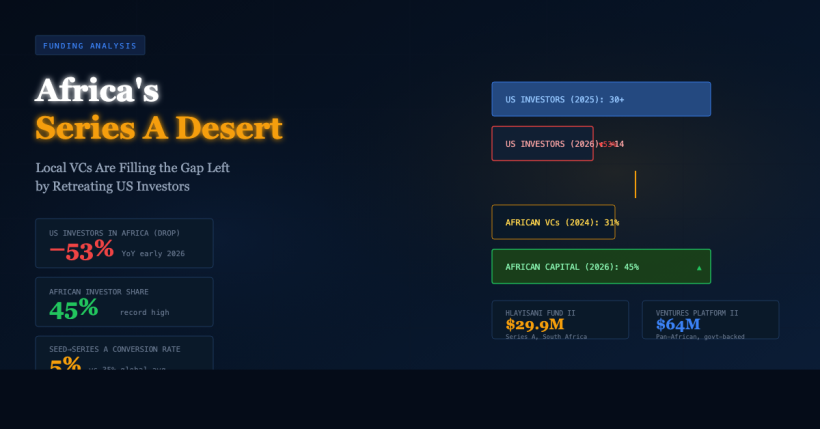
The divergence is stark. Analysis by Launch Base Africa published this month found that US-based investors active in African deals dropped from more than 30 in early 2025 to roughly 14 in early 2026 — a decline of approximately 53 percent in twelve months. Funds that were consistent participants in Nigerian and Kenyan rounds in 2024 — QED Investors, Quona Capital, Left Lane Capital — are largely absent from the deal record so far this year. Meanwhile, aggregate capital deployed is up, because a different class of capital has stepped into the breach: African institutions writing larger cheques, backed by pension funds, government programmes, and sovereign wealth vehicles that had never previously touched venture.
Why US VCs Stepped Back
The reasons for the US pullback are both cyclical and structural. The Federal Reserve’s rate-hiking cycle between 2022 and 2024 pushed risk-free returns above five percent, dramatically raising the opportunity cost of deploying capital into illiquid African positions with uncertain exit timelines. For US general partners already under LP pressure to demonstrate returns from earlier vintages, trimming emerging market exposure was the path of least resistance.
Africa compounds the global pressures with its own. Currency depreciation — naira, cedi, and rand all weakened significantly against the dollar over the past two years — erodes returns in ways that do not show up in local headline numbers. Exit infrastructure remains thin: African tech IPOs are rare, and the M&A buyer pool is shallow compared to Southeast Asia or Latin America, which compete for the same pool of globally mobile venture capital. North American investors accounted for half of the overall decline in active African investors in 2023, according to AfriLabs data — and the trend has accelerated rather than reversed in 2025 and early 2026.
The consequence is a funding mix that has shifted materially. Equity’s share of African startup deals fell from approximately 75 percent in early 2025 to under 50 percent by early 2026, with debt financing rising from nine percent to 23 percent of deal volume over the same period. More capital is flowing in, but less of it is the patient, network-connected equity that helps founders build companies at scale.
African Capital Reaches a Tipping Point
The structural response has been building for longer than the current headlines suggest. The African Private Capital Association reported last year that African investors became the single largest group of active venture participants on the continent for the first time in 2024, representing 31 percent of the 614 active investors tracked — up from 19 percent in 2015. Domestic institutional commitments to African VC funds grew 3.7 times over two years, from $171 million in 2022 to $639 million in 2024.
In 2025, that shift accelerated sharply. African corporates’ share of VC fundraising commitments jumped from seven percent — the average across 2022 to 2024 — to 41 percent in 2025, as pension funds, insurers, and state-linked development vehicles converted intention into deployed capital. The US retreat and the African advance are happening simultaneously, but they are not the same story. The local capital would be moving in regardless of what US VCs were doing — it is the product of a decade of ecosystem maturation finally producing a pipeline of investable Series A-stage companies.
The Funds at the Front
Two fund announcements in recent months crystallise the shift. In November 2025, Lagos-based Ventures Platform closed $64 million for its Pan-African Fund II — with the Nigerian government’s iDICE programme as the first LP. It was the first time the Nigerian federal government had invested in a private venture capital fund, delegating capital allocation to an experienced fund manager rather than picking startup winners directly through grants or equity stakes. “Having iDICE as an LP inspires and gives confidence to foreign LPs, and they have context into the markets, making them very helpful to the fund manager and portfolio companies in the local markets,” said Kola Aina, founding partner of Ventures Platform. The fund is targeting 30 to 40 investments and is working toward a $75 million final close.
Last week, South Africa’s Hlayisani Capital announced the first close of its Venture Fund II at $29.9 million — anchored by the Public Investment Corporation, which manages roughly $160 billion in South African government pension assets, and the SA SME Fund. The mandate is explicit: address what the firm describes as “Africa’s Series A desert” *(Hlayisani Capital, Fund II press release, February 2026)* — South African startups stranded between a well-developed seed ecosystem and an almost complete absence of growth-stage capital. “South Africa continues to produce globally competitive technology businesses,” the firm said in its announcement, “and HVF II exists to ensure they have the capital, opportunity, and long-term partners required to win on the international stage.” The fund is targeting sectors including AI, fintech, healthtech, and edtech, with a focus on Series A cheques in the $2 million to $5 million range.
The Desert Remains
The shift in who is writing cheques does not resolve the underlying problem. Only five percent of African seed-stage startups successfully raise a Series A — approximately 85 percent below the global average. The follow-on conversion rate collapsed from one in five in 2021 to roughly one in twenty by 2023. That gap will not be closed by two fund closings, however symbolically significant.
Hlayisani’s $29.9 million, deployed carefully, might finance five to eight Series A rounds in total. Ventures Platform’s $64 million fund will do perhaps 35 investments across pre-seed to Series A across the full continent. The institutional funds that US VCs brought to African deals — $100 million to $300 million vehicles capable of writing $10 million or $15 million Series A cheques alongside co-investors — have not been replaced. They have been partially substituted by smaller, more locally grounded capital that cannot match the ticket sizes US funds could deploy at their peak.
What has changed is the architecture. African institutional capital — pension funds, government programmes, sovereign wealth vehicles — is now structurally present in the venture ecosystem in a way it was not three years ago. That changes the return expectations, the timeline pressures, and the exit assumptions that govern how African companies are built. Whether it proves sufficient to break the Series A desert depends on whether it continues to scale — or whether it, too, proves cyclical, retreating when the macro environment shifts again.
The founders raising now will be the first to find out.
— Business Reporter, BETAR.africa


 UphivaBETAR
 Joseph Busari