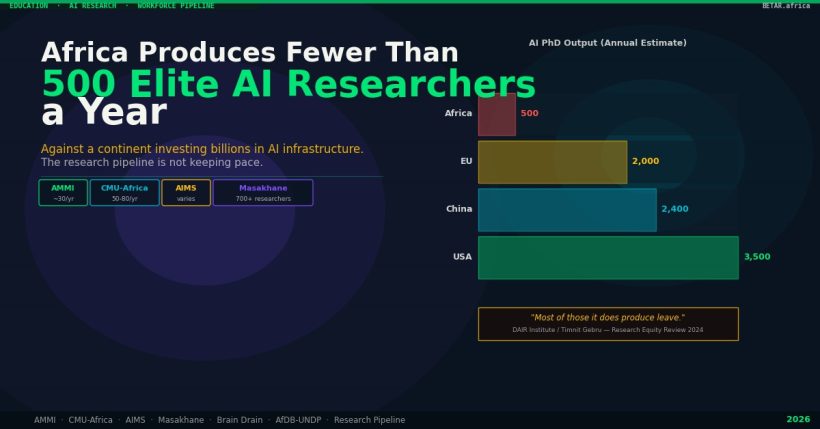

Africa’s AI investment narrative is dominated by compute infrastructure and policy frameworks. Behind both sits a smaller, harder problem: the continent’s elite AI researcher training pipeline produces a fraction of what is needed — and most of those it does produce leave.
Each year, the African Masters of Machine Intelligence programme accepts approximately 30 students onto its twelve-month residential track. The programme — launched by the African Institute for Mathematical Sciences and backed by Google DeepMind — is among the most rigorous AI training environments on the continent: applicants must hold a strong mathematics or computer science background, and the curriculum covers machine learning theory, probabilistic modelling, and applied deep learning at a level comparable to top European programmes.
Thirty students. On a continent of 1.4 billion people.
AMMI is not alone. CMU-Africa in Kigali graduates roughly 50 to 80 master’s-level AI and computing students annually. The broader AIMS network — with nine centres from Ghana to Tanzania — produces a wider cohort of mathematically trained graduates, some of whom specialise in AI and data science. Add Strathmore University’s research directorate in Nairobi, Wits and UCT in South Africa, and a handful of Egyptian and Moroccan institutions with serious AI research programmes, and Africa’s total annual output of researchers trained at the frontier of AI is unlikely to exceed 400 to 500 people per year.
Against a continent investing billions in AI infrastructure, and an AfDB-UNDP initiative projecting 40 million AI-adjacent jobs by 2035, that pipeline is not enough.
Who Is Being Trained — and Where They Go
The institutions training Africa’s elite AI researchers share a common problem: their graduates are globally competitive, which means the global market competes for them.
CMU-Africa, by design, produces graduates who can move seamlessly into PhD programmes at Carnegie Mellon Pittsburgh, MIT, ETH Zurich, and Oxford. Many do. A 2024 analysis by the Distributed AI Research Institute found that African AI researchers who leave for Europe or North America rarely return to African institutions. “The infrastructure pull is too strong,” the institute noted in its research equity review. “When you train at the frontier, you want to work at the frontier — and the frontier, for now, is not in Accra or Nairobi.”
Masakhane, the African natural language processing research collective, offers a partial counterpoint. The community now spans more than 700 researchers across 38 countries — including a significant diaspora cohort — and produced 27 peer-reviewed papers in 2024. Its model is explicitly distributed: diaspora-based African researchers contribute to African AI infrastructure without requiring physical return. Datasets, models, and published research remain open and Africa-anchored.
But even Masakhane’s own community data shows that the majority of its most prolific contributors — those with five or more publications — are based outside Africa. The brain drain at the doctoral level is structurally different from broader STEM emigration. It is not primarily driven by safety or economic desperation. It is driven by research infrastructure: compute access, peer networks, and the proximity to other researchers working at the same level of sophistication.
Who Is Paying for the Pipeline
The funding architecture for Africa’s elite AI research training is narrow and concentrated.
Google DeepMind’s backing of AMMI is the single largest private commitment to African AI researcher training. The programme costs an estimated $2 million to $3 million annually to operate — a figure the AIMS network has indicated is sustainable only with continued corporate sponsorship. Canada’s International Development Research Centre funds AI-for-development research at a handful of African university departments. The AfDB-UNDP $10 billion AI initiative announced in February 2026 includes a researcher training component, though specific per-country allocations have not been published.
What is absent from this landscape is sustained, scalable public funding from African governments for AI research at the frontier level. South Africa’s National Research Foundation provides salary supplements for rated researchers, but its budget has been flat in real terms for several years. Nigeria’s Tertiary Education Trust Fund has not developed a specific AI research track. Rwanda is the continental outlier: its government has made sustained investments through a direct CMU-Africa partnership, contributing to campus facilities and supporting Rwandan student access to the programme.
The result is a training ecosystem heavily dependent on the continued goodwill of a small number of international funders — replicating, at the research level, the same structural vulnerability that DFI dependency creates across Africa’s broader education investment landscape.
The Scale of the Gap
The deficit is clearest in comparison. The United States produces approximately 3,500 AI and machine learning PhDs per year. China produces an estimated 2,400. The European Union, across its member states, produces roughly 2,000. Africa, across all 54 countries, produces fewer than a few hundred researchers with equivalent training — the vast majority from a handful of programmes in Rwanda, South Africa, Ghana, and Egypt.
This is not simply a function of population or economic scale. South Korea and Singapore — neither a continental power — each produce more elite AI researchers annually than the entire African continent, because both made PhD research in computing a national investment priority in the 1990s. The gap between Africa’s AI ambition and its researcher pipeline is a function of deliberate investment choices, made and deferred, over decades.
What Closing the Gap Requires
Three targeted interventions have the clearest evidence base.
Researcher salary supplements at frontier AI institutions. The single largest driver of researcher emigration from African universities is the gap between local academic salaries and international alternatives. A targeted five-year programme — modelled on South Africa’s NRF rating supplements — that brings salaries for AI researchers at AIMS, CMU-Africa, and qualifying national universities to within 60 to 70 per cent of European benchmarks would retain a meaningful share of mid-career researchers currently lost at the point of career decision. A $30 million annual fund across ten institutions would cover approximately 300 researcher positions.
Compute access parity for research institutions. Elite AI research requires GPU access. The cost differential for compute in Africa — as much as three times higher than in US or European research contexts — is not merely a startup problem; it is a research problem. Researcher productivity is directly constrained by compute availability. The AfDB-UNDP initiative must treat researcher compute access, not just enterprise use, as a core infrastructure investment.
Structured PhD pathways with return obligations. A government scholarship for doctoral AI training at top global institutions, linked to a three-to-five year return obligation and an affiliated position at a named African research institution, would increase the doctoral pipeline while building a return mechanism into the funding architecture. Rwanda’s CMU-Africa partnership is the closest existing model: government investment in an international institution, creating a local pipeline with institutional incentives to stay.
Africa’s AI investment ambition is real. The researcher pipeline that makes it durable is not yet built.
At a Glance: Africa’s Elite AI Research Training Landscape
| Programme | Location | Annual graduates (est.) | Primary funder |
|---|---|---|---|
| African Masters of Machine Intelligence (AMMI) | AIMS centres, multiple countries | ~30 per cohort | Google DeepMind, AIMS |
| CMU-Africa | Kigali, Rwanda | 50–80 | Carnegie Mellon University, Rwanda govt |
| AIMS Research Centres (AI/data science tracks) | 9 centres, pan-Africa | ~200–250 (all disciplines) | AfDB, IDRC, Mastercard Foundation |
| Masakhane Research Collective | Distributed (38 countries) | 700+ active researchers | Open / grants-based |
| UCT / Wits AI research programmes | South Africa | ~50–70 | NRF, university funding |
Sources: AMMI programme documentation; CMU-Africa annual report 2024; Distributed AI Research Institute, Research Equity Review 2024; Masakhane Research Collective, Annual Summary 2024; UNESCO Institute for Statistics researcher density data 2025; AfDB-UNDP AI Initiative announcement, February 2026.

 Joseph Busari

 UphivaBETAR