
Nigeria’s Fintech Two-Way Street: The ETIP Deal That Brings Wise In and Sends LemFi Out
A bilateral trade framework is reshaping Africa’s most important financial corridor — in both directions. The bigger question is who ends up owning the infrastructure.
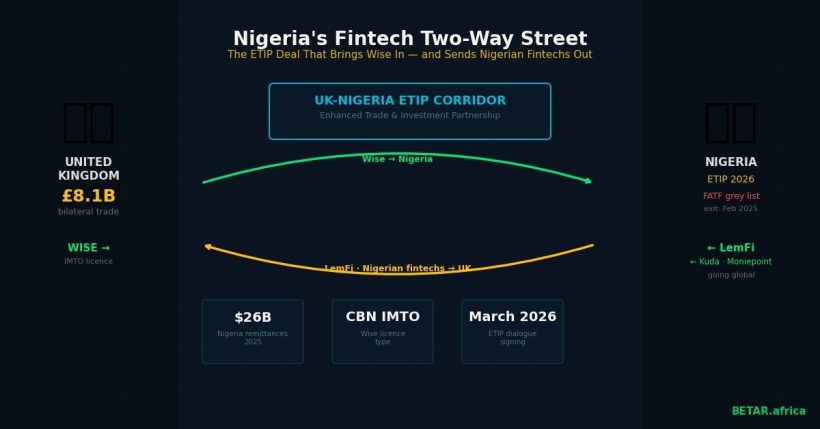
On 16 March 2026, UK and Nigerian ministers signed the communiqué of the inaugural UK-Nigeria Enhanced Trade and Investment Partnership dialogue, with President Tinubu in London on a state visit. The headline from most outlets: bilateral trade has hit an all-time high of £8.1 billion a year. The fintech story buried beneath that number is more interesting.
The same week, Wise — the UK’s largest independent cross-border payments company — confirmed it had secured a Central Bank of Nigeria International Money Transfer Operator (IMTO) licence, ending more than a decade of operating the Nigeria corridor through third-party intermediaries. In the parallel direction, three Nigerian-born fintechs announced or reaffirmed major UK expansions: LemFi committed to a £100 million, five-year investment making London its global headquarters; Kuda Bank announced it would double its UK footprint in 2026; Moniepoint said it would grow its London team to 100 employees this year.
This is not coincidence. It is the first visible output of a regulatory and diplomatic architecture that has been under construction since Nigeria’s removal from the FATF grey list in October 2025 — and it signals something about where Nigeria’s cross-border payments market is heading that deserves more scrutiny than the headlines have given it.
The FATF Dividend, Finally Showing Up
Nigeria was on the Financial Action Task Force’s grey list for two years, a period that imposed automatic enhanced due diligence requirements on counterparties in every major financial market. The practical effect was a higher cost of doing business in and with Nigeria — correspondent banking relationships became more expensive, international fintechs deprioritised Nigeria market entry, and Nigerian companies seeking to raise or deploy capital abroad faced an additional compliance burden.
CBN Governor Yemi Cardoso said after the October 2025 removal that the grey-listing had cost Nigeria approximately $30 billion in investment potential. That number is contested — attribution is hard — but directional evidence supports the idea that the cost was real. A working paper from the IMF found grey-listing reduces capital inflows by an average of 7.6% of GDP through compliance costs and de-risking decisions by global financial institutions.
Wise’s IMTO licence application — which had been in process for some time — cleared regulatory review in a post-grey-list environment where the CBN has explicit incentives to signal openness to international fintech. The ETIP framework provided the diplomatic scaffolding. The combination mattered: a bilateral trade agreement that signals Nigeria as a trusted economic partner made it easier for the CBN to approve, and easier for Wise to prioritise Nigeria in its global expansion queue.
The Two-Way Architecture
What makes the March 2026 moment different from previous market entries is the explicit bidirectionality. The ETIP is not structured as a one-way capital attraction play — it is a reciprocal framework in which Nigerian firms expanding into the UK receive facilitation support, and UK firms entering Nigeria receive regulatory coordination on the Nigerian side.
The numbers illustrate the imbalance this is intended to correct. Nigeria receives approximately $24 billion in annual remittances, with the UK accounting for an estimated $3.5 billion as the second-largest source corridor. For years, most of that flow has been intermediated by international players — Western Union, MoneyGram, WorldRemit — or by Nigerian-founded startups that operate primarily as conduits for inbound foreign currency. The Nigerian fintech sector has been, in aggregate, a receiver of the corridor’s economics rather than a controller of its infrastructure.
The ETIP’s fintech dimension attempts to shift that calculus. LemFi designating London its global headquarters is not a pivot away from Africa — it is an attempt to own the institutional layer of the UK-Nigeria corridor from both ends. Moniepoint’s London expansion is similarly about building UK-side infrastructure to support its African user base. The strategic logic is clear: own the corridor at both endpoints, and the middle takes care of itself.
The Pipeline Question
Wise will not be the last international fintech to enter Nigeria through the post-FATF, post-ETIP regulatory window. The CBN’s new framework — announced in its 2026 fintech report — includes a Single Regulatory Window consolidating multi-agency licensing into one digital portal within six months, and an expanded regulatory sandbox opening corridors for cross-border payments and embedded finance within nine months. A Standing Fintech Engagement Forum that launched in Q1 2026 provides a direct channel between international operators and the CBN.
These are not marginal reforms. A Single Regulatory Window addresses one of the most consistent structural complaints from international fintechs considering Nigerian market entry: that the multi-regulator licensing process (CBN, NITDA, NIBSS) created unpredictable timelines and opacity. If the reforms deliver on the design, Nigeria becomes the easiest major African market to enter through regulatory channels — which is a significant repositioning relative to Kenya, South Africa, and Egypt.
The question for African fintech investors and founders is what that pipeline means for the local competitive landscape. Wise’s entry at mid-market rates puts direct pressure on Chipper Cash’s consumer UK-Nigeria corridor — Chipper’s $2 billion peak valuation has already compressed significantly in a tighter funding environment, and Wise’s pricing discipline is a structural challenge, not a temporary one. For Flutterwave, the dynamic is more nuanced — its Send product competes on the consumer corridor, but Flutterwave also sells payment infrastructure that Wise may use as a settlement layer, making the company simultaneously a competitor and a potential partner. Grey, which serves a different use case (USD accounts for professionals receiving foreign currency salaries), is least exposed.
The Hard Question
The ETIP’s architects would argue that two-way capital and talent flows benefit Nigeria’s fintech ecosystem by creating deeper liquidity, more experienced operators, and a more credible institutional profile for the sector globally. That argument is reasonable as far as it goes.
But the structural concern is this: the firms best positioned to capture the post-FATF, post-ETIP regulatory liberalisation are the ones with existing balance sheet capacity, international licences, and institutional trust. Wise has all three. Most of the locally-founded challengers operating the same corridor do not. Regulatory openness does not, by itself, resolve the access-to-capital asymmetry between a London-headquartered public company and a Lagos-headquartered startup operating in a market where dollar-denominated institutional capital remains episodic.
The ETIP creates a corridor. Who controls it will depend on whether Nigeria’s fintech ecosystem can scale from corridor participant to corridor architect — before the international players build the infrastructure that makes that repositioning impossible.


 UphivaBETAR


 Joseph Busari