
By Business Reporter, BETAR.africa | 22 March 2026
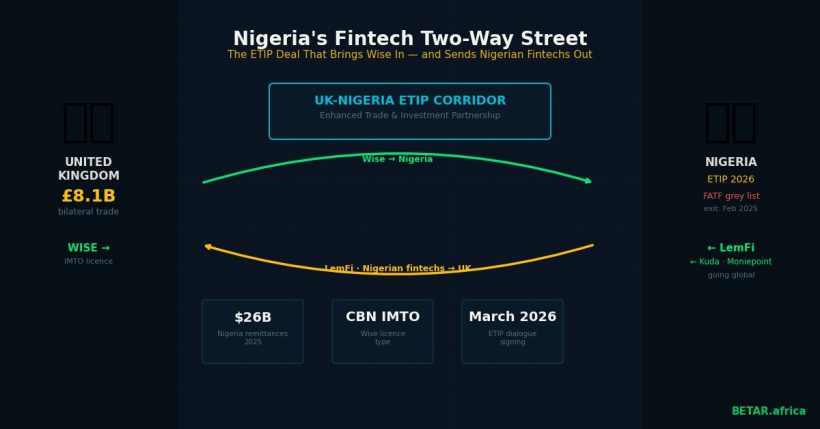
Wise has cleared the Central Bank of Nigeria’s International Money Transfer Operator (IMTO) licensing process and is now operating in Nigeria through a direct regulatory licence — not a third-party intermediary arrangement. For anyone sending money from the United Kingdom, United States, or Europe to Nigeria, the practical question is not what Wise’s entry means for fintech geopolitics. It is what it means for the price, speed, and reliability of the transfer.
The short answer: it is likely to mean lower fees on the UK-Nigeria corridor and increased pressure on the local operators who have built businesses serving the same route. The longer answer is more complicated.
What Licence Wise Actually Received
The IMTO licence issued by the CBN authorises Wise to receive foreign currency from senders abroad and disburse naira to recipients in Nigeria. It is a specific, narrow instrument — it permits inbound remittance processing, not domestic payment operations or naira account provision.
That distinction matters for understanding what Wise can and cannot do in Nigeria. Wise can accept a GBP transfer from a UK sender, convert it at its mid-market rate, and pay the naira equivalent into a Nigerian bank account or registered digital wallet. It cannot, under an IMTO licence alone, hold naira balances, issue accounts, or operate as a payment service bank in Nigeria.
This is structurally different from what Grey or Kuda do. Grey provides USD or GBP accounts to Nigerian professionals, primarily for receiving foreign currency salaries and contractor payments. Kuda is a full microfinance bank. Wise’s IMTO licence positions it as a remittance operator — optimised for inbound consumer transfers, not for the dollar-account layer that has become a primary use case for Nigeria’s diaspora fintech economy.
The Pricing Test
Wise’s competitive proposition globally is built on one claim: it charges the mid-market exchange rate and adds a transparent, low percentage fee. No margin buried in the FX spread.
On the UK-Nigeria corridor before Wise’s direct entry, senders sending £1,000 to Nigeria would typically encounter:
- Banks (Barclays, HSBC, Lloyds): 2.5%–4% FX margin plus transfer fee, total effective cost £30–£50 per £1,000
- Western Union / MoneyGram: 1%–2.5% explicit fee plus a ~3–5% FX spread, total £40–£75
- WorldRemit: £1.99 fixed fee plus a ~2% FX spread on larger amounts
- LemFi: Typically 0%–1% fee with a near-mid-market exchange rate — the most competitive incumbent
Wise’s direct licence removes the correspondent banking intermediary layer it previously used for Nigeria transfers. That intermediary layer typically added 0.5%–1.5% in cost due to additional settlement fees. The expectation is that direct IMTO authorisation allows Wise to lower its Nigeria transfer price to the floor of its global product: the mid-market rate plus 0.35%–0.85% fee, depending on amount and funding method.
At that price point, Wise would undercut every bank and match or beat LemFi — which has been the pricing benchmark for the corridor’s most cost-conscious users. LemFi and Wise will likely converge to near-identical pricing, with competition shifting to delivery speed, recipient bank compatibility, and app experience.
Where the Competition Actually Sits
Wise’s entry disrupts different competitors in different ways.
LemFi is the most directly exposed. LemFi has built its Nigeria corridor business on being the low-cost alternative to legacy operators. Wise at its direct-IMTO pricing removes that differentiation on price alone. LemFi’s response — designating London as its global headquarters and committing to a £100 million, five-year UK investment — signals a strategic pivot toward full-service financial infrastructure rather than competing purely on transfer price.
Grey is the least exposed. Grey’s core product is a USD or GBP account, not a remittance product. The typical Grey user is a Nigerian software engineer or contractor receiving a foreign currency salary. That user does not want to convert to naira immediately — they want to hold the foreign currency and spend it or convert it when rates are favourable. Wise does not serve this use case under its current IMTO licence.
Flutterwave Send targets a different user: primarily Africans in the diaspora who want to send smaller amounts to recipients in multiple African markets. Flutterwave’s competitive position depends on multi-market distribution, not on being the cheapest on a single corridor. Wise’s Nigeria entry does not challenge that multi-market positioning.
Chipper Cash is the most strategically vulnerable of the incumbents. Chipper built significant volume on the UK-Nigeria corridor at a time when Wise was not directly present. Chipper has faced balance sheet pressure in the tighter funding environment of 2024–2025, and it cannot respond to Wise’s direct entry with an equivalent pricing reduction without compressing margins that are already under strain.
The Consumer Reality
For the approximately 1.7 million Nigerians living in the UK — the largest African diaspora group in Britain — Wise’s direct market entry produces a concrete, if modest, improvement.
Transfer fees on a £500 payment at incumbent rates average £8–£25. At Wise’s expected direct-licence pricing, that same transfer costs £2–£5. Over 12 monthly transfers, the saving is £70–£240 per year per household — meaningful for a diaspora population that sends an estimated £3.5 billion annually to Nigeria.
Delivery time is a separate question. Wise’s direct IMTO licence removes one intermediary layer, which should improve transfer speed in most cases. But delivery to Nigerian bank accounts remains subject to NIBSS settlement windows, which can create delays regardless of the sending platform.
The Limits of the Opening
Wise’s entry is a product development, not a structural transformation of the corridor.
Nigeria’s IMTO framework still requires all inbound remittances to be received in foreign currency and converted at CBN-authorised rates. Naira-denominated settlement must flow through the official FX market. That constraint means Wise — like every other licensed IMTO operator — cannot offer the parallel-market rate that some informal hawala channels provide. For senders who prioritise maximising the naira received over the convenience and safety of a licensed channel, the informal market remains cheaper.
The CBN’s new Single Regulatory Window — consolidating multi-agency licensing into one digital portal, expected within six months of the Q1 2026 fintech framework — is likely to bring more international operators through the formal channel over the next 12–18 months. Each arrival increases competitive pressure and narrows the informal market’s cost advantage slightly.
But the structural question — who controls the infrastructure of the world’s fifth-largest remittance corridor — will not be resolved by one market entry. It will be resolved by which operators can build the full-stack relationship: account, transfer, spend, credit. Wise has a direct remittance licence. Building the rest requires more.
Wise is authorised by the Financial Conduct Authority in the UK and holds an IMTO licence from the Central Bank of Nigeria. Pricing estimates are based on publicly available transfer fee disclosures and BETAR market analysis. Related coverage: BETA-893 — UK-Nigeria ETIP and the fintech corridor architecture.


 UphivaBETAR


 Joseph Busari