
What Comes After CESA 2025? Mapping Africa’s Next Continental Education Strategy
The African Union’s ten-year education framework has closed with most targets unmet. CESA 2026–2035 is live — but whether it is a better strategy or merely a better-designed one depends on answers that the document alone cannot provide.
March 2026
When the African Union’s Continental Education Strategy for Africa — CESA 16–25 — closed at the end of 2025, it left behind a record that resists easy summary. Seventy-five million more African children are in school than a decade ago. More than 100 million remain out of school — a figure that increased during the CESA decade as Africa’s school-age population expanded faster than its systems could absorb. BETAR’s own audit of the strategy documented the scale of what was missed: a $77 billion annual financing gap, stalled TVET expansion, STEM gender targets without binding numbers, and a COVID disruption the framework was never designed to withstand.
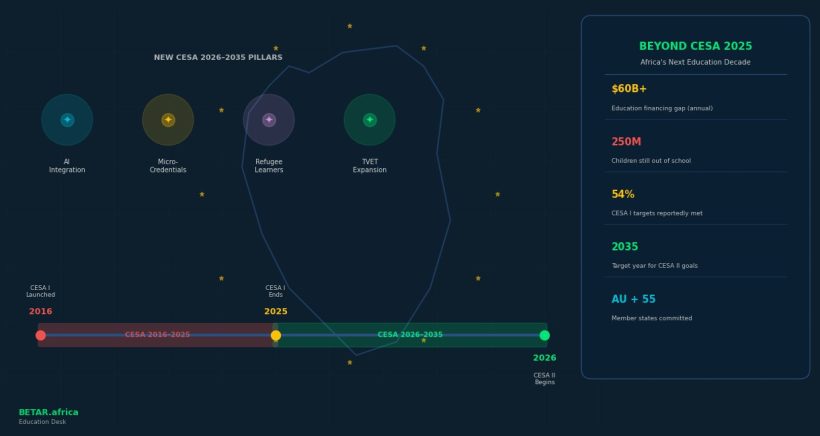
In February 2025, AU Heads of State adopted CESA 2026–2035. The successor strategy was formally launched in October 2025 at the Pan-African Conference on Teachers’ Education and Development, co-hosted with UNESCO. It is structured around six strategic areas and twenty objectives — a tighter architecture than its predecessor’s twelve diffuse objectives. “Gender, equity, and inclusion” appears as a named strategic area for the first time. UNESCO described it as “more ambitious and specific.” The AU Commission’s Department of Human Resources, Science and Technology is coordinating national implementation briefs with member states.
The question that matters now is not whether CESA 2026–2035 is better written than CESA 16–25. It almost certainly is. The question is whether it is different in the ways that caused the last strategy to underdeliver.
What the Architecture Looks Like — and What It Still Lacks
CESA 16–25 had two architectural failures. The first was the absence of binding numerical targets at country level. Twelve strategic objectives across 54 member states with no enforcement mechanism produced a framework everyone endorsed and few were held accountable to. The second was monitoring: no systematic, real-time data infrastructure existed to track progress against the strategy’s own goals. By the time the mid-term review flagged underperformance, the intervention window had passed.
CESA 26–35 represents a genuine structural improvement. The Association for the Development of Education in Africa (ADEA) has noted more coherent alignment between the continental framework and national education sector plans than its predecessor achieved. UNESCO’s IICBA is developing implementation briefs and a professional development course for policymakers. The institutional apparatus for a better-monitored implementation cycle exists in a way it did not in 2016.
“The accountability gap was CESA’s defining weakness,” said Dr. Mmantsetsa Marope, former Director of UNESCO’s International Bureau of Education and a leading voice in continental education policy since the early 2000s. “CESA 26–35 has been designed with more specificity. The test is whether the AU Commission builds the tracking infrastructure before the mid-term review — not after.”
Whether the new framework moves from directional language to country-level numerical commitments with consequences attached remains the central open question. The institutional authority exists. Whether it is exercised will determine whether the 2035 audit reads differently from the one just completed.
Four Priorities the Successor Strategy Must Address
Artificial intelligence and digital infrastructure. When CESA 16–25 launched, the dominant technology question in African education was basic internet connectivity. In 2026, generative AI is in active use in classrooms and universities across the continent, almost entirely without policy frameworks. Only 40 per cent of Africa’s primary schools and 50 per cent of lower-secondary schools had internet connectivity as of 2024 (International Telecommunication Union). CESA 26–35 must treat AI as curriculum subject, pedagogical tool, and governance challenge simultaneously — while recognising that AI tools deployed without connectivity investment will widen, not close, existing learning disparities.
Micro-credentials and qualifications portability. Africa’s private skills sector — ALX Africa, Moringa School, Decagon, and dozens of smaller bootcamps — has trained tens of thousands of workers outside the formal university system. Their credentials lack portability across borders. The African Continental Qualifications Framework was designed to resolve this. CESA 26–35’s alignment with ACQF operationalisation will determine whether the continent builds a genuinely portable skills infrastructure or sustains the fragmented landscape that disadvantages workers and slows intra-African labour mobility.
Refugee and displaced learner inclusion. Africa hosts the world’s largest internally displaced population, tens of millions of people, the majority school-age. CESA 16–25 had no dedicated framework for displaced learner inclusion. CESA 26–35’s “gender, equity, and inclusion” strategic area must translate into specific instruments — accelerated teacher deployment to displacement contexts, digital learning access in humanitarian settings, recognition of learning achieved outside formal institutions — or the designation will remain a framing layer on a strategy still designed primarily for settled urban learners.
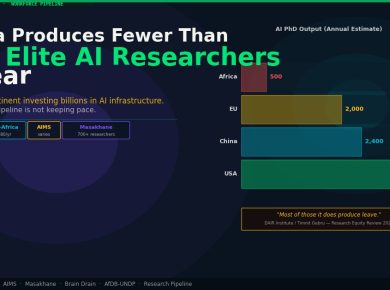
Research commercialisation and the deep-tech pipeline. Sub-Saharan Africa’s gross tertiary enrolment ratio stands at roughly 9 per cent against a global average of 40 per cent. The continent cannot build a competitive AI and deep-tech sector on a researcher pipeline this thin. CESA 26–35 must treat the research-to-revenue gap as an education policy problem, explicitly linking continental strategy to the AfDB’s human capital mandate and the AU’s Digital Transformation Strategy 2020–2030.
Who Gets a Seat at the Table
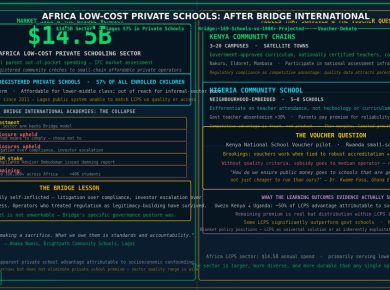
CESA 2026–2035 was developed through AU Commission-led processes with UNESCO, ADEA, and member state ministries as primary stakeholders. The EdTech sector — which now operates at scale across formal and informal learning, from Nairobi to Lagos to Dakar — was not a systematic participant in strategy design.
“The strategies are written for systems. The innovation is happening at the edges — in bootcamps, in mobile-first platforms, in peer learning networks,” said Fadekemi Akindele, Education Partnerships Lead at the Mastercard Foundation’s Young Africa Works programme. “CESA 26–35 needs formal consultation mechanisms with the EdTech and skills sector, not just endorsement from it after the fact.”
Africa’s education diaspora — researchers, curriculum designers, and technologists working outside the continent — represents an institutional resource that continental strategy has never systematically engaged. A formal diaspora advisory mechanism linked to IICBA’s implementation work would be a concrete signal that CESA 26–35 intends to draw on the full breadth of African expertise.
What EdTech Operators and Investors Should Watch
CESA 2026–2035 is the policy architecture within which the next decade of African education technology will operate. CESA frameworks shape national education sector plans, government procurement, and the public-private partnership environment for EdTech operators. Platforms aligned with AUDA-NEPAD’s EdTech 2030 Vision — which frames institutional B2B delivery as the continent’s primary EdTech scale pathway — are better positioned for what the new strategy creates than platforms still built around direct-to-consumer subscription models.
The UNESCO Institute for Statistics’ monitoring role will be the leading indicator of accountability quality. If UIS is embedded in formal CESA reporting with obligations attached, the accountability architecture will be materially stronger than anything the previous decade produced. If monitoring remains advisory, the 2035 audit will read similarly to this one.
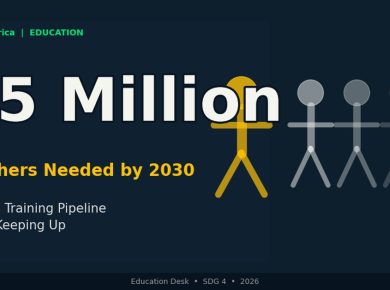
The structural constraints have not changed. The $77 billion financing gap is not closed. The 15 million teacher deficit is not resolved. CESA 2026–2035 is better designed than its predecessor. Whether it becomes better by result depends on whether African governments, development banks, and the AU Commission treat continental education commitments as binding obligations — or as aspirations that a well-designed document will somehow convert into outcomes without the financing, enforcement, and political will required to achieve them.
The 100 million children still out of school are waiting for the answer.


 UphivaBETAR