
By BETAR.africa Business Desk
Filed: March 2026 | Beat: [BUSINESS/EARNINGS] | Issue: BETA-945
For most of MTN Group’s 30-year history, South Africa was the anchor. It was the home market, the largest EBITDA contributor, the stabilising floor beneath a portfolio that spanned volatile currencies, regulatory upheaval, and uneven infrastructure across 19 African countries. That arrangement ended in 2025.
MTN’s full-year results for the year ended 31 December 2025, released on 16 March 2026, confirmed what analysts had been tracking since the H1 results: Nigeria has overtaken South Africa as the group’s top profit contributor — and by a margin that is not close. MTN Nigeria generated EBITDA of $1.926 billion in 2025, roughly 84 percent above South Africa’s $1.048 billion. Ghana, positioned between the two, contributed $1.276 billion. West Africa is now the earnings engine of Africa’s largest telecoms operator.
The implications run deeper than a headline reordering. Understanding what drove the shift — and how durable it is — matters for investors, for the broader African telecoms sector, and for how MTN will deploy the $2 billion war chest it has assembled for acquisitions.
The Numbers
MTN Group posted service revenue of R218 billion for FY2025, a 22.7 percent increase in constant-currency terms. Profit before tax came in at R47.4 billion ($2.81 billion), a swing from a pre-tax loss of R4.1 billion ($243 million) in 2024. Group EBITDA reached R98.5 billion, up 64 percent on a reported basis and 36.8 percent in constant currency, with EBITDA margin expanding 5.4 percentage points to 44.5 percent.
Operating free cash flow before spectrum and licence payments grew 82 percent to R57 billion — the metric that matters most for a company managing both a capex-intensive infrastructure expansion and an active M&A programme. The board declared a dividend of ZAR 5.00 per share, 45 percent above the prior year’s ZAR 3.45. Adjusted headline earnings per share rose 67 percent to ZAR 13.59.
The subscriber base crossed 307.2 million customers (+5.6%), with active data customers growing 9.4 percent to 172.6 million and MoMo monthly active users expanding 10 percent to 69.5 million.
Why Nigeria
The Nigerian turnaround is the central narrative of FY2025, and it needs to be read correctly — because the risk it carries is as significant as the recovery it represents.
MTN Nigeria reported total revenue of ₦5.20 trillion for FY2025, a 54.9 percent increase from ₦3.36 trillion in 2024. Profit after tax was ₦1.11 trillion, versus a loss of ₦400.44 billion the prior year. Free cash flow grew 215.5 percent to ₦1.22 trillion.
Two things drove the recovery. The first is structural: Nigerian data revenue grew 74.5 percent to ₦2.78 trillion, reflecting the combination of subscriber growth (87.3 million mobile subscribers, +7.9%), increasing data penetration (53.2 million data subscribers, +11.6%), and higher average revenue per user as the SIM-NIN compliance environment reduced inactive SIM churn and concentrated value on active customers. Fintech revenue grew 79.7 percent to ₦191.27 billion, with MoMo active wallets reaching 3.7 million by December 2025.
The second driver is one-off in character and cannot be assumed to repeat: the foreign exchange reversal. MTN Nigeria recorded a net FX gain of ₦90.27 billion in 2025, compared to a loss of ₦925.36 billion in 2024. The naira devaluation of 2023 to 2024 — which wiped more than $2 billion from MTN Group’s reported earnings over those two years — has partially unwound. The 2025 FX environment, while still volatile, was dramatically more favourable than the prior period.
Investors should hold both of these things simultaneously: the structural growth (data, fintech, subscriber base) is real and likely to compound; the FX contribution to margin recovery is fragile and tied to naira stability that Nigeria’s macro environment does not guarantee.
Ghana’s Quiet Outperformance
Ghana received less coverage than Nigeria, but its numbers are striking. Service revenue grew 35.9 percent in constant currency, with EBITDA of $1.276 billion — placing it second in the group’s market earnings table and above South Africa. Ghana’s recovery has been driven by a combination of cedi stabilisation, strong data growth, and fintech penetration in a market that was significantly disrupted by the banking sector crisis of 2018 to 2019 and the currency pressure of 2022 to 2023.
The Ghana story is further along its recovery arc than Nigeria, and its EBITDA base is now substantial enough that it functions as a diversification buffer for the group — a role previously held exclusively by South Africa.
What South Africa’s Flatness Signals
MTN SA’s service revenue grew 2.0 percent in FY2025 — operational resilience in a mature, competitive market with low-single-digit GDP growth. The South African telecoms market is structurally different from West Africa: higher penetration, intense competition from Vodacom and Rain, a consumer base facing load-shedding-related demand compression, and an enterprise segment that has been MTN SA’s growth lever.
The 2.0 percent growth is not a failure; it is a reflection of market maturity. What has changed is the relative weighting. South Africa was once the ballast that could offset a bad year in Nigeria. In 2025, Nigeria and Ghana together generated more than twice South Africa’s EBITDA. The floor has shifted, and with it, MTN Group’s risk profile has changed: the group is now more exposed to West African macro and regulatory conditions than at any point in its history.
The Capex and M&A Tension
MTN reported capex (ex-leases) of R38.5 billion for FY2025, with capex intensity at 17 percent of service revenue — toward the top of its 15 to 18 percent guidance range. The company has committed to moderating capex intensity as the heavy infrastructure investment cycle matures, which should translate to free cash flow expansion in 2026 and 2027.
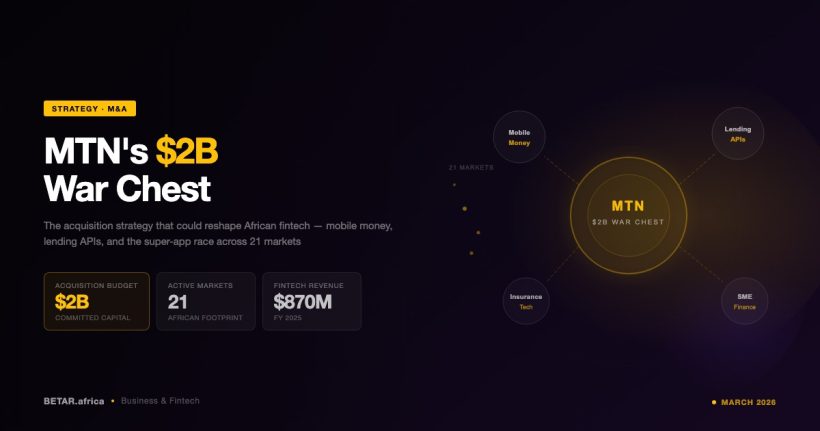
That expansion creates the fiscal headroom for the $2 billion acquisition war chest that MTN Group CEO Ralph Mupita confirmed in February 2026. The strategic rationale remains what BETAR analysed earlier this year: MoMo has the distribution (70 million monthly active users across 16 markets), but lacks the product depth — lending, insurance, savings — that would make it a full-service financial platform rather than a payments rail. Acquisitions are the accelerant.
The question the FY2025 results raise is geographic: where does MTN direct the M&A capital? Nigeria is now the profit engine — but MTN Nigeria is not absent from the market. It is a 87-million-subscriber operation growing at 55 percent. East Africa — Kenya, Tanzania, Ethiopia — remains the geographic gap. A Kenya-licenced fintech acquisition would give MTN immediate access to M-Pesa’s most important adjacent market. Tanzania and Ethiopia represent the greenfield opportunity for a company that has stated it may not re-enter through traditional telecoms licensing.
There is also an internal capital allocation question. MTN Nigeria tripled its capital expenditure to ₦757 billion in 2025, funding the FibreX fixed wireless push targeting 8 million connected homes by 2028. At the group level, the 30 million homes fixed broadband target requires sustained capex. These are not competing priorities today — MTN’s free cash flow growth makes both manageable — but they are competing priorities in a scenario where the naira weakens again or the South African market deteriorates further.
Ambition 2030
MTN used the FY2025 results to announce the successor to its Ambition 2025 strategy. Ambition 2030 consolidates the group’s execution into three platforms: Connectivity (mobile and fixed broadband), Fintech (MoMo and adjacent financial services), and Digital Infrastructure (data centres, cloud services). The framing is consistent with where MTN’s margin expansion is coming from — data and fintech revenue growing faster than voice — and signals that Mupita intends to manage the company as a platform business rather than a traditional operator.
The 307 million subscriber milestone crossed in 2025 was the defining Ambition 2025 target. The Ambition 2030 targets have not been fully disclosed, but the strategic architecture — connectivity at scale, fintech monetisation, infrastructure services — positions MTN to compound the FY2025 recovery rather than treat it as a one-cycle event.
What the Results Mean
The FY2025 results are as significant as any MTN has produced. The company turned a billion-dollar pre-tax loss into a $2.81 billion pre-tax profit in a single year, rebuilt its dividend, and closed the year with its largest subscriber base. The geographic reordering — Nigeria first, Ghana second, South Africa third by EBITDA — is the most consequential structural change in the group’s history.
The risk is also at its most concentrated in a single market than it has been in decades. If Nigeria’s naira deteriorates materially again, or the NCC imposes tariff caps that constrain ARPU growth, the cushion that South Africa once provided is now much thinner in relative terms.
For investors: MTN returned because Nigeria recovered. The question they should be asking is not whether FY2025 was exceptional — it clearly was — but whether the earnings base it has established is the floor or the ceiling for what Nigeria can contribute. Given data penetration that still has significant room to grow, fintech revenue below 4 percent of service revenue (a fraction of what financial services platforms typically achieve), and a fixed broadband opportunity that has barely started, the answer is probably: this is the floor.
Sources: MTN Group FY2025 Results Press Release | MTN Nigeria FY2025 Earnings Release | Nairametrics | Business Remarks | Finance in Africa | IT-Online
Related BETAR coverage: BETA-366 — MTN’s $2B Acquisition War Chest | BETA-743 — MTN 30M Connected Homes FWA Push
— Business Reporter, BETAR.africa


 UphivaBETAR


 Joseph Busari