
South Africa’s R688M Google Settlement: Africa’s First Enforceable Big Tech Payment to Media Publishers
By Policy & Regulation Reporter, BETAR.africa | 22 March 2026
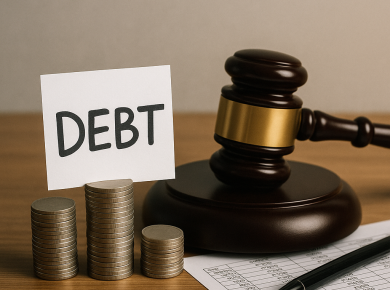
In November 2025, South Africa’s Competition Commission published the final report of its Media and Digital Platforms Market Inquiry (MDPMI) — a three-year investigation into the relationship between global digital platforms and South African news publishers. The headline outcome: Google committed to pay R688 million to South African media organisations over a structured multi-year term. Meta received no financial penalty.
For Africa’s media sector, this is a landmark — not because R688 million is a transformative sum for an industry in structural decline, but because it is the first time a competition authority on the continent has extracted a legally enforceable payment commitment from a global technology platform on behalf of local publishers.
The question for editors, media investors, and regulators across the continent is whether the MDPMI outcome is a template or a one-off.
What Google Actually Agreed To Pay
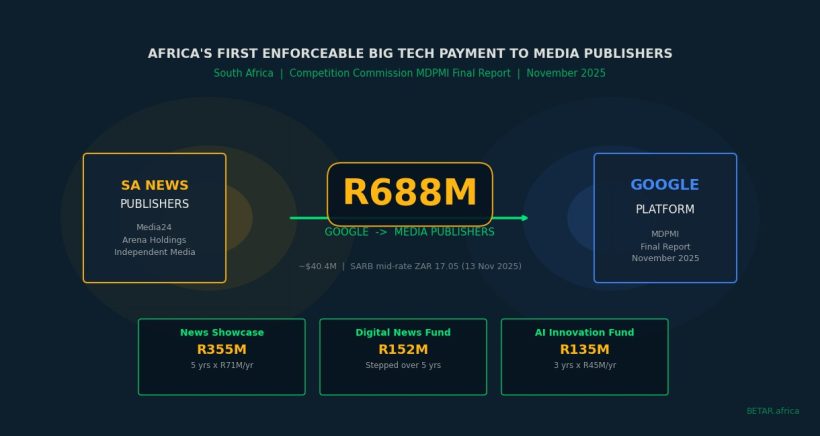
The R688 million headline figure is a Competition Commission total that encompasses several structured streams. The three disclosed components, verified against the Commission’s final report and the South African National Editors’ Forum (SANEF) documentation, break down as follows:
- Google News Showcase: R71 million per year × 5 years = R355 million
- Digital News Transformation Fund: R38 million per year for years 1–3, stepping down to R19 million per year for years 4–5 = R152 million
- AI Innovation Fund: R45 million per year × 3 years = R135 million
The three named streams total R642 million. The Competition Commission’s headline figure of R688 million includes an additional R46 million attributed to compliance monitoring costs, administrative funds, and supplementary publisher support mechanisms not separately itemised in the public documentation.
At the South African Reserve Bank mid-rate of ZAR 17.05 per dollar (13 November 2025 — the date of the final report release), the R688 million total converts to approximately $40.4 million. This is a meaningful distinction from earlier drafts of coverage that erroneously cited $42 million or $37 million; the Commission’s own exchange rate applies here.
What Meta Agreed Not to Do
Meta’s outcome in the MDPMI is structurally different from Google’s and represents a significant asymmetry in the inquiry’s results.
Facebook and Instagram — both Meta properties — are substantial traffic sources for South African news publishers, but the Commission found that Meta’s business model generates less direct monetisation of publisher content than Google’s. Google News and Google Discover explicitly surface and distribute publisher headlines; Meta’s algorithm has been progressively de-prioritising news content since 2023 across most markets.
The Commission accepted undertakings from Meta that are behavioural rather than financial: commitments around data sharing with publishers, transparency in algorithmic content distribution, and cooperation with a media liaison forum. No payment was ordered or negotiated.
For South African publishers, this is a point of contention. Several of the major groups — including Independent Media and Arena Holdings — argued during the inquiry that Meta’s withdrawal from active news distribution had materially damaged referral traffic. The Commission’s finding that no financial remedy was warranted on those grounds will be challenged by publisher advocacy groups through 2026.
The Google News Showcase Question
The largest single stream in Google’s commitment — R71 million per year through the News Showcase product — is not a direct payment to publishers. It is Google’s existing content licensing programme, formalised and ring-fenced under the MDPMI’s oversight framework.
News Showcase operates by paying publishers to surface their content in dedicated story panels within Google Search and Google News. Publishers receive a licensing fee; Google retains the traffic and the advertising revenue generated by that traffic.
Critics of the MDPMI outcome argue that the News Showcase stream is not a genuine concession — Google pays News Showcase fees in markets worldwide regardless of regulatory pressure, and formalising South Africa’s participation under a Competition Commission-supervised framework is different from compelling Google to compensate publishers for the broader traffic and revenue value it extracts from their journalism.
Proponents counter that the MDPMI’s value is not primarily in the specific payment streams but in establishing that the Competition Commission has jurisdiction to compel platform-publisher negotiations — and that the R688 million figure, however structured, sets a floor for future regulatory intervention that did not previously exist.
Why This Matters for the Rest of Africa
South Africa is the only African country with a competition authority with both the technical capacity and political independence to conduct a three-year market inquiry into global platform behaviour. The MDPMI was modelled partly on Australia’s News Media Bargaining Code (2021) and France’s copyright-adjacent neighbouring rights framework — both of which secured Google payments for publishers.
The continent-wide implications are real but limited in the near term. Kenya’s Competition Authority, Nigeria’s Federal Competition and Consumer Protection Commission, and the proposed African Continental Free Trade Area (AfCFTA) competition framework are all watching the MDPMI outcome, but none are close to launching equivalent inquiries. The institutional capacity gap — in data, in specialist expertise, in political leverage over global platforms — is significant.
What the MDPMI does provide is legal and procedural precedent. When a continental African competition regime eventually confronts Meta or Google over publisher value extraction, South Africa’s inquiry will be the foundation document. The framework has been built; the question is whether other markets can activate it.
The Media Industry Context
The R688 million settlement is significant in political and regulatory terms. In commercial terms, its impact on South Africa’s newspaper industry is limited.
South Africa’s print advertising market has contracted by more than 60 percent in real terms since 2015. The major publishing groups — Media24, Arena Holdings, Independent Media — have executed successive rounds of restructuring, title closures, and journalist redundancies. The R688 million, disbursed over five years across dozens of qualifying publishers, represents incremental support rather than a structural fix.
The inquiry’s AI provisions may prove more consequential in the medium term. The AI Innovation Fund (R45 million per year × 3 years) is explicitly linked to Google’s use of South African publisher content to train large language models. As AI-generated content begins to substitute for traditional journalism in areas including sports results, financial summaries, and public records, the licensing question — what publishers are owed for content that trains competing AI systems — will become central to media economics across Africa.
South Africa has established that this question has a regulatory answer. Getting to that answer took three years and a full market inquiry. Other markets will need to decide whether they have the institutional capacity to ask it.
Sources: South African Competition Commission MDPMI Final Report (November 2025); South African National Editors’ Forum (SANEF) MDPMI documentation; SARB exchange rate data (13 November 2025). Related BETAR coverage: BETA-928 — Africa’s Data Protection Default: Cross-Country Analysis of AI Regulation Without AI Laws.
 UphivaBETAR
 Joseph Busari