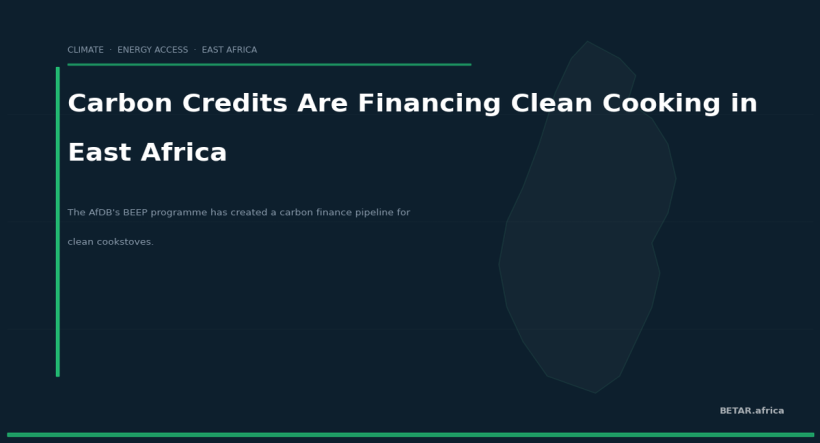

Carbon Credits Are Financing Clean Cooking in East Africa — and the AfDB Just Made It Official
The African Development Bank’s $4M SEFA grant to BURN Manufacturing’s Electric Cooking Expansion Program is the continent’s first carbon finance transaction for electric cooking. It deploys 115,000 induction cookers across Kenya, Uganda, and Zambia — paid for by global carbon buyers before households ever make their first repayment.
BETAR.africa has tracked two structural pathologies in African climate finance this year: the debt spiral created when green loans carry conditionalities that developing economies cannot sustain, and the persistent financing gap between the solar capacity that developers want to build and the capital willing to fund it. The AfDB’s BEEP transaction, announced in July 2025 and now entering active deployment, illustrates a third structural question that those debates have obscured — what happens when the carbon market itself becomes the delivery mechanism for energy access, rather than just the accountability mechanism for emissions reductions?
The answer matters because clean cooking is the part of Africa’s energy transition that debt-driven green finance has never adequately addressed. It is also, by any measure, the most lethal.
The Deadliest Energy Problem No One Is Financing
Every year, cooking kills more Africans than malaria. Household air pollution from solid fuels — charcoal, wood, crop waste — causes an estimated 2.9 million deaths globally each year, the majority of them in sub-Saharan Africa. Sixty per cent of those deaths are women and children. The mechanism is chronic respiratory failure, caused not by a single catastrophic event but by a lifetime of daily exposure to particulate matter at levels that would trigger industrial shutdown orders in any European city.
As of 2022 — the most recent year for which comprehensive data are available — 923 million people globally lacked access to clean cooking fuels and technologies (IEA Energy Access Outlook, most recent available). The majority live on the African continent. In sub-Saharan Africa, 84 per cent of the population still cooks over open fire or charcoal. The transition has moved at a fraction of the pace of electrification, mobile connectivity, or even solar home system deployment — not because the solutions do not exist, but because the financing model has never been properly solved.
The AfDB’s BEEP Transaction: What It Is and What It Is Not
In July 2025, the African Development Bank’s Sustainable Energy Fund for Africa committed a $4 million reimbursable grant to BURN Manufacturing’s Electric Cooking Expansion Program — marking the AfDB’s first-ever use of carbon finance as a delivery mechanism for household energy access. The $4M SEFA grant anchors a $10 million blended vehicle that includes a $5 million loan from the Spark+ Africa Fund and $1 million in equity from BURN itself. The programme targets deployment of 115,000 ECOA induction cookers across Kenya, Uganda, and Zambia.
The ECOA is BURN’s flagship electric cooking device: a two-plate induction cooker priced at Kshs. 14,000 (approximately $109) in Kenya, repayable through BURN’s PAYGo system at Kshs. 240 per day. The cooker includes IoT connectivity and M-Pesa integration, enabling remote monitoring of usage and automated payment collection. If a household falls behind on repayments, the cooker can be remotely locked; when payments resume, it reactivates. The hardware is designed for the cooking patterns of East African households — large pots, multiple daily sessions, high heat for staple foods — rather than the Western residential market that most induction cookers are engineered for.
Africa has a long history of climate grant programmes that subsidise hardware into the market and then disappear when funding cycles end. Appliances distributed at cost or below-cost create momentary adoption spikes that do not survive the withdrawal of external support, because the underlying economics of operation never change. BEEP is not that model. The $4M SEFA grant is reimbursable — it is repaid as the programme generates revenue — and the cost recovery mechanism is not household repayment alone. It is carbon credits.
The Carbon Credit Mechanism: Who Is Actually Paying for These Cookers
BURN Manufacturing is the first cookstove company in Africa to receive the Carbon Credit Quality label — a rigorous third-party certification developed by the carbon market reform movement to address the methodology disputes that have plagued cookstove credits since the voluntary carbon market’s early growth phase. The CCP label requires independently verified emissions quantification, robust additionality arguments, and monitoring protocols that can demonstrate real displacement of charcoal and biomass use. BURN has built its credibility in the carbon market through years of iterative methodology work, and that credibility is the financial foundation of BEEP.
The mechanism works as follows. BURN issues CCP-labelled carbon credits on the voluntary market, generated by verified displacement of charcoal combustion in households that switch to ECOA induction cooking. Corporate buyers — European companies with net-zero commitments, sustainability-linked debt covenants, or voluntary offset programmes — purchase these credits. The revenue from those credit sales flows into the BEEP vehicle, where it is used to pre-finance the cost of the cookers before households make their first repayment. A household in Nairobi or Kampala receives an ECOA at an accessible PAYGo price not because an NGO subsidised it, but because a company in Germany or the Netherlands is paying for the right to account for avoided charcoal emissions in its own carbon footprint.
The extraterritoriality of this arrangement is worth stating plainly: global carbon buyers are, in structural effect, subsidising East African energy access — but through a market mechanism rather than a grant programme, and in exchange for verified emissions reductions that have independent value. The subsidy does not disappear when the funding cycle ends. It scales with verified impact.
BURN’s Track Record and the Scale of the Ambition
BURN Manufacturing is Nairobi-headquartered and manufactures at a factory in Ruiru, outside the capital — one of the few clean cookstove companies in Africa that has integrated hardware production on the continent rather than importing assembled units. The company has deployed more than 1 million clean cooking devices across Africa since its founding, and has established distribution partnerships in more than 10 countries. In October 2024, the European Investment Bank committed $15 million to BURN, validating its capacity to execute at scale and handle institutional capital.
The BEEP programme represents BURN’s largest single deployment commitment: 115,000 ECOA cookers across three markets in a single programme cycle. At launch, the company cited a long-term goal of reaching 1 million ECOA households. Whether that target remains current as of March 2026 — given the pace of prior deployments — should be confirmed against BURN’s most recent investor communications before citing as a forward projection.
Risks the Deal Does Not Resolve
Three structural risks attach to BEEP that the programme design has not fully resolved, and that any serious assessment of the model must acknowledge.
The first is PAYGo default. Africa’s PAYGo clean energy sector has operated with default rates between 12 and 20 per cent across most markets and product categories. BURN’s own historical default rates have been lower than the sector average — its M-Pesa integration and remote lock capability reduce the moral hazard that characterises early PAYGo models — but BEEP’s three-market deployment introduces Uganda and Zambia at scale, and both markets present collection infrastructure challenges that Kenya does not. If default rates in Zambia and Uganda track the sector average rather than BURN’s Kenya performance, the economics of the SPV will require recalibration.
The second is carbon credit methodology. The voluntary carbon market’s cookstove credit segment has been its most controversial. Early-vintage cookstove credits from other issuers have faced independent audits questioning whether the baseline charcoal displacement was overstated. BURN’s CCP certification addresses the methodology concern more rigorously than any prior cookstove programme, but the voluntary market’s credibility crisis is not fully resolved. If corporate buyers of voluntary credits face regulatory or reputational pressure to exit the cookstove credit category, the revenue stream that pre-finances ECOA deployment will compress.
The third is Zambia’s grid reliability. ECOA induction cookers require reliable grid power. In Kenya and Uganda’s urban centres, grid uptime is adequate for the product to perform as designed. In Zambia, which has experienced sustained load-shedding during drought years due to its dependence on hydroelectric generation, a prolonged grid reliability episode would reduce cooker utilisation, lower measured emissions displacement, and reduce the volume of verifiable carbon credits BURN can issue. The programme’s Zambia component carries a climate risk exposure that the Kenya and Uganda components do not.
What the Model Signals
The AfDB’s decision to structure its first clean cooking carbon finance transaction as a reimbursable grant — rather than a concessional loan or equity investment — signals something specific about where carbon finance fits in the development finance architecture. A reimbursable grant is repaid from programme revenues. If BEEP works as designed, the SEFA recovers its $4 million and redeploys it in the next programme. If the carbon credit revenue underperforms, the grant absorbs the loss. The AfDB has effectively used its balance sheet to take first-loss exposure on a carbon credit mechanism that private capital alone would not have been willing to test at this scale.
That is a legitimate and structurally useful intervention. The question is whether the model generalises. BEEP works because BURN has an unusually strong carbon credit methodology, a manufacturing base on the continent, and a PAYGo infrastructure that has been tested over years. Replicating the transaction with a less sophisticated operator — or in a market with weaker collection infrastructure — would not produce the same results. The AfDB has not funded a replicable template. It has funded a proof of concept with an unusually capable implementing partner.
Whether the continent’s clean cooking transition can be financed at the scale it requires — hundreds of millions of households, not 115,000 — through carbon market mechanisms alone is a question this programme does not answer. What it does establish is that the AfDB is willing to test that question with real capital, and that BURN’s carbon credit architecture is credible enough to anchor a blended vehicle backed by one of Africa’s most rigorous development lenders. That is further than any prior clean cooking programme has reached.

 UphivaBETAR