
Africa BESS 2026: The Battery Layer That Turns Solar Into Reliable Power
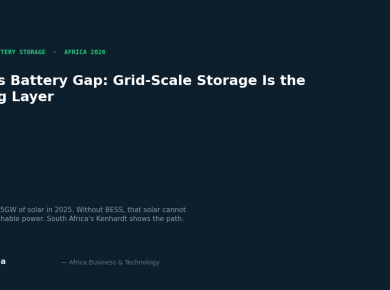
Africa added 4.5 gigawatts of solar in 2025. That record obscures a structural problem: solar is intermittent, and without storage, much of what the continent is generating cannot be dispatched when it is actually needed. Battery Energy Storage Systems are the missing infrastructure layer — and Africa is only now beginning to build them at scale.
Africa added 4.5 gigawatts of solar in 2025. That record obscures a structural problem the continent’s energy press has not adequately covered: solar power is intermittent, and without storage, a large share of what Africa is generating cannot be dispatched when it is actually needed.
Battery Energy Storage Systems — BESS — are the infrastructure layer that converts intermittent solar and wind into dispatchable grid power. Africa is only now beginning to build them at scale. The gap between what exists and what is needed is the most consequential financing story in African energy in 2026.
The Number That Tells the Story
Africa had 31 megawatt-hours of grid-scale battery storage installed in 2017. By 2024, that had grown to 1,600MWh — a 50-fold increase in seven years that still leaves the continent with less than 1% of global installed BESS capacity.
For context: South Africa’s Kenhardt facility, commissioned in late 2024 alongside Scatec’s 540MW solar plant, holds 1,140MWh alone — more than 70% of what the entire continent installed over the previous seven years combined. Kenhardt is one of the ten largest BESS installations anywhere on Earth. It is also, so far, largely an outlier.
South Africa accounts for over 86% of Africa’s operational grid-scale storage capacity. Egypt is the second-largest market. Every other country on the continent — 52 of them — holds less than 14% combined. The BESS buildout that Africa needs is not happening evenly, and in most markets, it is barely beginning.
Why Storage Is Now Commercially Viable
Three structural shifts have changed the BESS economics in the past eighteen months.
Battery costs crossed the $100/kWh threshold. Chinese manufacturers CATL and BYD, operating at a scale that no other industry in the world matches, have driven lithium iron phosphate (LFP) battery pack prices below $100 per kilowatt-hour for the first time. LFP chemistry — safer, longer-cycle, and better suited to the high-ambient-temperature environments common across African project sites — has become the de facto standard for utility-scale storage. The cost curve that made solar commercially viable in Africa between 2015 and 2020 is now running through batteries.
Project finance precedent is forming. When Standard Bank underwrote the full ~ZAR 4 billion debt financing for Lyra Energy’s Thakadu 255MW solar plant in South Africa without a DFI backstop, it established that South African commercial capital will price renewable energy project risk without requiring multilateral guarantees. The same logic is beginning to apply to co-located BESS. Standalone BESS projects are structurally more complex — they earn from ancillary services and capacity payments rather than energy sales — but the lender comfort that solar PPAs built over a decade is transferring to storage.
Government procurement is creating bankable revenue. South Africa’s Battery Energy Storage Independent Power Procurement Programme (BESIPPPP) is the most developed BESS tender framework on the continent. Window 3, concluded in 2025, awarded 612MW across five projects — four to Mulilo (Copenhagen Infrastructure Partners) and one to Scatec — at a total investment of approximately ZAR 9.5 billion ($533 million). Commercial close was targeted for January 2026; commercial operations by January 2028. The BESIPPPP model gives developers a government-backed offtake against which they can raise project finance. Without equivalent procurement frameworks, other African markets remain dependent on C&I contracts or costly standalone financing.
The Pipeline Is Real
Beyond South Africa, early-stage BESS pipelines are forming in markets where solar scale is pushing curtailment and reliability issues to the surface.
In Egypt, AMEA Power’s Aswan project will be Africa’s largest single-asset renewable energy and BESS facility when it reaches commercial operations in June 2026, backed by IFC financing. In Kenya, Globeleq holds a development pipeline that includes BESS co-located with solar and geothermal capacity, and Energy Storage Africa has a 120MW/480MWh standalone project in active development. In Nigeria, where diesel backup costs across the commercial sector run to an estimated $14 billion annually, distributed BESS is attracting C&I developer interest — though bankable grid-scale projects remain rare.
Globally, BESS demand grew 53% year-on-year in 2024. Africa’s pipeline, concentrated heavily in South Africa with an 11GWh pipeline across 30+ projects (spanning operational, under construction, and in development stages), is beginning to reflect that trajectory. The rest of the continent is three to five years behind.
The Constraint That Remains
The fundamental constraint on BESS deployment in most African markets is not the technology and not the underlying economics. It is the absence of procurement frameworks that create bankable, long-term revenue certainty.
A solar IPP can model its project finance around a 20-year power purchase agreement with a utility. A BESS project that provides frequency regulation, spinning reserve, or peak capacity to a grid needs an equivalent long-term ancillary services agreement with a creditworthy counterparty. In South Africa, BESIPPPP provides this. In almost every other African market, it does not exist.
The World Bank, AfDB, and DBSA are working to address this through Mission 300 and the Just Energy Transition Partnership instruments. But DFI project-level co-financing — while necessary — does not substitute for domestic procurement architecture. Until African power utilities and regulators develop the same BESS-specific offtake frameworks that South Africa’s BESIPPPP represents, grid-scale storage will remain a South African story told in the context of a continental gap.
What 2026 Will Show
The next twelve months will determine whether Africa’s BESS story is a South African anomaly or the beginning of a continental curve. Three milestones to watch:
BESIPPPP Window 4 — South Africa is expected to tender additional storage capacity in 2026. How aggressively it moves will signal whether Pretoria sees BESS as a core grid infrastructure layer or a supplement to coal dispatch.
East Africa procurement — Kenya and Tanzania have renewable portfolios with curtailment risk that makes the storage case financially self-evident. Whether either government structures a formal storage procurement in 2026 will determine the pace of East African BESS development.
LFP price trajectory — If LFP battery pack costs continue falling below $80/kWh — the level at which standalone BESS C&I contracts in Africa pencil out without government offtake — the procurement dependency weakens and project finance structures become more diverse.
Africa’s solar buildout is ahead of the storage buildout. That gap is the defining infrastructure constraint of the continent’s energy transition. The capital is available. The technology economics have arrived. What is missing in most markets is the policy architecture that turns storage from an engineering solution into a financeable project.


 UphivaBETAR