
South Africa’s Largest Private Solar+Battery Project Breaks Ground — And It’s Designed to Decarbonise Sasol and Air Liquide
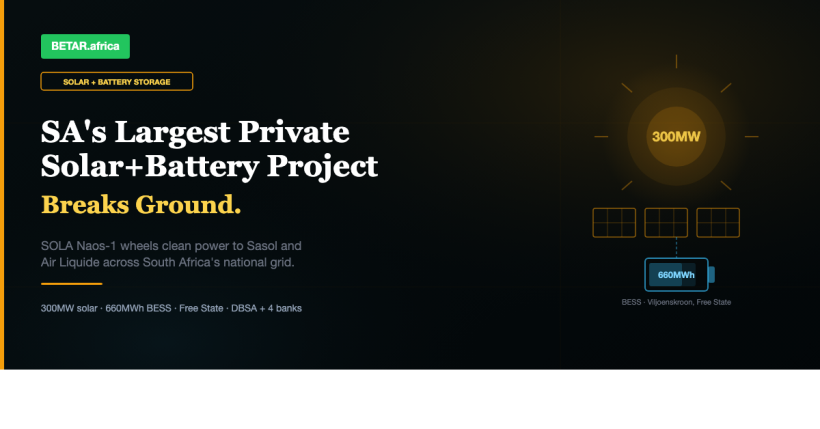
SOLA Group has reached financial close on Naos-1, a 300MW solar plant with 660MWh of battery energy storage near Viljoenskroon in the Free State. It is the country’s first utility-scale solar+storage project purpose-built for wheeling clean power to private industrial end-users — and its off-takers include two of South Africa’s most energy-intensive companies.
In the taxonomy of South Africa’s energy transition, Naos-1 is a different category of project. It is not a government-procured plant under the Renewable Energy Independent Power Producer Procurement Programme. It is not a rooftop solar installation or a commercial solar farm feeding a single facility behind a meter. It is something that did not exist in the country a year ago: a utility-scale solar plant combined with grid-scale battery energy storage, purpose-built to wheel clean electricity across the national transmission network to private industrial customers who cannot afford to wait for Eskom’s own decarbonisation timeline.
SOLA Group, the South African renewable energy developer, reached financial close on Naos-1 in February 2026 and has commenced construction. The project will deliver 300 MW of solar generation capacity — 435 MWp at peak — with 660 MWh of battery energy storage, sited near Viljoenskroon in the Free State. Target commercial operations date: the first half of 2028. The off-takers secured under long-term power purchase agreements are Sasol and Air Liquide.
The scale is significant. Naos-1 is the largest privately contracted hybrid renewable energy project in South Africa to reach financial close to date. But the design intent is what makes it worth studying closely.
Why Industrial Off-Takers Need Storage
Sasol operates the Secunda chemicals complex in Mpumalanga — one of the world’s largest coal-based synthetic fuels and chemicals facilities, and among the continent’s highest-emitting individual industrial sites. Air Liquide produces industrial gases including oxygen, nitrogen, and hydrogen at facilities across South Africa that run continuously around the clock. Both companies are under intensifying pressure from investors, lenders, and South Africa’s carbon tax framework to demonstrate a credible decarbonisation path.
The challenge with conventional solar as an industrial decarbonisation tool is firmness. A chemicals complex running continuous processes cannot run on intermittent generation. Solar generation peaks at midday and falls to zero at night. Industrial electricity demand is distributed across the full 24-hour cycle. Without storage, wheeling solar energy to an industrial customer delivers cheap, clean power for roughly eight hours a day and leaves the customer dependent on the grid — or on legacy diesel backup — for the remainder.
Naos-1’s battery storage system resolves this directly. The 660 MWh BESS captures excess solar generation during peak production hours and discharges it during the evening and overnight hours when the solar plant is not generating. The result is a dispatchable clean power supply — solar energy that can be scheduled and shaped to match industrial load profiles in a way that solar-only projects cannot achieve. For Sasol and Air Liquide, this is the difference between a partial decarbonisation solution and one that can meaningfully replace fossil fuel-derived grid electricity across a larger share of their operating hours.
The Wheeling Mechanism
Electricity wheeling — the transmission of power from a generator to a buyer across the national grid without the buyer being co-located at the generation site — has existed in South African law for years but was largely theoretical at utility scale until the regulatory amendments of 2022 and 2023 that made large-scale private wheeling commercially viable. The National Energy Regulator of South Africa and Eskom’s transmission division created a framework that allows third-party generators to inject power into the transmission network at one point and have a designated buyer draw it down at another, with wheeling fees paid to the grid operator for use of the infrastructure.
The practical implication is that a solar plant in the Free State can supply clean electricity to industrial customers in Mpumalanga or Gauteng without those customers needing to be adjacent to the generation source. Naos-1 is located near Viljoenskroon — close enough to the transmission backbone to inject at scale, and far enough from industrial facilities that the wheeling mechanism is the only viable connection model.
This is why the BESS component is structurally different from a battery attached to a behind-the-meter solar installation. Naos-1’s storage does not just smooth generation variability at a single site — it enables the dispatchability that makes wheeled solar commercially viable for industrial buyers who need to commit to a load profile in advance. A 660 MWh BESS providing evening dispatch capacity transforms a variable renewable asset into something that industrial procurement teams can contractually plan around.
The Financing Stack
Naos-1 was financed with the Development Bank of Southern Africa as lead lender, joined by Absa, Nedbank, Rand Merchant Bank, and Investec as commercial co-lenders. The involvement of four major South African commercial banks alongside a development finance institution reflects the degree to which the South African private power market has matured as a bankable asset class.
The DBSA’s lead position is consistent with its mandate to support South African infrastructure and energy transition projects, and the institution has been an active participant in renewable energy financing across the REIPPPP programme rounds. The commercial bank participation — Absa, Nedbank, RMB, and Investec all bringing their own balance sheets to the transaction — demonstrates that the project’s PPA structure with investment-grade industrial off-takers was sufficient to attract domestic commercial lenders at the required scale without requiring multilateral development finance backstops.
The financial close occurred against a backdrop of declining battery storage capital costs. Lithium iron phosphate battery system prices have fallen below $100 per kilowatt-hour at the system level in recent procurement cycles — a threshold that makes utility-scale storage economically competitive as a component of project finance structures where the long-term PPA revenue provides lenders with the cash flow visibility they require to underwrite battery replacement and degradation risk over the loan term.
What Naos-1 Changes
South Africa’s private power market has seen significant growth in C&I solar — commercial and industrial installations behind the meter — over the past three years, driven by Eskom load shedding pressure and the regulatory liberalisation that removed the licensing threshold for self-generation in 2022. But behind-the-meter solar has natural limits: it works best for facilities with significant rooftop or open land area adjacent to the electricity load, and it delivers savings on the portion of demand that can be displaced during solar generation hours.
Naos-1 represents the next phase: front-of-meter, utility-scale solar+storage using the transmission network as the delivery mechanism. This model works for industrial customers who are geographically separated from available generation sites, who need firmer supply than behind-the-meter solar can provide, and whose scale of demand justifies the transaction costs of a long-term wheeling PPA with a dedicated generation asset.
For the broader continent, Naos-1 is a proof of concept with replicability potential. The electricity wheeling model — a generator transmitting clean power to a private industrial buyer across a national grid — is not unique to South Africa. Across East Africa, where industrial demand is concentrated in urban centres far from the best renewable resource sites, and across West Africa, where national grids are extending reach but state utilities remain under financial stress, the combination of wheeling regulation and utility-scale solar+storage could unlock industrial clean energy supply in markets that have not yet developed the regulatory frameworks to enable it.
That framework development is the critical prerequisite. Naos-1 became possible in South Africa because of years of regulatory work on wheeling tariffs, grid access rules, and PPA structures that gave lenders and off-takers enough certainty to commit. The project’s commercial close is a data point for regulators in Kenya, Nigeria, Ghana, and Egypt who are considering similar frameworks: utility-scale private wheeling works, it attracts domestic commercial bank financing, and it can deliver industrial decarbonisation at meaningful scale. The Free State precedent is live evidence.


 UphivaBETAR